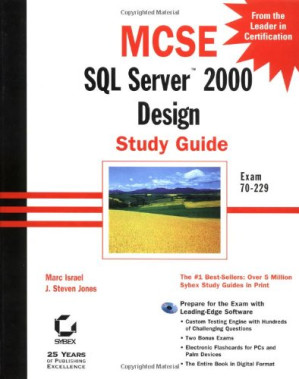
MCSE: SQL Server 2000 Design Study Guide (Exam 70-229) 🔍
Marc Israel, J. Steven Jones, Steve Jones
Sybex [Imprint] John Wiley & Sons, Incorporated, John Wiley & Sons, Inc. (trade), San Francisco, CA, 2001
英语 [en] · PDF · 5.9MB · 2001 · 📘 非小说类图书 · 🚀/duxiu/lgli/lgrs/nexusstc/zlib · Save
描述
I purchased this book with the expectation that it would help me prepare for the exam. The CD provides practice exams and other resources to give one the impression they are on their way to certification. However, there are numerous errors in the book as well as on the CD, particularly with the "Edge Test" software, which incorrectly grades tests and does not allow users to select the right answers. This issue is actually moot, since the practice tests actually do not address problems presented in the certification exam. I recommend using the on-line resources affiliated with the testing organizations. They also provide discounted vouchers.
备用文件名
lgli/Sybex SQL Server 2000 Design Study Guide.pdf
备用文件名
lgrsnf/Sybex SQL Server 2000 Design Study Guide.pdf
备用文件名
zlib/Computers/Programming/Marc Israel, J. Steven Jones, Steve Jones/MCSE SQL Server 2000 design study guide_608656.pdf
备选作者
Israel, Marc, Jones, J. Steven, Jones, Steve
备选作者
Marc Israel; Steve Jones; J. Steven Jones
备用版本
Student ed. of Textbook, Hoboken, Sept. 2001
备用版本
United States, United States of America
备用版本
Har/Cdr edition, August 20, 2001
备用版本
San Francisco, Calif, 2001
备用版本
PS, 2001
备用版本
1, 2001
元数据中的注释
linked by Irbis
元数据中的注释
lg180632
元数据中的注释
{"isbns":["0782129420","9780782129427"],"last_page":21,"publisher":"Sybex"}
元数据中的注释
topic: Database software; Databases; &; data structures; SQL; Microsoft software; Database Management-General; Relational Databases; Sql (Programming Language); Computers; Computers-Certification; Examinations; Computer Books: Operating Systems; Electronic data processing personnel; Database Management-SQL Server; Certification Guides-Msce; Computers/Technical Skills; Certification Guides-MCSE; Programming Languages-SQL; Study guides; Certification; Electronic data processing per
元数据中的注释
Type: 英文图书
元数据中的注释
Bookmarks:
1. (p1) Introduction
2. (p2) Chapter 1 Database Logical Modeling
2.1. (p3) Designing a Database System
2.2. (p4) The Entity/Relationship Model
2.2.1. (p5) Defining Entities and Attributes
2.2.2. (p6) Defining Relationships and Keys
2.2.3. (p7) Adding Data Integrity Rules
2.3. (p8) The Relational Model and the Normalization Process
2.3.1. (p9) The Relational Table
2.3.2. (p10) Normal Forms
2.4. (p11) The Denormalization Process
2.4.1. (p12) Adding a Redundant Column
2.4.2. (p13) Adding a Derived Column
2.4.3. (p14) Partitioning Tables
2.5. (p15) Summary
2.6. (p16) Exam Essentials
2.7. (p17) Key Terms
2.8. (p18) Review Questions
2.9. (p19) Answers to Review Questions
3. (p20) Chapter 2 Database Physical Modeling
3.1. (p21) Creating and Managing a Database
3.1.1. (p22) Creating a Simple Database
3.1.2. (p23) Data and Log Files
3.1.3. (p24) Managing Databases
3.1.4. (p25) Space Management
3.1.5. (p26) Database Options
3.2. (p27) Filegroups
3.2.1. (p28) Creating Filegroups
3.2.2. (p29) Maintenance and Performance
3.3. (p30) File Placement and Performance
3.3.1. (p31) Data Placement
3.3.2. (p32) Log File Placement
3.4. (p33) Summary
3.5. (p34) Key Terms
3.6. (p35) Exam Essentials
3.7. (p36) Review Questions
3.8. (p37) Answers to Review Questions
4. (p38) Chapter 3 Creating and Maintaining Tables
4.1. (p39) Creating and Altering a Table
4.1.1. (p40) Creating a Table
4.1.2. (p41) Altering a Table
4.2. (p42) Columns and Datatypes
4.2.1. (p43) System Datatypes
4.2.2. (p44) User-defined Datatypes
4.2.3. (p45) Computed Columns
4.3. (p46) Extended Properties
4.4. (p47) Table Storage
4.4.1. (p48) Record Storage
4.4.2. (p49) Text, ntext, and Image Storage
4.5. (p50) Summary
4.6. (p51) Key Terms
4.7. (p52) Exam Essentials
4.8. (p53) Review Questions
4.9. (p54) Answers to Review Questions
5. (p55) Chapter 4 Implementing Data Integrity
5.1. (p56) Data Integrity
5.1.1. (p57) Integrity Types
5.1.2. (p58) Integrity Implementation
5.2. (p59) Default Values
5.2.1. (p60) Default Constraint
5.2.2. (p61) Default Object
5.3. (p62) Check
5.3.1. (p63) Check Constraints
5.3.2. (p64) Rules
5.4. (p65) Primary Keys
5.4.1. (p66) Defining a Primary Key Constraint at Table Creation
5.4.2. (p67) Defining a Primary Key at Table Modification
5.5. (p68) Unique Constraints
5.5.1. (p69) Defining a Unique Constraint at Table Creation
5.5.2. (p70) Defining a Unique Constraint at Table Modification
5.6. (p71) Foreign Keys and Relationships
5.6.1. (p72) Defining a Foreign Key Constraint at Table Creation
5.6.2. (p73) Defining a Foreign Key Constraint at Table Modification
5.7. (p74) Summary
5.8. (p75) Key Terms
5.9. (p76) Exam Essentials
5.10. (p77) Review Questions
5.11. (p78) Answers to Review Questions
6. (p79) Chapter 5 Creating and Maintaining Indexes
6.1. (p80) Definition and Advantages of Indexes
6.1.1. (p81) Heaps and Indexes
6.1.2. (p82) Clustered Index
6.1.3. (p83) Nonclustered Index
6.1.4. (p84) Composite Indexes
6.1.5. (p85) Unique Indexes
6.2. (p86) Accessing Data with and without Indexes
6.2.1. (p87) Accessing Data with a Heap
6.2.2. (p88) Accessing Data with a Clustered Index
6.2.3. (p89) Accessing Data with a Nonclustered Index
6.3. (p90) Statistics and Index Choice
6.3.1. (p91) Distribution Statistics
6.3.2. (p92) Index Choice
6.3.3. (p93) Statistics Maintenance
6.4. (p94) Creating Indexes and Statistics
6.4.1. (p95) Indexes
6.4.2. (p96) Statistics
6.5. (p97) Fragmentation and Index Maintenance
6.5.1. (p98) Fragmentation Types
6.5.2. (p99) Inserts
6.5.3. (p100) Updates
6.5.4. (p101) Deletes
6.5.5. (p102) What to Do Now
6.6. (p103) Summary
6.7. (p104) Key Terms
6.8. (p105) Exam Essentials
6.9. (p106) Review Questions
6.10. (p107) Answers to Review Questions
7. (p108) Chapter 6 Creating and Maintaining Database Objects
7.1. (p109) Views
7.1.1. (p110) Definition and Advantages of Views
7.1.2. (p111) Creating and Altering Views
7.1.3. (p112) Using Views
7.1.4. (p113) Indexed Views
7.1.5. (p114) Partitioned Views
7.2. (p115) Stored Procedures
7.2.1. (p116) Definition and Advantages of Stored Procedures
7.2.2. (p117) Creating and Altering a Stored Procedure
7.2.3. (p118) Using Parameters
7.2.4. (p119) Executing a Stored Procedure
7.2.5. (p120) Error Handling
7.3. (p121) Transactions
7.4. (p122) User-defined Functions
7.4.1. (p123) Definition and Advantages of User-defined Functions
7.4.2. (p124) Creating and Altering a UDF
7.4.3. (p125) Using UDFs
7.5. (p126) Triggers
7.5.1. (p127) Definition and Advantages of Triggers
7.5.2. (p128) AFTER Triggers
7.5.3. (p129) INSTEAD OF Triggers
7.5.4. (p130) Performance Considerations
7.5.5. (p131) Various Considerations
7.6. (p132) Summary
7.7. (p133) Key Terms
7.8. (p134) Exam Essentials
7.9. (p135) Review Questions
7.10. (p136) Answers to Review Questions
8. (p137) Chapter 7 Accessing Data
8.1. (p138) The SELECT Command
8.1.1. (p139) Single Table SELECT
8.1.2. (p140) Inner Joins
8.1.3. (p141) Outer Joins
8.1.4. (p142) Aggregate Operators
8.1.5. (p143) The UNION Command
8.1.6. (p144) The Distinct Command
8.1.7. (p145) Scalars
8.1.8. (p146) Subqueries
8.2. (p147) Functions for Transforming Data
8.3. (p148) Cursors
8.3.1. (p149) Using a Cursor
8.3.2. (p150) Cursor Declaration
8.3.3. (p151) Retrieving Data from the Cursor
8.4. (p152) Distributed Queries
8.4.1. (p153) Linked Servers
8.4.2. (p154) The OPENROWSET Function
8.4.3. (p155) Distributed Partitioned Views
8.5. (p156) SQL Server 2000 and XML
8.6. (p157) Summary
8.7. (p158) Exam Essentials
8.8. (p159) Key Terms
8.9. (p160) Review Questions
8.10. (p161) Answers to Review Questions
9. (p162) Chapter 8 Modifying Data
9.1. (p163) The INSERT Statement
9.1.1. (p164) Single Row Insert
9.1.2. (p165) Inserting a Single Row with Selected Columns
9.1.3. (p166) Inserting Single Rows with an Identity Field
9.1.4. (p167) Inserting Multiple Rows
9.2. (p168) The UPDATE Statement
9.2.1. (p169) Updating All Rows
9.2.2. (p170) Updating a Set of Rows
9.2.3. (p171) Updating Multiple Columns
9.2.4. (p172) Updating a View
9.3. (p173) The DELETE Statement
9.3.1. (p174) Deleting All Rows
9.3.2. (p175) Deleting a Set of Rows
9.4. (p176) Modifying Data inside a Cursor
9.4.1. (p177) Declaring an Updateable Cursor
9.4.2. (p178) Updating Data within a Cursor
9.5. (p179) Modifying Data Using XIML
9.5.1. (p180) Modifying Data Using OPENXML
9.6. (p181) Using Distributed Queries to Modify Data
9.6.1. (p182) Modifying Data Using Linked Servers
9.6.2. (p183) Modifying Data Using OPENROWSET
9.7. (p184) Summary
9.8. (p185) Key Terms
9.9. (p186) Exam Essentials
9.10. (p187) Review Questions
9.11. (p188) Answers to Review Questions
10. (p189) Chapter 9 Importing and Exporting Data
10.1. (p190) Bulk Copy
10.1.1. (p191) BCP
10.1.2. (p192) BULK INSERT
10.2. (p193) Data Transformation Services
10.2.1. (p194) The DTS Environment
10.3. (p195) Summary
10.4. (p196) Key Terms
10.5. (p197) Exam Essentials
10.6. (p198) Review Questions
10.7. (p199) Answers to Review Questions
11. (p200) Chapter 10 Locking
12. (p216) Chapter 11 Developing a Security Plan
13. (p227) Chapter 12 Analyzing and Optimizing Data Access
14. (p247) Index
1. (p1) Introduction
2. (p2) Chapter 1 Database Logical Modeling
2.1. (p3) Designing a Database System
2.2. (p4) The Entity/Relationship Model
2.2.1. (p5) Defining Entities and Attributes
2.2.2. (p6) Defining Relationships and Keys
2.2.3. (p7) Adding Data Integrity Rules
2.3. (p8) The Relational Model and the Normalization Process
2.3.1. (p9) The Relational Table
2.3.2. (p10) Normal Forms
2.4. (p11) The Denormalization Process
2.4.1. (p12) Adding a Redundant Column
2.4.2. (p13) Adding a Derived Column
2.4.3. (p14) Partitioning Tables
2.5. (p15) Summary
2.6. (p16) Exam Essentials
2.7. (p17) Key Terms
2.8. (p18) Review Questions
2.9. (p19) Answers to Review Questions
3. (p20) Chapter 2 Database Physical Modeling
3.1. (p21) Creating and Managing a Database
3.1.1. (p22) Creating a Simple Database
3.1.2. (p23) Data and Log Files
3.1.3. (p24) Managing Databases
3.1.4. (p25) Space Management
3.1.5. (p26) Database Options
3.2. (p27) Filegroups
3.2.1. (p28) Creating Filegroups
3.2.2. (p29) Maintenance and Performance
3.3. (p30) File Placement and Performance
3.3.1. (p31) Data Placement
3.3.2. (p32) Log File Placement
3.4. (p33) Summary
3.5. (p34) Key Terms
3.6. (p35) Exam Essentials
3.7. (p36) Review Questions
3.8. (p37) Answers to Review Questions
4. (p38) Chapter 3 Creating and Maintaining Tables
4.1. (p39) Creating and Altering a Table
4.1.1. (p40) Creating a Table
4.1.2. (p41) Altering a Table
4.2. (p42) Columns and Datatypes
4.2.1. (p43) System Datatypes
4.2.2. (p44) User-defined Datatypes
4.2.3. (p45) Computed Columns
4.3. (p46) Extended Properties
4.4. (p47) Table Storage
4.4.1. (p48) Record Storage
4.4.2. (p49) Text, ntext, and Image Storage
4.5. (p50) Summary
4.6. (p51) Key Terms
4.7. (p52) Exam Essentials
4.8. (p53) Review Questions
4.9. (p54) Answers to Review Questions
5. (p55) Chapter 4 Implementing Data Integrity
5.1. (p56) Data Integrity
5.1.1. (p57) Integrity Types
5.1.2. (p58) Integrity Implementation
5.2. (p59) Default Values
5.2.1. (p60) Default Constraint
5.2.2. (p61) Default Object
5.3. (p62) Check
5.3.1. (p63) Check Constraints
5.3.2. (p64) Rules
5.4. (p65) Primary Keys
5.4.1. (p66) Defining a Primary Key Constraint at Table Creation
5.4.2. (p67) Defining a Primary Key at Table Modification
5.5. (p68) Unique Constraints
5.5.1. (p69) Defining a Unique Constraint at Table Creation
5.5.2. (p70) Defining a Unique Constraint at Table Modification
5.6. (p71) Foreign Keys and Relationships
5.6.1. (p72) Defining a Foreign Key Constraint at Table Creation
5.6.2. (p73) Defining a Foreign Key Constraint at Table Modification
5.7. (p74) Summary
5.8. (p75) Key Terms
5.9. (p76) Exam Essentials
5.10. (p77) Review Questions
5.11. (p78) Answers to Review Questions
6. (p79) Chapter 5 Creating and Maintaining Indexes
6.1. (p80) Definition and Advantages of Indexes
6.1.1. (p81) Heaps and Indexes
6.1.2. (p82) Clustered Index
6.1.3. (p83) Nonclustered Index
6.1.4. (p84) Composite Indexes
6.1.5. (p85) Unique Indexes
6.2. (p86) Accessing Data with and without Indexes
6.2.1. (p87) Accessing Data with a Heap
6.2.2. (p88) Accessing Data with a Clustered Index
6.2.3. (p89) Accessing Data with a Nonclustered Index
6.3. (p90) Statistics and Index Choice
6.3.1. (p91) Distribution Statistics
6.3.2. (p92) Index Choice
6.3.3. (p93) Statistics Maintenance
6.4. (p94) Creating Indexes and Statistics
6.4.1. (p95) Indexes
6.4.2. (p96) Statistics
6.5. (p97) Fragmentation and Index Maintenance
6.5.1. (p98) Fragmentation Types
6.5.2. (p99) Inserts
6.5.3. (p100) Updates
6.5.4. (p101) Deletes
6.5.5. (p102) What to Do Now
6.6. (p103) Summary
6.7. (p104) Key Terms
6.8. (p105) Exam Essentials
6.9. (p106) Review Questions
6.10. (p107) Answers to Review Questions
7. (p108) Chapter 6 Creating and Maintaining Database Objects
7.1. (p109) Views
7.1.1. (p110) Definition and Advantages of Views
7.1.2. (p111) Creating and Altering Views
7.1.3. (p112) Using Views
7.1.4. (p113) Indexed Views
7.1.5. (p114) Partitioned Views
7.2. (p115) Stored Procedures
7.2.1. (p116) Definition and Advantages of Stored Procedures
7.2.2. (p117) Creating and Altering a Stored Procedure
7.2.3. (p118) Using Parameters
7.2.4. (p119) Executing a Stored Procedure
7.2.5. (p120) Error Handling
7.3. (p121) Transactions
7.4. (p122) User-defined Functions
7.4.1. (p123) Definition and Advantages of User-defined Functions
7.4.2. (p124) Creating and Altering a UDF
7.4.3. (p125) Using UDFs
7.5. (p126) Triggers
7.5.1. (p127) Definition and Advantages of Triggers
7.5.2. (p128) AFTER Triggers
7.5.3. (p129) INSTEAD OF Triggers
7.5.4. (p130) Performance Considerations
7.5.5. (p131) Various Considerations
7.6. (p132) Summary
7.7. (p133) Key Terms
7.8. (p134) Exam Essentials
7.9. (p135) Review Questions
7.10. (p136) Answers to Review Questions
8. (p137) Chapter 7 Accessing Data
8.1. (p138) The SELECT Command
8.1.1. (p139) Single Table SELECT
8.1.2. (p140) Inner Joins
8.1.3. (p141) Outer Joins
8.1.4. (p142) Aggregate Operators
8.1.5. (p143) The UNION Command
8.1.6. (p144) The Distinct Command
8.1.7. (p145) Scalars
8.1.8. (p146) Subqueries
8.2. (p147) Functions for Transforming Data
8.3. (p148) Cursors
8.3.1. (p149) Using a Cursor
8.3.2. (p150) Cursor Declaration
8.3.3. (p151) Retrieving Data from the Cursor
8.4. (p152) Distributed Queries
8.4.1. (p153) Linked Servers
8.4.2. (p154) The OPENROWSET Function
8.4.3. (p155) Distributed Partitioned Views
8.5. (p156) SQL Server 2000 and XML
8.6. (p157) Summary
8.7. (p158) Exam Essentials
8.8. (p159) Key Terms
8.9. (p160) Review Questions
8.10. (p161) Answers to Review Questions
9. (p162) Chapter 8 Modifying Data
9.1. (p163) The INSERT Statement
9.1.1. (p164) Single Row Insert
9.1.2. (p165) Inserting a Single Row with Selected Columns
9.1.3. (p166) Inserting Single Rows with an Identity Field
9.1.4. (p167) Inserting Multiple Rows
9.2. (p168) The UPDATE Statement
9.2.1. (p169) Updating All Rows
9.2.2. (p170) Updating a Set of Rows
9.2.3. (p171) Updating Multiple Columns
9.2.4. (p172) Updating a View
9.3. (p173) The DELETE Statement
9.3.1. (p174) Deleting All Rows
9.3.2. (p175) Deleting a Set of Rows
9.4. (p176) Modifying Data inside a Cursor
9.4.1. (p177) Declaring an Updateable Cursor
9.4.2. (p178) Updating Data within a Cursor
9.5. (p179) Modifying Data Using XIML
9.5.1. (p180) Modifying Data Using OPENXML
9.6. (p181) Using Distributed Queries to Modify Data
9.6.1. (p182) Modifying Data Using Linked Servers
9.6.2. (p183) Modifying Data Using OPENROWSET
9.7. (p184) Summary
9.8. (p185) Key Terms
9.9. (p186) Exam Essentials
9.10. (p187) Review Questions
9.11. (p188) Answers to Review Questions
10. (p189) Chapter 9 Importing and Exporting Data
10.1. (p190) Bulk Copy
10.1.1. (p191) BCP
10.1.2. (p192) BULK INSERT
10.2. (p193) Data Transformation Services
10.2.1. (p194) The DTS Environment
10.3. (p195) Summary
10.4. (p196) Key Terms
10.5. (p197) Exam Essentials
10.6. (p198) Review Questions
10.7. (p199) Answers to Review Questions
11. (p200) Chapter 10 Locking
12. (p216) Chapter 11 Developing a Security Plan
13. (p227) Chapter 12 Analyzing and Optimizing Data Access
14. (p247) Index
元数据中的注释
theme: Database software; Databases; &; data structures; SQL; Microsoft software; Database Management-General; Relational Databases; Sql (Programming Language); Computers; Computers-Certification; Examinations; Computer Books: Operating Systems; Electronic data processing personnel; Database Management-SQL Server; Certification Guides-Msce; Computers/Technical Skills; Certification Guides-MCSE; Programming Languages-SQL; Study guides; Certification; Electronic data processing per
备用描述
<b>Here's the book you need to prepare for Exam 70-229, Designing and Implementing Databases with Microsoft SQL Server 2000 Enterprise Edition:</b>
<ul>
<li>In-depth coverage of every exam objective--all the information you need to know</li>
<li>Practical information on designing and implementing a SQL Server 2000 database</li>
<li>Hundreds of challenging review questions, in the book and on the CD</li>
<li>Leading-edge exam preparation software, including a testing engine and electronic flashcards</li>
</ul>
<p><b>Authoritative coverage of all exam objectives, including:</b></p>
<ul>
<li>Developing a logical data model</li>
<li>Implementing the physical database</li>
<li>Retrieving and modifying data</li>
<li>Programming business logic</li>
<li>Tuning and optimizing data access</li>
<li>Designing a database security plan</li>
</ul>
<p> <b>Note:</b> CD-ROM/DVD and other supplementary materials are not included as part of eBook file.</p>
<p>Microsoft SQL Server 2000 Enterprise Ed. is Microsoft's database product for delivering the next generation of scalable e-commerce, line of business and data warehousing solutions. It is a key component in Microsoft's new .NET initiative. The <i>MCSE: SQL server 2000 design Study Guide</i> is perfect for candidates preparing for the Designing and Implementing Databases with Microsoft SQL Server 2000 Enterprise Ed. Exam #70-229.
</p>
<ul>
<li>In-depth coverage of every exam objective--all the information you need to know</li>
<li>Practical information on designing and implementing a SQL Server 2000 database</li>
<li>Hundreds of challenging review questions, in the book and on the CD</li>
<li>Leading-edge exam preparation software, including a testing engine and electronic flashcards</li>
</ul>
<p><b>Authoritative coverage of all exam objectives, including:</b></p>
<ul>
<li>Developing a logical data model</li>
<li>Implementing the physical database</li>
<li>Retrieving and modifying data</li>
<li>Programming business logic</li>
<li>Tuning and optimizing data access</li>
<li>Designing a database security plan</li>
</ul>
<p> <b>Note:</b> CD-ROM/DVD and other supplementary materials are not included as part of eBook file.</p>
<p>Microsoft SQL Server 2000 Enterprise Ed. is Microsoft's database product for delivering the next generation of scalable e-commerce, line of business and data warehousing solutions. It is a key component in Microsoft's new .NET initiative. The <i>MCSE: SQL server 2000 design Study Guide</i> is perfect for candidates preparing for the Designing and Implementing Databases with Microsoft SQL Server 2000 Enterprise Ed. Exam #70-229.
</p>
备用描述
-Full coverage of all the information you need to not only pass the MCSE SQL Server 2000 Design exam, but also all the knowledge you need as a system administrator in the real world. --Content mirrors the Microsoft objectives, and includes an assessment
备用描述
Annotation Microsoft SQL Server 2000 Enterprise Edition is Microsoft's database product for delivering the next generation of scalable e-commerce, line-of-business and data warehousing solutions. It is a key component in Microsoft's new .NET initiative
开源日期
2010-01-11
🚀 快速下载
成为会员以支持书籍、论文等的长期保存。为了感谢您对我们的支持,您将获得高速下载权益。❤️
如果您在本月捐款,您将获得双倍的快速下载次数。
🐢 低速下载
由可信的合作方提供。 更多信息请参见常见问题解答。 (可能需要验证浏览器——无限次下载!)
- 低速服务器(合作方提供) #1 (稍快但需要排队)
- 低速服务器(合作方提供) #2 (稍快但需要排队)
- 低速服务器(合作方提供) #3 (稍快但需要排队)
- 低速服务器(合作方提供) #4 (稍快但需要排队)
- 低速服务器(合作方提供) #5 (无需排队,但可能非常慢)
- 低速服务器(合作方提供) #6 (无需排队,但可能非常慢)
- 低速服务器(合作方提供) #7 (无需排队,但可能非常慢)
- 低速服务器(合作方提供) #8 (无需排队,但可能非常慢)
- 低速服务器(合作方提供) #9 (无需排队,但可能非常慢)
- 下载后: 在我们的查看器中打开
所有选项下载的文件都相同,应该可以安全使用。即使这样,从互联网下载文件时始终要小心。例如,确保您的设备更新及时。
外部下载
-
对于大文件,我们建议使用下载管理器以防止中断。
推荐的下载管理器:JDownloader -
您将需要一个电子书或 PDF 阅读器来打开文件,具体取决于文件格式。
推荐的电子书阅读器:Anna的档案在线查看器、ReadEra和Calibre -
使用在线工具进行格式转换。
推荐的转换工具:CloudConvert和PrintFriendly -
您可以将 PDF 和 EPUB 文件发送到您的 Kindle 或 Kobo 电子阅读器。
推荐的工具:亚马逊的“发送到 Kindle”和djazz 的“发送到 Kobo/Kindle” -
支持作者和图书馆
✍️ 如果您喜欢这个并且能够负担得起,请考虑购买原版,或直接支持作者。
📚 如果您当地的图书馆有这本书,请考虑在那里免费借阅。
下面的文字仅以英文继续。
总下载量:
“文件的MD5”是根据文件内容计算出的哈希值,并且基于该内容具有相当的唯一性。我们这里索引的所有影子图书馆都主要使用MD5来标识文件。
一个文件可能会出现在多个影子图书馆中。有关我们编译的各种数据集的信息,请参见数据集页面。
有关此文件的详细信息,请查看其JSON 文件。 Live/debug JSON version. Live/debug page.