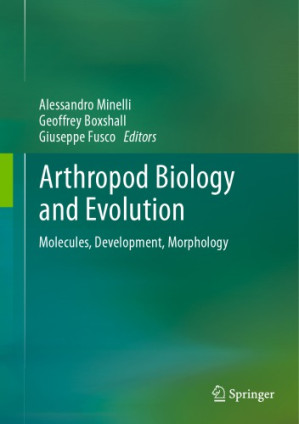
Arthropod Biology and Evolution : Molecules, Development, Morphology 🔍
Alessandro Minelli, Geoffrey Boxshall, Giuseppe Fusco (Editors)
Springer, Springer Science+Business Media, 2012-2013 Springer E-Books - Biomedical & Life Sciences, Berlin ; New York, ©2013
英语 [en] · PDF · 13.8MB · 2013 · 📘 非小说类图书 · 🚀/lgli/lgrs/nexusstc/scihub/zlib · Save
描述
Main subject categories: • Arthropod biology • Arthropod evolution • Molecular phylogenetics • Evolutionary developmental biologyMore than two thirds of all living organisms described to date belong to the phylum Arthropoda. But their diversity, as measured in terms of species number, is also accompanied by an amazing disparity in terms of body form, developmental processes, and adaptations to every inhabitable place on Earth, from the deepest marine abysses to the earth surface and the air. The Arthropoda also include one of the most fashionable and extensively studied of all model organisms, the fruit-fly, whose name is not only linked forever to Mendelian and population genetics, but has more recently come back to centre stage as one of the most important and more extensively investigated models in developmental genetics. This approach has completely changed our appreciation of some of the most characteristic traits of arthropods as are the origin and evolution of segments, their regional and individual specialization, and the origin and evolution of the appendages. At approximately the same time as developmental genetics was eventually turning into the major agent in the birth of evolutionary developmental biology (evo-devo), molecular phylogenetics was challenging the traditional views on arthropod phylogeny, including the relationships among the four major groups: insects, crustaceans, myriapods, and chelicerates. In the meantime, palaeontology was revealing an amazing number of extinct forms that on the one side have contributed to a radical revisitation of arthropod phylogeny, but on the other have provided evidence of a previously unexpected disparity of arthropod and arthropod-like forms that often challenge a clear-cut delimitation of the phylum.
备用文件名
lgli/arthropod_biol_evol_2013.pdf
备用文件名
lgrsnf/arthropod_biol_evol_2013.pdf
备用文件名
scihub/10.1007/978-3-642-36160-9.pdf
备用文件名
zlib/Biology and other natural sciences/Zoology/Alessandro Minelli, Geoffrey Boxshall, Giuseppe Fusco (Editors)/Arthropod Biology and Evolution: Molecules, Development, Morphology_2202094.pdf
备选作者
Alessandro Minelli; Geoffrey Allan Boxshall; Giuseppe Fusco
备选作者
Minelli, Alessandro; Boxshall, Geoffrey; Fusco, Giuseppe
备用出版商
Spektrum Akademischer Verlag. in Springer-Verlag GmbH
备用出版商
Springer Berlin Heidelberg : Imprint: Springer
备用出版商
Springer Spektrum. in Springer-Verlag GmbH
备用出版商
Steinkopff. in Springer-Verlag GmbH
备用出版商
Springer London, Limited
备用版本
1st ed. 2013, Berlin, Heidelberg :, 2013
备用版本
Springer Nature, Berlin, 2013
备用版本
1, Dordrecht, 2013
备用版本
2013, 2013-04-23
备用版本
Germany, Germany
备用版本
2013, US, 2013
备用版本
Apr 23, 2013
元数据中的注释
0
元数据中的注释
lg1032927
元数据中的注释
{"edition":"1","isbns":["3642361595","3642361609","3662457989","9783642361593","9783642361609","9783662457986"],"last_page":532,"publisher":"Springer"}
元数据中的注释
Source title: Arthropod Biology and Evolution: Molecules, Development, Morphology
备用描述
Contents......Page 5
Contributors......Page 7
1 An Introduction to the Biology and Evolution of Arthropods......Page 10
Reference......Page 24
2.1...Introduction......Page 25
2.2...Arthropods in the Animal Tree of Life......Page 26
2.3...The Arthropod Tree of Life......Page 29
2.3.1 Neural Cladistics......Page 31
2.3.2 Novel Molecular Approaches......Page 32
2.4.1 Chelicerata......Page 35
2.4.2 Myriapoda......Page 36
2.4.3 Tetraconata......Page 37
2.5...Final Remarks......Page 39
References......Page 40
3.1...Introduction......Page 49
3.2.1 Mitogenomic Studies......Page 50
3.2.3 Arthropod Mitogenomes: A Composition Nightmare......Page 52
3.3...Arthropod Comparative Genomics......Page 54
3.3.1 Uneven Taxonomic Sampling......Page 56
3.3.2 Heterogeneity of Genome Sizes and Shortage of microRNA......Page 57
3.4.1 A Robust Phylogenetic Framework for Genomic Studies......Page 58
3.4.2 Expanding Our Understanding of the Arthropod Comparative Genomics......Page 59
3.4.3 The Evolution of Orphan Gene Families in Arthropoda......Page 60
3.4.4 Conserved Rate of Gene Gain with Some Surprises......Page 63
A. Generation of the Onychophoran Transcriptome......Page 64
Identification of Novel Gene Families......Page 65
References......Page 66
4.1...Developmental Diversity in Arthropods......Page 70
4.3...Cleavage Modes: Superficial, Total, and Mixed......Page 71
4.4...Dealing with a Yolk Mass: Yolk Pyramids......Page 74
4.5...Determinate Versus Indeterminate Cleavage......Page 75
4.6.2 Myriapoda......Page 76
4.6.3 Pancrustacea/Tetraconata......Page 77
4.7.1 Determinate Cleavage or Irregular Blastomere Arrangement......Page 80
4.8...The Arthropod Sister Group......Page 81
4.9...Once More, the Question of Spiral Cleavage......Page 82
4.11...Short Germ Versus Long Germ Development......Page 83
4.12...What is a Growth Zone?......Page 86
4.13...Germ Band Formation and Differentiation......Page 88
4.15...Embryonic and Post-Embryonic Growth......Page 89
References......Page 90
5.1...A Neglected Developmental Time and Its Periodization......Page 97
5.2.1 Development of Segmentation......Page 98
5.2.1.1 Anamorphosis and Epimorphosis......Page 99
5.2.1.2 A Law of Anamorphosis?......Page 100
5.2.2.1 Onset of Maturity......Page 101
5.2.2.2 Changes Accompanying the Moult to the Only or First Reproductive Stage......Page 103
5.2.3.1 Number of Moults: An Overview......Page 104
5.2.3.2 Number of Moults: Male Versus Female......Page 106
5.2.3.5 Homology of Stages......Page 107
5.2.4.1 Growth Modes......Page 109
Size Increment......Page 110
Growth Compensation......Page 111
5.2.4.4 Meristic Growth......Page 112
5.2.5.1 Arthropod Larvae......Page 113
Larva as a Stage Lacking Some Pairs of Adult Appendages......Page 114
Larva as an Active Stage Preceding a Resting One......Page 115
5.2.5.2 Larval Kinds Across the Arthropoda (and their Too Many Names)......Page 116
5.3...Combining Developmental Events......Page 117
5.3.1 The Embryonic/Post-embryonic Divide......Page 118
5.4...Evolutionary Patterns in Post-embryonic Development......Page 119
5.4.2 Increasing Complexity......Page 120
5.4.2.1 Hypermetamorphosis......Page 121
References......Page 122
6.1...Introduction......Page 129
6.2.1 The Moulting Process......Page 130
6.2.3 Control of Moulting......Page 131
6.2.3.1 Moulting: Crustacea......Page 132
6.2.3.2 Moulting: Insects......Page 133
Role and Control of PTTH......Page 134
Role of Ecdysone......Page 135
6.2.3.3 Growth at the Moult......Page 136
6.2.3.4 Intermoult Growth......Page 137
6.2.4 Body Size......Page 138
6.3...Metamorphosis......Page 140
6.3.2 Insects and Juvenile Hormone......Page 141
6.4...Polyphenism......Page 144
6.4.2 Social Insects......Page 145
6.5...Concluding Remarks......Page 146
References......Page 147
7.1...Introduction......Page 155
7.3...Limb Regeneration......Page 156
7.3.1.3 Good Regenerative Potential......Page 158
7.3.1.4 Very Good Regenerative Potential......Page 160
7.3.2 Physiological Limb Regeneration......Page 162
7.3.3.1 Morphological Aspects......Page 163
7.3.3.2 Histological Aspects......Page 164
7.3.3.3 Developmental Genetic Aspects......Page 165
7.3.5.2 Ecdysteroids and Other Signals Involved in Regeneration......Page 167
7.4.2 Physiological Regeneration......Page 169
7.5...Conclusions......Page 170
References......Page 171
8.1...Introduction......Page 176
8.2.1 The Surface Envelope......Page 178
8.2.2 The Epicuticle......Page 181
8.2.3 The Procuticle......Page 182
8.3.1 Properties of Cuticle Producing Epithelial Cells......Page 185
8.3.2 The Plasma Membrane of Cuticle Producing Cells......Page 186
8.4.1 A Dityrosine Transcellular Barrier......Page 189
8.4.2 Resilin......Page 190
8.4.4 Sclerotisation and Melanisation......Page 192
8.5...Tracheal Cuticle......Page 193
8.6...Control of Cuticle Differentiation......Page 194
References......Page 195
9.1...Basic Features of Arthropod Body Architecture......Page 202
9.2.2 Segment: Definition and Use of the Term......Page 204
9.2.3 Tagma: Definition and Use of the Term......Page 206
9.3.1 Interspecific Variation in the Number of Post-cephalic Segments......Page 207
9.3.2 Intraspecific Variation in the Number of Segments......Page 208
9.3.3 Forms of Segmental Mismatch......Page 212
9.3.4 Periodic Patterns......Page 214
9.3.5 Homology of Segments......Page 216
9.4.1 Delimitation of Tagmata......Page 217
9.4.3 Homology of Tagmata......Page 218
9.5...Limits to Segmental and Tagmatic Organization......Page 220
9.5.1 Pervasivity of Segmentation......Page 221
9.5.3 Pervasivity of Tagmosis......Page 222
Acknowledgments......Page 223
References......Page 224
10.1...What is a Head?......Page 227
10.2...Endoskeleton......Page 229
10.3...Brain......Page 231
10.4...Gene Expression Data......Page 232
10.5...Origin of the Arthropod Head......Page 233
10.6...The Fate of the Onychophoran Antenna......Page 235
10.7...A Fossil Perspective on the Evolution of the Arthropod Head......Page 236
References......Page 240
11.1...Introduction......Page 245
11.2...The Distinction Between Segments and Annuli......Page 246
11.2.1 How are Segments Formed?......Page 248
11.2.3 Is There a Difference in Timing of Appearance of Segments and Annuli During Development?......Page 249
11.2.4 Are Segments Fundamentally Different from Annuli?......Page 250
11.3.1 The First Cephalic Limb......Page 252
11.3.2.1 Protopodite......Page 254
11.3.2.2 Endopodite (= Telopodite)......Page 258
11.3.2.3 Exopodite......Page 259
11.3.2.4 Epipodites and Pre-epipodites......Page 262
11.4...Heteronomy of Post-antennulary Limbs......Page 263
References......Page 266
12.1...Introduction......Page 272
12.1.1 A General Word of Caution and Plea for Phylogeny......Page 273
12.2...Development of Insect Wings......Page 274
12.2.1 Embryology and Tissue Development......Page 275
12.2.2 Genes and Genetic Pathways......Page 277
12.2.3 Homologous Versus Novel: ‘Epipodite’ Versus Amalgamation......Page 280
12.2.4 Developmental Implications for Wing Origins?......Page 283
12.3...Palaeontology of Insect Wings......Page 284
12.3.1 First Appearance of Winged Insects......Page 285
12.3.2 Wing Flexion and Palaeoptery Versus Neoptery as Crucial Innovations......Page 286
12.3.3 Principal Lineages of Palaeozoic Pterygota......Page 290
12.4...Conclusions......Page 295
References......Page 296
13 Architectural Principles and Evolution of the Arthropod Central Nervous System......Page 302
13.1.1 The Arthropod Ventral Nerve Cord is Segmentally Organized......Page 303
13.1.2 The Segmental Ganglia are Highly Structured......Page 304
13.1.3 Common Features in Arthropod Ventral Nerve Cord Structure are Based on Developmental and Genetic Similarities......Page 309
13.1.4 Homologies Across the Arthropod Taxa......Page 310
13.2...The Brain......Page 312
13.2.1 The Compound Eyes and Visual Neuropils......Page 315
13.2.2 The Lamina......Page 316
13.2.3 The Medulla......Page 319
13.2.5 Evolution of Visual Neuropils......Page 320
13.2.6 Olfactory Lobes......Page 322
13.2.7 Mechanosensory Neuropils......Page 327
13.2.8 The Mushroom Bodies......Page 329
13.2.9 The Central Body......Page 331
13.3.1 Ground pattern of the Arthropod Nervous System......Page 334
References......Page 335
14.1...Introduction......Page 346
14.2...General Anatomy of the Circulatory Organs......Page 349
14.2.1 Hearts......Page 350
14.2.3 Pericardial Sinuses and Associated Structures......Page 351
14.2.4 Heart Function and Circulation......Page 352
14.3.1.1 Hearts......Page 353
14.3.1.2 Arterial Systems......Page 354
14.3.1.3 Diaphragms and Sinuses......Page 357
14.3.2 Myriapods......Page 358
14.3.2.2 Arterial Systems......Page 360
14.3.2.3 Accessory Pulsatile Organs (Aortic Diverticles)......Page 361
14.3.3 Crustaceans......Page 362
14.3.3.1 Hearts......Page 363
14.3.3.2 Arterial Systems......Page 365
14.3.3.3 Accessory Pulsatile Organs (Myoarterial Formations)......Page 366
14.3.4.1 Dorsal Vessel......Page 367
14.3.4.2 Other Vessels......Page 368
14.3.4.4 Accessory Pulsatile Organs......Page 370
14.4.1 General Development of the Circulatory Organs......Page 374
14.4.2 Genetic Control of Mesoderm and Dorsal Vessel Formation......Page 376
14.5.1 Ancestral Condition......Page 378
14.5.2 Evolutionary Trends and Factors......Page 379
14.6.1 From Water to Land: New Modes of Respiration and the Effects on the Cardiovascular System......Page 380
14.6.2 From Land to Air: Lightweight Body Construction and New Tasks for the Circulatory System......Page 382
14.7...Concluding Remarks......Page 385
Acknowledgments......Page 386
References......Page 387
15.1...Introduction......Page 395
15.2.1.1 Naraoiids......Page 396
15.2.1.3 Bradoriida......Page 398
15.2.2 The Burgess Shale......Page 399
15.2.2.3 Megacheira: ‘‘Great Appendage Arthropods’’......Page 400
15.2.2.5 Anomalocaris and Other Radiodonta: Stem-, Crown- or Non-Arthropods?......Page 401
15.2.3 Sirius Passet......Page 402
15.3.1 Orsten......Page 403
15.3.1.2 Agnostus......Page 404
15.3.1.4 ‘‘Stem-Group Crustaceans’’......Page 405
15.3.3 Virtual Fossils......Page 406
15.4...The Early Terrestrial Record......Page 408
15.4.2 Gilboa......Page 409
15.5...Amber Fossils......Page 410
References......Page 411
16.1...Introduction......Page 418
16.2...Secrets of Success......Page 419
16.3...What is ‘Terrestrial’?......Page 420
16.4.1 Trackways......Page 421
16.4.2.2 Rhynie......Page 424
16.4.2.3 Alken and Other Sites......Page 425
16.4.2.4 Gilboa......Page 426
16.4.3 Molecular Clocks......Page 427
16.5...Challenges and Solutions......Page 428
16.5.1 Body Size......Page 429
16.5.3 Osmoregulation......Page 430
16.5.4.1 Mating Chelicerates and Myriapods......Page 431
16.5.4.3 Arthropod Eggs......Page 432
16.5.5.1 Book Lungs......Page 433
16.5.5.2 Modified Branchial Chamber Walls and Gills......Page 434
16.5.5.3 Tracheae......Page 435
16.6...Concluding Remarks......Page 436
References......Page 437
17.1...Introduction......Page 441
17.2.1 Obligate Nutritional Endosymbionts......Page 442
17.2.2 Facultative Endosymbionts......Page 447
Facultative Symbionts and Defence......Page 448
Facultative Symbionts and Environmental Tolerance......Page 449
17.2.2.2 Bacteria as Reproductive Parasites of Insects and Other Arthropods......Page 450
Diversity and Transmission of Reproductive Parasites......Page 451
Thelytokous Parthenogenesis......Page 452
Male-Killing......Page 454
Interactions Between Reproductive Manipulators and the Host Immune System......Page 455
Evolution of Host Resistance Genes, Sex Determination Mechanisms, and Genetic Systems......Page 456
Reproductive Manipulators as Drivers of Host Reproductive Isolation and Speciation......Page 457
The Role of Reproductive Parasites in Altering Host Behaviour......Page 459
17.3.1 Polydnaviruses as Beneficial Symbionts......Page 460
17.3.1.1 BVs and IVs Have Different Evolutionary Origins......Page 461
17.3.1.2 Roles of Polydnaviruses in Parasitism of Hosts......Page 462
17.3.3 Ascoviruses as Parasitoid-Vectored Pathogens and Potential Beneficial Symbionts......Page 464
17.3.6 Viruses and Aphid Polyphenism......Page 465
17.3.8 Plant Viruses and Insect Vectors......Page 466
17.4...Conclusions......Page 467
References......Page 468
18.1...Introduction......Page 478
18.2.2 Compartmentalization of Arthropod Development: Genetically Decoupled Units......Page 479
18.2.3 Compartmentalization of Arthropod Development: Semi-Autonomy of Gene Networks......Page 481
18.3...Evolvability in Developmental Time......Page 482
18.3.1 Mechanisms......Page 483
18.3.3 Ontogenetic and Spatial Modularity, Diversification and Innovation......Page 484
18.4...Evolvability through Developmental Plasticity......Page 485
18.4.1 Contributions of Developmental Plasticity to Diversification and Innovation in Arthropods......Page 487
References......Page 489
Index......Page 493
Contributors......Page 7
1 An Introduction to the Biology and Evolution of Arthropods......Page 10
Reference......Page 24
2.1...Introduction......Page 25
2.2...Arthropods in the Animal Tree of Life......Page 26
2.3...The Arthropod Tree of Life......Page 29
2.3.1 Neural Cladistics......Page 31
2.3.2 Novel Molecular Approaches......Page 32
2.4.1 Chelicerata......Page 35
2.4.2 Myriapoda......Page 36
2.4.3 Tetraconata......Page 37
2.5...Final Remarks......Page 39
References......Page 40
3.1...Introduction......Page 49
3.2.1 Mitogenomic Studies......Page 50
3.2.3 Arthropod Mitogenomes: A Composition Nightmare......Page 52
3.3...Arthropod Comparative Genomics......Page 54
3.3.1 Uneven Taxonomic Sampling......Page 56
3.3.2 Heterogeneity of Genome Sizes and Shortage of microRNA......Page 57
3.4.1 A Robust Phylogenetic Framework for Genomic Studies......Page 58
3.4.2 Expanding Our Understanding of the Arthropod Comparative Genomics......Page 59
3.4.3 The Evolution of Orphan Gene Families in Arthropoda......Page 60
3.4.4 Conserved Rate of Gene Gain with Some Surprises......Page 63
A. Generation of the Onychophoran Transcriptome......Page 64
Identification of Novel Gene Families......Page 65
References......Page 66
4.1...Developmental Diversity in Arthropods......Page 70
4.3...Cleavage Modes: Superficial, Total, and Mixed......Page 71
4.4...Dealing with a Yolk Mass: Yolk Pyramids......Page 74
4.5...Determinate Versus Indeterminate Cleavage......Page 75
4.6.2 Myriapoda......Page 76
4.6.3 Pancrustacea/Tetraconata......Page 77
4.7.1 Determinate Cleavage or Irregular Blastomere Arrangement......Page 80
4.8...The Arthropod Sister Group......Page 81
4.9...Once More, the Question of Spiral Cleavage......Page 82
4.11...Short Germ Versus Long Germ Development......Page 83
4.12...What is a Growth Zone?......Page 86
4.13...Germ Band Formation and Differentiation......Page 88
4.15...Embryonic and Post-Embryonic Growth......Page 89
References......Page 90
5.1...A Neglected Developmental Time and Its Periodization......Page 97
5.2.1 Development of Segmentation......Page 98
5.2.1.1 Anamorphosis and Epimorphosis......Page 99
5.2.1.2 A Law of Anamorphosis?......Page 100
5.2.2.1 Onset of Maturity......Page 101
5.2.2.2 Changes Accompanying the Moult to the Only or First Reproductive Stage......Page 103
5.2.3.1 Number of Moults: An Overview......Page 104
5.2.3.2 Number of Moults: Male Versus Female......Page 106
5.2.3.5 Homology of Stages......Page 107
5.2.4.1 Growth Modes......Page 109
Size Increment......Page 110
Growth Compensation......Page 111
5.2.4.4 Meristic Growth......Page 112
5.2.5.1 Arthropod Larvae......Page 113
Larva as a Stage Lacking Some Pairs of Adult Appendages......Page 114
Larva as an Active Stage Preceding a Resting One......Page 115
5.2.5.2 Larval Kinds Across the Arthropoda (and their Too Many Names)......Page 116
5.3...Combining Developmental Events......Page 117
5.3.1 The Embryonic/Post-embryonic Divide......Page 118
5.4...Evolutionary Patterns in Post-embryonic Development......Page 119
5.4.2 Increasing Complexity......Page 120
5.4.2.1 Hypermetamorphosis......Page 121
References......Page 122
6.1...Introduction......Page 129
6.2.1 The Moulting Process......Page 130
6.2.3 Control of Moulting......Page 131
6.2.3.1 Moulting: Crustacea......Page 132
6.2.3.2 Moulting: Insects......Page 133
Role and Control of PTTH......Page 134
Role of Ecdysone......Page 135
6.2.3.3 Growth at the Moult......Page 136
6.2.3.4 Intermoult Growth......Page 137
6.2.4 Body Size......Page 138
6.3...Metamorphosis......Page 140
6.3.2 Insects and Juvenile Hormone......Page 141
6.4...Polyphenism......Page 144
6.4.2 Social Insects......Page 145
6.5...Concluding Remarks......Page 146
References......Page 147
7.1...Introduction......Page 155
7.3...Limb Regeneration......Page 156
7.3.1.3 Good Regenerative Potential......Page 158
7.3.1.4 Very Good Regenerative Potential......Page 160
7.3.2 Physiological Limb Regeneration......Page 162
7.3.3.1 Morphological Aspects......Page 163
7.3.3.2 Histological Aspects......Page 164
7.3.3.3 Developmental Genetic Aspects......Page 165
7.3.5.2 Ecdysteroids and Other Signals Involved in Regeneration......Page 167
7.4.2 Physiological Regeneration......Page 169
7.5...Conclusions......Page 170
References......Page 171
8.1...Introduction......Page 176
8.2.1 The Surface Envelope......Page 178
8.2.2 The Epicuticle......Page 181
8.2.3 The Procuticle......Page 182
8.3.1 Properties of Cuticle Producing Epithelial Cells......Page 185
8.3.2 The Plasma Membrane of Cuticle Producing Cells......Page 186
8.4.1 A Dityrosine Transcellular Barrier......Page 189
8.4.2 Resilin......Page 190
8.4.4 Sclerotisation and Melanisation......Page 192
8.5...Tracheal Cuticle......Page 193
8.6...Control of Cuticle Differentiation......Page 194
References......Page 195
9.1...Basic Features of Arthropod Body Architecture......Page 202
9.2.2 Segment: Definition and Use of the Term......Page 204
9.2.3 Tagma: Definition and Use of the Term......Page 206
9.3.1 Interspecific Variation in the Number of Post-cephalic Segments......Page 207
9.3.2 Intraspecific Variation in the Number of Segments......Page 208
9.3.3 Forms of Segmental Mismatch......Page 212
9.3.4 Periodic Patterns......Page 214
9.3.5 Homology of Segments......Page 216
9.4.1 Delimitation of Tagmata......Page 217
9.4.3 Homology of Tagmata......Page 218
9.5...Limits to Segmental and Tagmatic Organization......Page 220
9.5.1 Pervasivity of Segmentation......Page 221
9.5.3 Pervasivity of Tagmosis......Page 222
Acknowledgments......Page 223
References......Page 224
10.1...What is a Head?......Page 227
10.2...Endoskeleton......Page 229
10.3...Brain......Page 231
10.4...Gene Expression Data......Page 232
10.5...Origin of the Arthropod Head......Page 233
10.6...The Fate of the Onychophoran Antenna......Page 235
10.7...A Fossil Perspective on the Evolution of the Arthropod Head......Page 236
References......Page 240
11.1...Introduction......Page 245
11.2...The Distinction Between Segments and Annuli......Page 246
11.2.1 How are Segments Formed?......Page 248
11.2.3 Is There a Difference in Timing of Appearance of Segments and Annuli During Development?......Page 249
11.2.4 Are Segments Fundamentally Different from Annuli?......Page 250
11.3.1 The First Cephalic Limb......Page 252
11.3.2.1 Protopodite......Page 254
11.3.2.2 Endopodite (= Telopodite)......Page 258
11.3.2.3 Exopodite......Page 259
11.3.2.4 Epipodites and Pre-epipodites......Page 262
11.4...Heteronomy of Post-antennulary Limbs......Page 263
References......Page 266
12.1...Introduction......Page 272
12.1.1 A General Word of Caution and Plea for Phylogeny......Page 273
12.2...Development of Insect Wings......Page 274
12.2.1 Embryology and Tissue Development......Page 275
12.2.2 Genes and Genetic Pathways......Page 277
12.2.3 Homologous Versus Novel: ‘Epipodite’ Versus Amalgamation......Page 280
12.2.4 Developmental Implications for Wing Origins?......Page 283
12.3...Palaeontology of Insect Wings......Page 284
12.3.1 First Appearance of Winged Insects......Page 285
12.3.2 Wing Flexion and Palaeoptery Versus Neoptery as Crucial Innovations......Page 286
12.3.3 Principal Lineages of Palaeozoic Pterygota......Page 290
12.4...Conclusions......Page 295
References......Page 296
13 Architectural Principles and Evolution of the Arthropod Central Nervous System......Page 302
13.1.1 The Arthropod Ventral Nerve Cord is Segmentally Organized......Page 303
13.1.2 The Segmental Ganglia are Highly Structured......Page 304
13.1.3 Common Features in Arthropod Ventral Nerve Cord Structure are Based on Developmental and Genetic Similarities......Page 309
13.1.4 Homologies Across the Arthropod Taxa......Page 310
13.2...The Brain......Page 312
13.2.1 The Compound Eyes and Visual Neuropils......Page 315
13.2.2 The Lamina......Page 316
13.2.3 The Medulla......Page 319
13.2.5 Evolution of Visual Neuropils......Page 320
13.2.6 Olfactory Lobes......Page 322
13.2.7 Mechanosensory Neuropils......Page 327
13.2.8 The Mushroom Bodies......Page 329
13.2.9 The Central Body......Page 331
13.3.1 Ground pattern of the Arthropod Nervous System......Page 334
References......Page 335
14.1...Introduction......Page 346
14.2...General Anatomy of the Circulatory Organs......Page 349
14.2.1 Hearts......Page 350
14.2.3 Pericardial Sinuses and Associated Structures......Page 351
14.2.4 Heart Function and Circulation......Page 352
14.3.1.1 Hearts......Page 353
14.3.1.2 Arterial Systems......Page 354
14.3.1.3 Diaphragms and Sinuses......Page 357
14.3.2 Myriapods......Page 358
14.3.2.2 Arterial Systems......Page 360
14.3.2.3 Accessory Pulsatile Organs (Aortic Diverticles)......Page 361
14.3.3 Crustaceans......Page 362
14.3.3.1 Hearts......Page 363
14.3.3.2 Arterial Systems......Page 365
14.3.3.3 Accessory Pulsatile Organs (Myoarterial Formations)......Page 366
14.3.4.1 Dorsal Vessel......Page 367
14.3.4.2 Other Vessels......Page 368
14.3.4.4 Accessory Pulsatile Organs......Page 370
14.4.1 General Development of the Circulatory Organs......Page 374
14.4.2 Genetic Control of Mesoderm and Dorsal Vessel Formation......Page 376
14.5.1 Ancestral Condition......Page 378
14.5.2 Evolutionary Trends and Factors......Page 379
14.6.1 From Water to Land: New Modes of Respiration and the Effects on the Cardiovascular System......Page 380
14.6.2 From Land to Air: Lightweight Body Construction and New Tasks for the Circulatory System......Page 382
14.7...Concluding Remarks......Page 385
Acknowledgments......Page 386
References......Page 387
15.1...Introduction......Page 395
15.2.1.1 Naraoiids......Page 396
15.2.1.3 Bradoriida......Page 398
15.2.2 The Burgess Shale......Page 399
15.2.2.3 Megacheira: ‘‘Great Appendage Arthropods’’......Page 400
15.2.2.5 Anomalocaris and Other Radiodonta: Stem-, Crown- or Non-Arthropods?......Page 401
15.2.3 Sirius Passet......Page 402
15.3.1 Orsten......Page 403
15.3.1.2 Agnostus......Page 404
15.3.1.4 ‘‘Stem-Group Crustaceans’’......Page 405
15.3.3 Virtual Fossils......Page 406
15.4...The Early Terrestrial Record......Page 408
15.4.2 Gilboa......Page 409
15.5...Amber Fossils......Page 410
References......Page 411
16.1...Introduction......Page 418
16.2...Secrets of Success......Page 419
16.3...What is ‘Terrestrial’?......Page 420
16.4.1 Trackways......Page 421
16.4.2.2 Rhynie......Page 424
16.4.2.3 Alken and Other Sites......Page 425
16.4.2.4 Gilboa......Page 426
16.4.3 Molecular Clocks......Page 427
16.5...Challenges and Solutions......Page 428
16.5.1 Body Size......Page 429
16.5.3 Osmoregulation......Page 430
16.5.4.1 Mating Chelicerates and Myriapods......Page 431
16.5.4.3 Arthropod Eggs......Page 432
16.5.5.1 Book Lungs......Page 433
16.5.5.2 Modified Branchial Chamber Walls and Gills......Page 434
16.5.5.3 Tracheae......Page 435
16.6...Concluding Remarks......Page 436
References......Page 437
17.1...Introduction......Page 441
17.2.1 Obligate Nutritional Endosymbionts......Page 442
17.2.2 Facultative Endosymbionts......Page 447
Facultative Symbionts and Defence......Page 448
Facultative Symbionts and Environmental Tolerance......Page 449
17.2.2.2 Bacteria as Reproductive Parasites of Insects and Other Arthropods......Page 450
Diversity and Transmission of Reproductive Parasites......Page 451
Thelytokous Parthenogenesis......Page 452
Male-Killing......Page 454
Interactions Between Reproductive Manipulators and the Host Immune System......Page 455
Evolution of Host Resistance Genes, Sex Determination Mechanisms, and Genetic Systems......Page 456
Reproductive Manipulators as Drivers of Host Reproductive Isolation and Speciation......Page 457
The Role of Reproductive Parasites in Altering Host Behaviour......Page 459
17.3.1 Polydnaviruses as Beneficial Symbionts......Page 460
17.3.1.1 BVs and IVs Have Different Evolutionary Origins......Page 461
17.3.1.2 Roles of Polydnaviruses in Parasitism of Hosts......Page 462
17.3.3 Ascoviruses as Parasitoid-Vectored Pathogens and Potential Beneficial Symbionts......Page 464
17.3.6 Viruses and Aphid Polyphenism......Page 465
17.3.8 Plant Viruses and Insect Vectors......Page 466
17.4...Conclusions......Page 467
References......Page 468
18.1...Introduction......Page 478
18.2.2 Compartmentalization of Arthropod Development: Genetically Decoupled Units......Page 479
18.2.3 Compartmentalization of Arthropod Development: Semi-Autonomy of Gene Networks......Page 481
18.3...Evolvability in Developmental Time......Page 482
18.3.1 Mechanisms......Page 483
18.3.3 Ontogenetic and Spatial Modularity, Diversification and Innovation......Page 484
18.4...Evolvability through Developmental Plasticity......Page 485
18.4.1 Contributions of Developmental Plasticity to Diversification and Innovation in Arthropods......Page 487
References......Page 489
Index......Page 493
备用描述
The Arthropoda is by far the largest living phylum, comprising over 1.2 million living species, and its unique evolutionary success is the primary focus for this up-to-date and comprehensive overview of the biology of the group. This astonishing species richness is matched by a spectacular diversity in body forms and adaptations. To counter the largely unavoidable trend towards increased specialization within a particular group, this volume adopts a comparative viewpoint across the entire phylum, encompassing both extant and fossil forms. The phylum-wide perspective allows us to appreciate the wave of recent advances in knowledge of arthropod biology and evolution and to identify emerging themes and priorities for future research. As ever in the history of science, this wave of advances is driven by the rapid development of new methods and techniques. New methods of extracting and studying fossils have vastly improved understanding of Palaeozoic arthropods. New non-invasive, non-destructive techniques, such as micro-computed tomography, have revolutionised anatomical analysis and imaging. Arthropod comparative genomics is still in its infancy but high-throughput sequencing together with next-generation sequencing has facilitated spectacular growth in volumes of sequence data, which in turn has driven advances in bioinformatics. These novel methods have generated a wealth of data which has been critically reviewed by the chapter authors, to provide a new perspective on arthropod biology and evolution. The concise factual summaries and the questions articulated in this book will be of interest to evolutionary biologists, palaeontologists, developmental geneticists and invertebrate zoologists. It will be of special interest to advanced graduate and post-graduate students and have the potential to stimulate younger researchers to address questions in arthropod biology from the vantage point of a phylum-wide comparative perspective.
备用描述
More than two thirds of all living organisms described so far belong to the four major groups of the phylum Arthropoda: insects, crustaceans, myriapods and chelicerates. This book covers known species, and reviews evidence provided by a number of extinct forms.
开源日期
2013-10-25
🚀 快速下载
成为会员以支持书籍、论文等的长期保存。为了感谢您对我们的支持,您将获得高速下载权益。❤️
如果您在本月捐款,您将获得双倍的快速下载次数。
🐢 低速下载
由可信的合作方提供。 更多信息请参见常见问题解答。 (可能需要验证浏览器——无限次下载!)
- 低速服务器(合作方提供) #1 (稍快但需要排队)
- 低速服务器(合作方提供) #2 (稍快但需要排队)
- 低速服务器(合作方提供) #3 (稍快但需要排队)
- 低速服务器(合作方提供) #4 (稍快但需要排队)
- 低速服务器(合作方提供) #5 (无需排队,但可能非常慢)
- 低速服务器(合作方提供) #6 (无需排队,但可能非常慢)
- 低速服务器(合作方提供) #7 (无需排队,但可能非常慢)
- 低速服务器(合作方提供) #8 (无需排队,但可能非常慢)
- 低速服务器(合作方提供) #9 (无需排队,但可能非常慢)
- 下载后: 在我们的查看器中打开
所有选项下载的文件都相同,应该可以安全使用。即使这样,从互联网下载文件时始终要小心。例如,确保您的设备更新及时。
外部下载
-
对于大文件,我们建议使用下载管理器以防止中断。
推荐的下载管理器:JDownloader -
您将需要一个电子书或 PDF 阅读器来打开文件,具体取决于文件格式。
推荐的电子书阅读器:Anna的档案在线查看器、ReadEra和Calibre -
使用在线工具进行格式转换。
推荐的转换工具:CloudConvert和PrintFriendly -
您可以将 PDF 和 EPUB 文件发送到您的 Kindle 或 Kobo 电子阅读器。
推荐的工具:亚马逊的“发送到 Kindle”和djazz 的“发送到 Kobo/Kindle” -
支持作者和图书馆
✍️ 如果您喜欢这个并且能够负担得起,请考虑购买原版,或直接支持作者。
📚 如果您当地的图书馆有这本书,请考虑在那里免费借阅。
下面的文字仅以英文继续。
总下载量:
“文件的MD5”是根据文件内容计算出的哈希值,并且基于该内容具有相当的唯一性。我们这里索引的所有影子图书馆都主要使用MD5来标识文件。
一个文件可能会出现在多个影子图书馆中。有关我们编译的各种数据集的信息,请参见数据集页面。
有关此文件的详细信息,请查看其JSON 文件。 Live/debug JSON version. Live/debug page.