The Mozi: A Complete Translation (Translations from the Asian Classics) 🔍
Johnston Ian (translator)
Columbia University Press, Chinese University Press, Hong Kong, 2010
英语 [en] · 中文 [zh] · DJVU · 6.9MB · 2010 · 📘 非小说类图书 · 🚀/lgli/lgrs/nexusstc/zlib · Save
描述
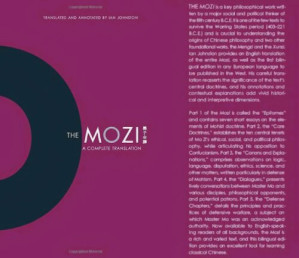
THE MOZI, a key philosophical work written by a major social and political thinker of the fifth century B.C.E. It is one of the few texts to survive the Warring States period (403-221 B.C.E) and is crucial to understanding the origins of Chinese philosophy and two other foundational works, the Mengzi and the Xunzi. Ian Johnston provides an English translation of the entire Mozi. as wel as the first bilingual edition in any European language to be published in the West. His careful translation reasserts the significance of the text's central doctrines, and his annotations and contextual explanations add vivid historical and interpretive dimensions.
Part 1 of the Mozi is called the "Epitomes” and contains seven short essays on the elements of Mozi doctrine. Part 2 the "Core Doctrines" establishes the ten central tenets of Mo Zi's ethical, social and political philosophy, while articulating his opposition to Confucianism. Part 3, the "Canons and Explonations" comprises observations on logic, language, disputation, ethics, science, and other matters, written parliculany in defense of Mohism. Part 4, the "Dialogues," presents lively conversations between Master Mo and various disciples, phiosophical opponents, and potential patrons. Part 5, the "Defense Chapters" detail the principles and practices of defensive warfare, a subject on which Master Mo was an acknowledged authority. Now available to English-speaking readers of all backgrounds, the Mozi is a rich and varied text, and ths bilingual edition provides an excellent tool for learning classical Chinese.
Part 1 of the Mozi is called the "Epitomes” and contains seven short essays on the elements of Mozi doctrine. Part 2 the "Core Doctrines" establishes the ten central tenets of Mo Zi's ethical, social and political philosophy, while articulating his opposition to Confucianism. Part 3, the "Canons and Explonations" comprises observations on logic, language, disputation, ethics, science, and other matters, written parliculany in defense of Mohism. Part 4, the "Dialogues," presents lively conversations between Master Mo and various disciples, phiosophical opponents, and potential patrons. Part 5, the "Defense Chapters" detail the principles and practices of defensive warfare, a subject on which Master Mo was an acknowledged authority. Now available to English-speaking readers of all backgrounds, the Mozi is a rich and varied text, and ths bilingual edition provides an excellent tool for learning classical Chinese.
备用文件名
lgrsnf/Mozi. A Complete Translation_Johnston 2010.djvu
备用文件名
zlib/no-category/Johnston Ian (translator)/The Mozi: A Complete Translation_13784660.djvu
备选标题
The Mozi (A Bilingual Edition) 墨子 A Complete Translation
备选标题
Mozi. English & Chinese
备选标题
Mozi quan yi
备选作者
translated and annotated by Ian Johnston
备选作者
墨翟, active 400 B. C
备选作者
Di Mo; Ian Johnston
备选作者
Mozi
备用出版商
The Chinese University of Hong Kong Press
备用出版商
Columbia Business School Publishing
备用出版商
King's Crown Paperbacks
备用版本
Translations from the Asian classics, Translations from the Asian classics, New York, New York State, 2010
备用版本
Translations from the Asian classics, New York, cop. 2010
备用版本
First Edition /First Printing, PS, 2010
备用版本
United States, United States of America
备用版本
Hong Kong, China, Hong Kong
备用版本
Hong Kong, China, 2010
备用版本
1, 2009-01-01
元数据中的注释
lg3007739
元数据中的注释
{"isbns":["023115240X","9629962705","9780231152402","9789629962708"],"publisher":"Chinese University Press"}
元数据中的注释
Includes bibliographical references and indexes.
Parallel text in English and Chinese.
Parallel text in English and Chinese.
元数据中的注释
Includes bibliographical references and index.
元数据中的注释
Includes bibliographical referencs (p. [923]-930) and indexes.
Text in Chinese and English; introduction, comments and notes in English.
Text in Chinese and English; introduction, comments and notes in English.
备用描述
Preface
Introduction
I. Mo Zi - The Man
II. The Mohist School
III. Mozi - The Book
IV. The “Core” Doctrines
V. Mohist Responses to Other Pre-Han Philosophers
VI. Pre-Han Responses to Mohism
VII. Han Yu’s Essay
VIII. The Translation
Key to Abbreviations
Table of Equivalences for Weights and Measures
The Mozi - Text and Translation
Part I The Epitomes
1. On Being Sympathetic towards Officers (Qin Shi 親士)
2. On Cultivating the Self (Xiu Shen 修身)
3. On Dyeing (Suo Ran 所染)
4. On Standards and Rules (Fa Yi 法儀)
5. On the Seven Misfortunes (Qi Huan 七患)
6. On Eschewing Faults (Ci Guo 辭過)
7. Three Arguments (San Bian 三辯)
Part II Core Doctrines
8. Exalting Worthiness I (Shang Xian, Shang 尚賢上)
9. Exalting Worthiness II (Shang Xian, Zhong 尚賢中)
10. Exalting Worthiness III (Shang Xian, Xia 尚賢下)
11. Exalting Unity I (Shang Tong, Shang 尚同上)
12. Exalting Unity II (Shang Tong, Zhong 尚同中)
13. Exalting Unity III (Shang Tong, Xia 尚同下)
14. Universal Love I (Jian Ai, Shang 兼愛上)
15. Universal Love II (Jian Ai, Zhong 兼愛 E )
16. Universal Love III (Jian Ai, Xia 兼愛下)
17. Condemning Offensive Warfare I (Fei Gong, Shang 非攻上)
18. Condemning Offensive Warfare II (Fei Gong, Zhong 非攻中)
19. Condemning Offensive Warfare III (Fei Gong, Xia 非攻下)
20. Moderation in Use I (Jie Yong, Shang 節用上)
21. Moderation in Use II (Jie Yong, Zhong 節用 中)
22. Moderation in Use III (Jie Yong, Xia 節用下)一 Lost
23. Moderation in Funerals I (Jie Zang, Shang 節葬上)一 Lost
24. Moderation in Funerals II (Jie Zang, Zhong 節葬中)一 Lost
25. Moderation in Funerals III (Jie Zang, Xia 節葬下)
26. Heaven,s Intention I (Tian Zhi, Shang 天志上)
27. Heaven,s Intention II (Tian Zhi, Zhong 天志 中)
28. Heaven,s Intention III (Tian Zhi, Xia 天志下)
29. Percipient Ghosts I (Ming Gui, Shang 明鬼上)一 Lost
30. Percipient Ghosts II (Ming Gui, Zhong 明鬼中)一 Lost
31. Percipient Ghosts III (Ming Gui, Xia 明鬼下)
32. Condemning Music I (Fei Yue, Shang 非樂上)
33. Condemning Music II (Fei Yue, Zhong 3F樂中)一 Lost
34. Condemning Music III (Fei Yue, Xia 非樂下)一 Lost
35. Against Fate I (Fei Ming, Shang 非命上)
36. Against Fate II (Fei Ming, Zhong 非命中)
37. Against Fate III (Fei Ming, Xia 非命下)
38. Against the Confucians I (Fei Ru, Shang 非儒上)一 Lost
39. Against the Confucians II (Fei Ru, Xia 非儒下)
Part III Language, Logic & Science
40. Canons A (Jing, Shang 經上)
41. Canons B (Jing, Xia 經下)
42. Explanations A (Jing Shuo, Shang 經説上)(combined with chapter 40)
43. Explanations B (Jing Shuo, Xia 經説下)(combined with chapter 41)
44. Choosing the Greater (Da Qu 大取)
45. Choosing the Lesser (Xiao Qu 小取)
Part IV Dialogues
46. Geng Zhu 耕柱
47. Valuing Righteousness (Gui Yi 貴義)
48. Gongmeng 公孟
49. Lu's Questions (Lu Wen 魯間)
50. Gongshu 公輸
51. Lost
Part V Defence of a City
52. Preparing the Wall and Gates (Bei Cheng Men 備城門)
53. Preparing against the High Approach (Bei Gao Lin 備高臨)
54. Lost
55. Lost
56. Preparing against Ladders (Bei Ti 備梯)
57. Lost
58. Preparing against Water (Flooding) (Bei Shui 備水)
59. Lost
60. Lost
61. Preparing against Sudden Attack (Bei Tu 備突)
62. Preparing against Tunnelling (Bei Xue 備穴)
63. Preparing against the “Ant Approach” (Bei E Fu 備蛾彳f)
64. Lost
65. Lost
66. Lost
67. Lost
68. Sacrifices for Meeting the Enemy (Yingdi Ci 迎敵祠)
69. Flags and Pennons (Qi Zhi 旗幟)
70. Orders and Commands (Hao Ling 號令)
71. Miscellaneous Defences (Za Shou 雜守)
Bibliography
Personal Names Index
Places, Subjects & Writings Index
Introduction
I. Mo Zi - The Man
II. The Mohist School
III. Mozi - The Book
IV. The “Core” Doctrines
V. Mohist Responses to Other Pre-Han Philosophers
VI. Pre-Han Responses to Mohism
VII. Han Yu’s Essay
VIII. The Translation
Key to Abbreviations
Table of Equivalences for Weights and Measures
The Mozi - Text and Translation
Part I The Epitomes
1. On Being Sympathetic towards Officers (Qin Shi 親士)
2. On Cultivating the Self (Xiu Shen 修身)
3. On Dyeing (Suo Ran 所染)
4. On Standards and Rules (Fa Yi 法儀)
5. On the Seven Misfortunes (Qi Huan 七患)
6. On Eschewing Faults (Ci Guo 辭過)
7. Three Arguments (San Bian 三辯)
Part II Core Doctrines
8. Exalting Worthiness I (Shang Xian, Shang 尚賢上)
9. Exalting Worthiness II (Shang Xian, Zhong 尚賢中)
10. Exalting Worthiness III (Shang Xian, Xia 尚賢下)
11. Exalting Unity I (Shang Tong, Shang 尚同上)
12. Exalting Unity II (Shang Tong, Zhong 尚同中)
13. Exalting Unity III (Shang Tong, Xia 尚同下)
14. Universal Love I (Jian Ai, Shang 兼愛上)
15. Universal Love II (Jian Ai, Zhong 兼愛 E )
16. Universal Love III (Jian Ai, Xia 兼愛下)
17. Condemning Offensive Warfare I (Fei Gong, Shang 非攻上)
18. Condemning Offensive Warfare II (Fei Gong, Zhong 非攻中)
19. Condemning Offensive Warfare III (Fei Gong, Xia 非攻下)
20. Moderation in Use I (Jie Yong, Shang 節用上)
21. Moderation in Use II (Jie Yong, Zhong 節用 中)
22. Moderation in Use III (Jie Yong, Xia 節用下)一 Lost
23. Moderation in Funerals I (Jie Zang, Shang 節葬上)一 Lost
24. Moderation in Funerals II (Jie Zang, Zhong 節葬中)一 Lost
25. Moderation in Funerals III (Jie Zang, Xia 節葬下)
26. Heaven,s Intention I (Tian Zhi, Shang 天志上)
27. Heaven,s Intention II (Tian Zhi, Zhong 天志 中)
28. Heaven,s Intention III (Tian Zhi, Xia 天志下)
29. Percipient Ghosts I (Ming Gui, Shang 明鬼上)一 Lost
30. Percipient Ghosts II (Ming Gui, Zhong 明鬼中)一 Lost
31. Percipient Ghosts III (Ming Gui, Xia 明鬼下)
32. Condemning Music I (Fei Yue, Shang 非樂上)
33. Condemning Music II (Fei Yue, Zhong 3F樂中)一 Lost
34. Condemning Music III (Fei Yue, Xia 非樂下)一 Lost
35. Against Fate I (Fei Ming, Shang 非命上)
36. Against Fate II (Fei Ming, Zhong 非命中)
37. Against Fate III (Fei Ming, Xia 非命下)
38. Against the Confucians I (Fei Ru, Shang 非儒上)一 Lost
39. Against the Confucians II (Fei Ru, Xia 非儒下)
Part III Language, Logic & Science
40. Canons A (Jing, Shang 經上)
41. Canons B (Jing, Xia 經下)
42. Explanations A (Jing Shuo, Shang 經説上)(combined with chapter 40)
43. Explanations B (Jing Shuo, Xia 經説下)(combined with chapter 41)
44. Choosing the Greater (Da Qu 大取)
45. Choosing the Lesser (Xiao Qu 小取)
Part IV Dialogues
46. Geng Zhu 耕柱
47. Valuing Righteousness (Gui Yi 貴義)
48. Gongmeng 公孟
49. Lu's Questions (Lu Wen 魯間)
50. Gongshu 公輸
51. Lost
Part V Defence of a City
52. Preparing the Wall and Gates (Bei Cheng Men 備城門)
53. Preparing against the High Approach (Bei Gao Lin 備高臨)
54. Lost
55. Lost
56. Preparing against Ladders (Bei Ti 備梯)
57. Lost
58. Preparing against Water (Flooding) (Bei Shui 備水)
59. Lost
60. Lost
61. Preparing against Sudden Attack (Bei Tu 備突)
62. Preparing against Tunnelling (Bei Xue 備穴)
63. Preparing against the “Ant Approach” (Bei E Fu 備蛾彳f)
64. Lost
65. Lost
66. Lost
67. Lost
68. Sacrifices for Meeting the Enemy (Yingdi Ci 迎敵祠)
69. Flags and Pennons (Qi Zhi 旗幟)
70. Orders and Commands (Hao Ling 號令)
71. Miscellaneous Defences (Za Shou 雜守)
Bibliography
Personal Names Index
Places, Subjects & Writings Index
备用描述
<p>The <i>Mozi</i> is a key philosophical work written by a major social and political thinker of the fifth century B.C.E. It is one of the few texts to survive the Warring States period (403-221 B.C.E.) and is crucial to understanding the origins of Chinese philosophy and two other foundational works, the <i>Mengzi</i> and the <i>Xunzi</i>. Ian Johnston provides an English translation of the entire <i>Mozi</i>, as well as the first bilingual edition in any European language to be published in the West. His careful translation reasserts the significance of the text's central doctrines, and his annotations and contextual explanations add vivid historical and interpretive dimensions.</p><p>Part 1 of the <i>Mozi</i> is called the Epitomes and contains seven short essays on the elements of Mohist doctrine. Part 2, the Core Doctrines, establishes the ten central tenets of Mo Zi's ethical, social, and political philosophy, while articulating his opposition to Confucianism. Part 3, the Canons and Explanations, comprises observations on logic, language, disputation, ethics, science, and other matters, written particularly in defense of Mohism. Part 4, the Dialogues, presents lively conversations between Master Mo and various disciples, philosophical opponents, and potential patrons. Part 5, the Defense Chapters, details the principles and practices of defensive warfare, a subject on which Master Mo was an acknowledged authority. Now available to English-speaking readers of all backgrounds, the Mozi is a rich and varied text, and this bilingual edition provides an excellent tool for learning classical Chinese.</p><p> Columbia University Press</p>
备用描述
The "Mozi" is a key philosophical work written by a major social and political thinker of the fifth century B.C.E. It is one of the few texts to survive the Warring States period (403-221 B.C.E.) and is crucial to understanding the origins of Chinese philosophy and two other foundational works, the "Mengzi" and the "Xunzi." Ian Johnston provides an English translation of the entire "Mozi," as well as the first bilingual edition in any European language to be published in the West. His careful translation reasserts the significance of the text's central doctrines, and his annotations and contextual explanations add vivid historical and interpretive dimensions.
Part 1 of the "Mozi" is called the "Epitomes" and contains seven short essays on the elements of Mohist doctrine. Part 2, the "Core Doctrines," establishes the ten central tenets of Mo Zi's ethical, social, and political philosophy, while articulating his opposition to Confucianism. Part 3, the "Canons and Explanations," comprises observations on logic, language, disputation, ethics, science, and other matters, written particularly in defense of Mohism. Part 4, the "Dialogues," presents lively conversations between Master Mo and various disciples, philosophical opponents, and potential patrons. Part 5, the "Defense Chapters," details the principles and practices of defensive warfare, a subject on which Master Mo was an acknowledged authority. Now available to English-speaking readers of all backgrounds, the Mozi is a rich and varied text, and this bilingual edition provides an excellent tool for learning classical Chinese.
Part 1 of the "Mozi" is called the "Epitomes" and contains seven short essays on the elements of Mohist doctrine. Part 2, the "Core Doctrines," establishes the ten central tenets of Mo Zi's ethical, social, and political philosophy, while articulating his opposition to Confucianism. Part 3, the "Canons and Explanations," comprises observations on logic, language, disputation, ethics, science, and other matters, written particularly in defense of Mohism. Part 4, the "Dialogues," presents lively conversations between Master Mo and various disciples, philosophical opponents, and potential patrons. Part 5, the "Defense Chapters," details the principles and practices of defensive warfare, a subject on which Master Mo was an acknowledged authority. Now available to English-speaking readers of all backgrounds, the Mozi is a rich and varied text, and this bilingual edition provides an excellent tool for learning classical Chinese.
备用描述
"The Mozi is a key philosophical work written by a major social and political thinker of the fifth century B.C.E. It is one of the few texts to survive the Warring States period (403-221 B.C.E.) and is crucial to understanding the origins of Chinese philosophy and two other foundational works, the Mengzi and the Xunzi. Ian Johnston provides an English translation of the entire Mozi, as well as the first bilingual edition in any European language to be published in the West. His careful translation reasserts the significance of the text's central doctrines, and his annotations and contextual explanations add vivid historical and interpretive dimensions. Part 1 of the Mozi is called the "Epitomes" and contains seven short essays on the elements of Mohist doctrine. Part 2, the "Core Doctrines," establishes the ten central tenets of Mo Zi's ethical, social, and political philosophy, while articulating his opposition to Confucianism. Part 3, the "Canons and Explanations," comprises observations on logic, language, disputation, ethics, science, and other matters, written particularly in defense of Mohism. Part 4, the "Dialogues," presents lively conversations between Master Mo and various disciples, philosophical opponents, and potential patrons. Part 5, the "Defense Chapters," details the principles and practices of defensive warfare, a subject on which Master Mo was an acknowledged authority. Now available to English-speaking readers of all backgrounds, the Mozi is a rich and varied text, and this bilingual edition provides an excellent tool for learning classical Chinese."--Jacket
备用描述
<p>The Mozi is one of the small number of key texts surviving from the first flowering of Chinese philosophy during the Warring States period (403–221 BC). In structure, the Mozi comprises five distinct parts.Part I, the Epitomes, contains seven short essays on elements of Mohist doctrine. Part II, the "Core Doctrines, " contains twenty-four chapters: twenty-three from the presumed thirty original chapters, arranged as ten triads, which set out the ten central doctrines of Mo Zi's ethical, social and political philosophy, and one of the two presumed chapters articulating Mo Zi's opposition to Confucianism. Part III, on "dialectics, " contains six chapters on logic, language, disputation, ethics, science and other matters, attributed to the Later Mohists and written, in part at least, in defence of the original Mohist doctrines. Part IV, the Dialogues, contains five chapters made up of lively conversations, edifying anecdotes and gnomic utterances, a form more characteristic of the philosophical writing of the time. Part V, on the defence of a city, contains eleven chapters detailing the principles and practices of defensive warfare, a subject on which Master Mo was acknowledged as the leading authority of the time. The Mozi is, then, a rich and varied work, and yet it has been sadly neglected, both in China and the West. This is the first English translation of the complete work and the first bilingual version in any European language.<br></p>
备用描述
The Mozi is one of the small number of key texts surviving from the first flowering of Chinese philosophy during the Warring States period (403–221 BC). In structure, the Mozi comprises five distinct parts. Part I, the Epitomes, contains seven short essays on elements of Mohist doctrine. Part II, the "Core Doctrines," contains twenty-four chapters: twenty-three from the presumed thirty original chapters, arranged as ten triads, which set out the ten central doctrines of Mo Zi's ethical, social and political philosophy, and one of the two presumed chapters articulating Mo Zi's opposition to Confucianism. Part III, on "dialectics," contains six chapters on logic, language, disputation, ethics, science and other matters, attributed to the Later Mohists and written, in part at least, in defence of the original Mohist doctrines. Part IV, the Dialogues, contains five chapters made up of lively conversations, edifying anecdotes and gnomic utterances, a form more characteristic of the philosophical writing of the time. Part V, on the defence of a city, contains eleven chapters detailing the principles and practices of defensive warfare, a subject on which Master Mo was acknowledged as the leading authority of the time. The Mozi is, then, a rich and varied work, and yet it has been sadly neglected, both in China and the West. This is the first English translation of the complete work and the first bilingual version in any European language.
备用描述
An English translation of the complete work and the first bilingual version in any European language. It is one of the small number of key texts surviving from the first flowering of Chinese philosophy during the Warring States period.
开源日期
2021-05-14
🚀 快速下载
成为会员以支持书籍、论文等的长期保存。为了感谢您对我们的支持,您将获得高速下载权益。❤️
如果您在本月捐款,您将获得双倍的快速下载次数。
🐢 低速下载
由可信的合作方提供。 更多信息请参见常见问题解答。 (可能需要验证浏览器——无限次下载!)
- 低速服务器(合作方提供) #1 (稍快但需要排队)
- 低速服务器(合作方提供) #2 (稍快但需要排队)
- 低速服务器(合作方提供) #3 (稍快但需要排队)
- 低速服务器(合作方提供) #4 (稍快但需要排队)
- 低速服务器(合作方提供) #5 (无需排队,但可能非常慢)
- 低速服务器(合作方提供) #6 (无需排队,但可能非常慢)
- 低速服务器(合作方提供) #7 (无需排队,但可能非常慢)
- 低速服务器(合作方提供) #8 (无需排队,但可能非常慢)
- 低速服务器(合作方提供) #9 (无需排队,但可能非常慢)
- 下载后: 在我们的查看器中打开
所有选项下载的文件都相同,应该可以安全使用。即使这样,从互联网下载文件时始终要小心。例如,确保您的设备更新及时。
外部下载
-
对于大文件,我们建议使用下载管理器以防止中断。
推荐的下载管理器:JDownloader -
您将需要一个电子书或 PDF 阅读器来打开文件,具体取决于文件格式。
推荐的电子书阅读器:Anna的档案在线查看器、ReadEra和Calibre -
使用在线工具进行格式转换。
推荐的转换工具:CloudConvert和PrintFriendly -
您可以将 PDF 和 EPUB 文件发送到您的 Kindle 或 Kobo 电子阅读器。
推荐的工具:亚马逊的“发送到 Kindle”和djazz 的“发送到 Kobo/Kindle” -
支持作者和图书馆
✍️ 如果您喜欢这个并且能够负担得起,请考虑购买原版,或直接支持作者。
📚 如果您当地的图书馆有这本书,请考虑在那里免费借阅。
下面的文字仅以英文继续。
总下载量:
“文件的MD5”是根据文件内容计算出的哈希值,并且基于该内容具有相当的唯一性。我们这里索引的所有影子图书馆都主要使用MD5来标识文件。
一个文件可能会出现在多个影子图书馆中。有关我们编译的各种数据集的信息,请参见数据集页面。
有关此文件的详细信息,请查看其JSON 文件。 Live/debug JSON version. Live/debug page.