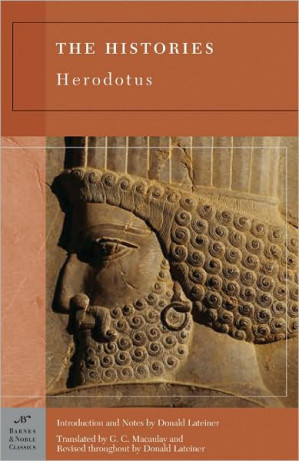
upload/duxiu_main/v/rar/41/Herodotus/The Histories (Barnes & Noble Classics) (15729)/The Histories (Barnes & Noble Classics) - Herodotus.mobi
The Histories (B&N) 🔍
Herodotus; Donald Lateiner; G. C. Macaulay
BARNES & NOBLE, 1890
英语 [en] · MOBI · 3.2MB · 1890 · 📕 小说类图书 · 🚀/lgli/upload/zlib · Save
描述
Product Description The Histories , by Herodotus , is part of the *Barnes & Noble Classics *series, which offers quality editions at affordable prices to the student and the general reader, including new scholarship, thoughtful design, and pages of carefully crafted extras. Here are some of the remarkable features of Barnes & Noble Classics :
New introductions commissioned from today's top writers and scholars Biographies of the authors Chronologies of contemporary historical, biographical, and cultural events Footnotes and endnotes Selective discussions of imitations, parodies, poems, books, plays, paintings, operas, statuary, and films inspired by the work Comments by other famous authors Study questions to challenge the reader's viewpoints and expectations Bibliographies for further reading Indices & Glossaries, when appropriateAll editions are beautifully designed and are printed to superior specifications; some include illustrations of historical interest. Barnes & Noble Classics pulls together a constellation of influences—biographical, historical, and literary—to enrich each reader's understanding of these enduring works.
The world's first great narrative history, Herodotus 's The Histories vividly describes how the Greeks—few in number, poor, and disunited—managed to repulse a massive invasion by the powerful Persian army in the 5th century b.c. This amazing upset victory changed the course of western civilization, as the cities that led the resistance—Athens and Sparta—became the two major powers on the Greek mainland. The remarkable period that followed introduced revolutionary ideas about democracy, education, philosophy, drama, and—thanks to Herodotus—the writing of history.
A wonderful storyteller, Herodotus filled the Histories with amusing anecdotes and dialogue, human details about the lives of important political figures, and a kaleidoscope of viewpoints from people of many lands. Magnificent in compass and enormously entertaining, the Histories is not only the leading source of original information for Greek history during the all-important period between 550 and 479 b.c., but also an artistic masterpiece that created a new genre of literature.
Features maps of several noted battles, index of proper names, and a general index.
Donald Lateiner teaches Greek, Latin, Ancient History and Comparative Folklore in the Humanities-Classics department at Ohio Wesleyan University. His scholarship focuses on Homer and Herodotus. He has published a book on each. He also researches nonverbal behaviors in ancient literature.
Excerpt. © Reprinted by permission. All rights reserved. From Donald Lateiner's Introduction to The Histories
"Herodotus sometimes writes for children and sometimes for philosophers," said the greatest of modern historians, Edward Gibbon ( The History of the Decline and Fall of the Roman Empire , 1776-1788, chapter 24, note 54). Casual and serious readers alike have loved the first historian, the inventor of history, for his narrative genius and tragi-comic view of human events, great and small. He has been equally criticized and damned by professional historians, ethnographers, and geographers for errors of fact and method, and even for his Greek. Cicero was not the first to call him "the father of lies." The German scholar Detlev Fehling (see "For Further Reading") actually avers that he never left Greece or perhaps even his Anatolian study, copying others' lies and travelers' tales, inventing claims of visits to exotic places and familiar monuments, and fabricating hundreds of alleged sources.
Whereas other ancient historians who followed his large footsteps narrowed their scope in terms of topic (Thucydides, Polybius, Sallust), time (Theopompus, Livy, Tacitus), or territory (the local historians, such as those of Athens, the Atthidographers, or the chroniclers of other poleis ), Herodotus Homerically encompasses vast realms in topic, time, and territory. After leaving his birthplace, Halicarnassos on the western edge of Asia Minor (Anatolia, now roughly Turkey), he sailed on various voyages, perhaps as a merchant, south to Egypt, east to Sidon, north to the Hellespont and Black Sea, and west to Italy and Sicily. He then traveled inland in all these directions, although one cannot always separate his reports based on personal visits from what he heard or thought he heard, through interpreters who were sometimes comparatively informed and sometimes no better than local loungers eager to help a tourist. He saw the earth beneath his feet and existing structures at Delphi, Marathon, and Delos. He traveled to the edges of the known and unknown inhabited world in Egypt and Italy, and around the Black Sea. He heard about Spain, Babylon (in modern Iraq), Afghanistan, cold Britain, and the hot Sahara. This last region, described with wonder and some disparagement in the latter half of book IV, is crucial to the story of Ondaatje's protagonist in The English Patient , a Central European explorer of North Africa. Herodotus was his guide in those vast spaces, and he was never separated from this talisman, a kind of Bible for his restless search in life.
Herodotus—the inquirer, evaluator, and judge (a combination of the three is what "historian" means in Greek) — tells us what he observed. He saw pyramids, inscriptions, and other natural and artificial alterations of the environment. He heard facts and fictions from combatants, travelers, and survivors. He gathered legends and anecdotes from oral traditional tales. And he surmised certain things to be possible or probable from his own penetrating critiques of humans, their normal and odd behaviors, and their environment. Some of his alleged errors turn out to be misunderstandings of what he wrote. Some real errors (such as his disbelief [4.42] in the possibility of Phoenician circumnavigation of Africa) derive from his honest mistakes in a young and illiterate world without prose books—his was one of the first and certainly the most ambitious work of research to his day.
Notwithstanding the somewhat exceptional case of the Athenians and the unavailability of scribal records of the Eastern autocracies, his world possessed few public records, no libraries or databases, only many personal and parochial biases and foreign tongues. His sources and source materials include Egyptian, African, Persian, Phoenician, Scythian, Celtic, and Ethiopian as well as Greek information. For one exotic example, his account of gold-digging, furry giant ants in the northeastern corner of the Persian Empire (Pactyike; 3.102-105) may have misreported, through many intermediary sources, the habits of a larger animal. The large burrowing marmots of the Dansar plateau, which overlooks the Indus in Kashmir, may have given rise to Herodotus' bizarre account of mining insects; see Michel Peissel's The Ants' Gold: The Discovery of the Greek El Dorado in the Himalayas (1984) and an article by Marlise Simons ("Gold-Digging Ants' Mystery Seems Solved, After Bugging Scholars for Centuries"; New York Times , November 25, 1996). In "The Place of Herodotus in the History of Historiography," the eminent student of ancient historiography Arnaldo Momigliano wrote: "If we had to give an a priori estimate of . . . success in writing history by Herodotus' method, we should probably shake our heads in sheer despondency."
classics
New introductions commissioned from today's top writers and scholars Biographies of the authors Chronologies of contemporary historical, biographical, and cultural events Footnotes and endnotes Selective discussions of imitations, parodies, poems, books, plays, paintings, operas, statuary, and films inspired by the work Comments by other famous authors Study questions to challenge the reader's viewpoints and expectations Bibliographies for further reading Indices & Glossaries, when appropriateAll editions are beautifully designed and are printed to superior specifications; some include illustrations of historical interest. Barnes & Noble Classics pulls together a constellation of influences—biographical, historical, and literary—to enrich each reader's understanding of these enduring works.
The world's first great narrative history, Herodotus 's The Histories vividly describes how the Greeks—few in number, poor, and disunited—managed to repulse a massive invasion by the powerful Persian army in the 5th century b.c. This amazing upset victory changed the course of western civilization, as the cities that led the resistance—Athens and Sparta—became the two major powers on the Greek mainland. The remarkable period that followed introduced revolutionary ideas about democracy, education, philosophy, drama, and—thanks to Herodotus—the writing of history.
A wonderful storyteller, Herodotus filled the Histories with amusing anecdotes and dialogue, human details about the lives of important political figures, and a kaleidoscope of viewpoints from people of many lands. Magnificent in compass and enormously entertaining, the Histories is not only the leading source of original information for Greek history during the all-important period between 550 and 479 b.c., but also an artistic masterpiece that created a new genre of literature.
Features maps of several noted battles, index of proper names, and a general index.
Donald Lateiner teaches Greek, Latin, Ancient History and Comparative Folklore in the Humanities-Classics department at Ohio Wesleyan University. His scholarship focuses on Homer and Herodotus. He has published a book on each. He also researches nonverbal behaviors in ancient literature.
Excerpt. © Reprinted by permission. All rights reserved. From Donald Lateiner's Introduction to The Histories
"Herodotus sometimes writes for children and sometimes for philosophers," said the greatest of modern historians, Edward Gibbon ( The History of the Decline and Fall of the Roman Empire , 1776-1788, chapter 24, note 54). Casual and serious readers alike have loved the first historian, the inventor of history, for his narrative genius and tragi-comic view of human events, great and small. He has been equally criticized and damned by professional historians, ethnographers, and geographers for errors of fact and method, and even for his Greek. Cicero was not the first to call him "the father of lies." The German scholar Detlev Fehling (see "For Further Reading") actually avers that he never left Greece or perhaps even his Anatolian study, copying others' lies and travelers' tales, inventing claims of visits to exotic places and familiar monuments, and fabricating hundreds of alleged sources.
Whereas other ancient historians who followed his large footsteps narrowed their scope in terms of topic (Thucydides, Polybius, Sallust), time (Theopompus, Livy, Tacitus), or territory (the local historians, such as those of Athens, the Atthidographers, or the chroniclers of other poleis ), Herodotus Homerically encompasses vast realms in topic, time, and territory. After leaving his birthplace, Halicarnassos on the western edge of Asia Minor (Anatolia, now roughly Turkey), he sailed on various voyages, perhaps as a merchant, south to Egypt, east to Sidon, north to the Hellespont and Black Sea, and west to Italy and Sicily. He then traveled inland in all these directions, although one cannot always separate his reports based on personal visits from what he heard or thought he heard, through interpreters who were sometimes comparatively informed and sometimes no better than local loungers eager to help a tourist. He saw the earth beneath his feet and existing structures at Delphi, Marathon, and Delos. He traveled to the edges of the known and unknown inhabited world in Egypt and Italy, and around the Black Sea. He heard about Spain, Babylon (in modern Iraq), Afghanistan, cold Britain, and the hot Sahara. This last region, described with wonder and some disparagement in the latter half of book IV, is crucial to the story of Ondaatje's protagonist in The English Patient , a Central European explorer of North Africa. Herodotus was his guide in those vast spaces, and he was never separated from this talisman, a kind of Bible for his restless search in life.
Herodotus—the inquirer, evaluator, and judge (a combination of the three is what "historian" means in Greek) — tells us what he observed. He saw pyramids, inscriptions, and other natural and artificial alterations of the environment. He heard facts and fictions from combatants, travelers, and survivors. He gathered legends and anecdotes from oral traditional tales. And he surmised certain things to be possible or probable from his own penetrating critiques of humans, their normal and odd behaviors, and their environment. Some of his alleged errors turn out to be misunderstandings of what he wrote. Some real errors (such as his disbelief [4.42] in the possibility of Phoenician circumnavigation of Africa) derive from his honest mistakes in a young and illiterate world without prose books—his was one of the first and certainly the most ambitious work of research to his day.
Notwithstanding the somewhat exceptional case of the Athenians and the unavailability of scribal records of the Eastern autocracies, his world possessed few public records, no libraries or databases, only many personal and parochial biases and foreign tongues. His sources and source materials include Egyptian, African, Persian, Phoenician, Scythian, Celtic, and Ethiopian as well as Greek information. For one exotic example, his account of gold-digging, furry giant ants in the northeastern corner of the Persian Empire (Pactyike; 3.102-105) may have misreported, through many intermediary sources, the habits of a larger animal. The large burrowing marmots of the Dansar plateau, which overlooks the Indus in Kashmir, may have given rise to Herodotus' bizarre account of mining insects; see Michel Peissel's The Ants' Gold: The Discovery of the Greek El Dorado in the Himalayas (1984) and an article by Marlise Simons ("Gold-Digging Ants' Mystery Seems Solved, After Bugging Scholars for Centuries"; New York Times , November 25, 1996). In "The Place of Herodotus in the History of Historiography," the eminent student of ancient historiography Arnaldo Momigliano wrote: "If we had to give an a priori estimate of . . . success in writing history by Herodotus' method, we should probably shake our heads in sheer despondency."
classics
备用文件名
upload/duxiu_main/v/mobi/The Histories (Barnes & Noble Classics) - Herodotus.mobi
备用文件名
lgli/Herodotus; Donald Lateiner; G. C. Macaulay - The Histories (B&N) (1890, BARNES & NOBLE).mobi
备用文件名
zlib/Fiction/Others/Herodotus; Donald Lateiner; G. C. Macaulay/The Histories (B&N)_16317583.mobi
开源日期
2021-06-15
🚀 快速下载
成为会员以支持书籍、论文等的长期保存。为了感谢您对我们的支持,您将获得高速下载权益。❤️
如果您在本月捐款,您将获得双倍的快速下载次数。
🐢 低速下载
由可信的合作方提供。 更多信息请参见常见问题解答。 (可能需要验证浏览器——无限次下载!)
- 低速服务器(合作方提供) #1 (稍快但需要排队)
- 低速服务器(合作方提供) #2 (稍快但需要排队)
- 低速服务器(合作方提供) #3 (稍快但需要排队)
- 低速服务器(合作方提供) #4 (稍快但需要排队)
- 低速服务器(合作方提供) #5 (无需排队,但可能非常慢)
- 低速服务器(合作方提供) #6 (无需排队,但可能非常慢)
- 低速服务器(合作方提供) #7 (无需排队,但可能非常慢)
- 低速服务器(合作方提供) #8 (无需排队,但可能非常慢)
- 低速服务器(合作方提供) #9 (无需排队,但可能非常慢)
- 下载后: 在我们的查看器中打开
所有选项下载的文件都相同,应该可以安全使用。即使这样,从互联网下载文件时始终要小心。例如,确保您的设备更新及时。
外部下载
-
对于大文件,我们建议使用下载管理器以防止中断。
推荐的下载管理器:JDownloader -
您将需要一个电子书或 PDF 阅读器来打开文件,具体取决于文件格式。
推荐的电子书阅读器:Anna的档案在线查看器、ReadEra和Calibre -
使用在线工具进行格式转换。
推荐的转换工具:CloudConvert和PrintFriendly -
您可以将 PDF 和 EPUB 文件发送到您的 Kindle 或 Kobo 电子阅读器。
推荐的工具:亚马逊的“发送到 Kindle”和djazz 的“发送到 Kobo/Kindle” -
支持作者和图书馆
✍️ 如果您喜欢这个并且能够负担得起,请考虑购买原版,或直接支持作者。
📚 如果您当地的图书馆有这本书,请考虑在那里免费借阅。
下面的文字仅以英文继续。
总下载量:
“文件的MD5”是根据文件内容计算出的哈希值,并且基于该内容具有相当的唯一性。我们这里索引的所有影子图书馆都主要使用MD5来标识文件。
一个文件可能会出现在多个影子图书馆中。有关我们编译的各种数据集的信息,请参见数据集页面。
有关此文件的详细信息,请查看其JSON 文件。 Live/debug JSON version. Live/debug page.