upload/newsarch_ebooks_2025_10/2020/07/11/Quantum Physics and Linguistics A Compositional, Diagrammat.pdf
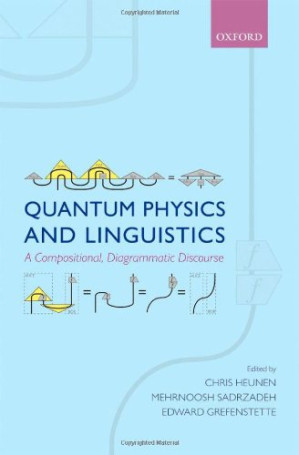
Quantum Physics and Linguistics : A Compositional, Diagrammatic Discourse 🔍
Chris Heunen, Mehrnoosh Sadrzadeh, Edward Grefenstette, (eds.)
IRL Press at Oxford University Press, 1, 2013-04-22
英语 [en] · 加泰罗尼亚语 [ca] · PDF · 6.8MB · 2013 · 📘 非小说类图书 · 🚀/lgli/lgrs/nexusstc/upload/zlib · Save
描述
New scientific paradigms typically consist of an expansion of the conceptual language with which we describe the world. Over the past decade, theoretical physics and quantum information theory have turned to category theory to model and reason about quantum protocols. This new use of categorical and algebraic tools allows a more conceptual and insightful expression of elementary events such as measurements, teleportation and entanglement operations, that were obscured in previous formalisms.
Recent work in natural language semantics has begun to use these categorical methods to relate grammatical analysis and semantic representations in a unified framework for analysing language meaning, and learning meaning from a corpus. A growing body of literature on the use of categorical methods in quantum information theory and computational linguistics shows both the need and opportunity for new research on the relation between these categorical methods and the abstract notion of information flow.
This book supplies an overview of how categorical methods are used to model information flow in both physics and linguistics. It serves as an introduction to this interdisciplinary research, and provides a basis for future research and collaboration between the different communities interested in applying category theoretic methods to their domain's open problems.
Recent work in natural language semantics has begun to use these categorical methods to relate grammatical analysis and semantic representations in a unified framework for analysing language meaning, and learning meaning from a corpus. A growing body of literature on the use of categorical methods in quantum information theory and computational linguistics shows both the need and opportunity for new research on the relation between these categorical methods and the abstract notion of information flow.
This book supplies an overview of how categorical methods are used to model information flow in both physics and linguistics. It serves as an introduction to this interdisciplinary research, and provides a basis for future research and collaboration between the different communities interested in applying category theoretic methods to their domain's open problems.
备用文件名
nexusstc/Quantum Physics and Linguistics: A Compositional, Diagrammatic Discourse/aa78f94af74caa161a770dce84cd567e.pdf
备用文件名
lgli/Quantum Physics and Linguistics - A Compositional, Diagrammatic Discourse.pdf
备用文件名
lgrsnf/Quantum Physics and Linguistics - A Compositional, Diagrammatic Discourse.pdf
备用文件名
zlib/Linguistics/Chris Heunen, Mehrnoosh Sadrzadeh, Edward Grefenstette, (eds.)/Quantum Physics and Linguistics: A Compositional, Diagrammatic Discourse_2515349.pdf
备选作者
Christiaan Johan Marie Heunen; Mehrnoosh Sadrzadeh; Edward Grefenstette
备选作者
ed. by Chris Heunen, Mehrnoosh Sadrzadeh, Edward Grefenstette
备选作者
Heunen, Chris, Sadrzadeh, Mehrnoosh, Grefenstette, Edward
备用出版商
Oxford Institute for Energy Studies
备用出版商
German Historical Institute London
备用出版商
OUP Oxford
备用版本
First edition, Oxford, United Kingdom, 2013
备用版本
United Kingdom and Ireland, United Kingdom
备用版本
Oxford University Press USA, Oxford, 2013
备用版本
Oxford, cop. 2013
备用版本
1, PS, 2013
元数据中的注释
0
元数据中的注释
lg1322541
元数据中的注释
producers:
Acrobat 11.0.0 Paper Capture Plug-in
Acrobat 11.0.0 Paper Capture Plug-in
元数据中的注释
{"content":{"parsed_at":1714834801,"parser":{"name":"textparser","version":"0.1.129"},"source":{"name":"grobid","version":"0.8.0"}},"edition":"1","isbns":["0199646295","9780199646296"],"last_page":432,"publisher":"Oxford University Press"}
元数据中的注释
Includes bibliographical references and index.
元数据中的注释
РГБ
元数据中的注释
Russian State Library [rgb] MARC:
=001 006587503
=005 20130924150620.0
=008 130419s2013\\\\xxka\\\\\b\\\\001\0\eng\\
=017 \\ $a И7950-13
=020 \\ $a 9780199646296 (hbk.)
=040 \\ $a DLC $c DLC $d RuMoRGB
=041 0\ $a eng
=044 \\ $a xxk
=084 \\ $a В314в2,0 $2 rubbk
=084 \\ $a Ш1в2:В314,0 $2 rubbk
=245 00 $a Quantum physics and linguistics $h [Текст] : $b a compositional, diagrammatic discourse $c ed. by Chris Heunen, Mehrnoosh Sadrzadeh, Edward Grefenstette
=260 \\ $a Oxford $b Oxford univ. press $c 2013
=300 \\ $a xx, 409 с. $b ил. $c 24 см
=336 \\ $a текст (text) $b txt $2 rdacontent
=337 \\ $a неопосредованный (unmediated) $b n $2 rdamedia
=338 \\ $a том (volume) $b nc $2 rdacarrier
=504 \\ $a Includes bibliographical references and index.
=650 \7 $a Физико-математические науки -- Физика -- Теоретическая физика -- Квантовая механика -- Философские вопросы -- Квантовая механика и лингвистика $2 rubbk
=650 \7 $a Квантовая теория $0 RU\NLR\AUTH\661278347 $2 nlr_sh
=650 \7 $a Филологические науки. Художественная литература -- Языкознание -- Методология языкознания -- Языкознание и другие науки -- Языкознание и квантовая физика $2 rubbk
=650 \7 $a Языкознание $x Методология $0 RU\NLR\AUTH\661213752 $2 nlr_sh
=700 1\ $a Heunen, Chris $e ред.
=852 0\ $a РГБ $b FB $h 5 13-8/215 $x 90
=001 006587503
=005 20130924150620.0
=008 130419s2013\\\\xxka\\\\\b\\\\001\0\eng\\
=017 \\ $a И7950-13
=020 \\ $a 9780199646296 (hbk.)
=040 \\ $a DLC $c DLC $d RuMoRGB
=041 0\ $a eng
=044 \\ $a xxk
=084 \\ $a В314в2,0 $2 rubbk
=084 \\ $a Ш1в2:В314,0 $2 rubbk
=245 00 $a Quantum physics and linguistics $h [Текст] : $b a compositional, diagrammatic discourse $c ed. by Chris Heunen, Mehrnoosh Sadrzadeh, Edward Grefenstette
=260 \\ $a Oxford $b Oxford univ. press $c 2013
=300 \\ $a xx, 409 с. $b ил. $c 24 см
=336 \\ $a текст (text) $b txt $2 rdacontent
=337 \\ $a неопосредованный (unmediated) $b n $2 rdamedia
=338 \\ $a том (volume) $b nc $2 rdacarrier
=504 \\ $a Includes bibliographical references and index.
=650 \7 $a Физико-математические науки -- Физика -- Теоретическая физика -- Квантовая механика -- Философские вопросы -- Квантовая механика и лингвистика $2 rubbk
=650 \7 $a Квантовая теория $0 RU\NLR\AUTH\661278347 $2 nlr_sh
=650 \7 $a Филологические науки. Художественная литература -- Языкознание -- Методология языкознания -- Языкознание и другие науки -- Языкознание и квантовая физика $2 rubbk
=650 \7 $a Языкознание $x Методология $0 RU\NLR\AUTH\661213752 $2 nlr_sh
=700 1\ $a Heunen, Chris $e ред.
=852 0\ $a РГБ $b FB $h 5 13-8/215 $x 90
备用描述
Preface 6
Contents 18
1 An Alternative Gospel of Structure: Order, Composition,Processes 22
1.1 Order 25
1.2 Orders and composition 30
1.3 Processes witnessing existence 36
1.4 Conclusion 42
2 Sorne Graphical Aspects of Frobenius Algebras 43
2.1 Introduction 43
2.2 Graphical calculus 45
2.3 Frobenius and Hopf algebras 52
2.4 A few pointers to further litera ture 67
3 A Graphical Approach to Measurement-BasedQuantum Computing 71
3.1 Introduction 71
3.2 The rudiments of quantum computing 75
3.3 Observables and strong complementarity 78
3.4 The zx-calculus 86
3.5 The measurement calculus 98
3.6 Determinism and flow 102
3.7 Conclusions 109
4 Quantum Groups and Braided Algebra 111
4.1 Introduction 111
4.2 Braided categories 113
4.3 Braided groups 117
4.4 Applications ofbraided groups 125
4.5 Braided-Lie algebras 130
4.6 Diagrammatic geometry 133
5 Hopf Algebras-Variant Notions and ReconstructionTheorems 136
5.1 Introduction 136
5.2 Preliminaries 138
5.3 Bialgebras and Hopf algebras in monoidal categories 140
5.4 Reconstruction theorems 148
5.5 Variations on the notion of Hopf algebra 153
6 Modular Categories 167
6.1 Introduction 167
6.2 Categories 168
6.3 Tensor categories 169
6.4 Braided tensor categories 176
6.5 Modular categories 187
6.6 Modularization of pre-modular categories: generalizations 196
6.7 The braided centre of a fusion category 198
6.8 The Witt group of modular categories 201
7 Scalars, Monads, and Categories 205
7.1 Introduction 205
7.2 Preliminaries 207
7.3 Monoids 210
7.4 Additive monads 217
7.5 Semirings and monads 226
7.6 Semirings and Lawvere theories 231
7.7 Semirings with involutions 234
7.8 Conclusions 237
8 Types and Forgetfulness in Categorical Linguistics andQuantum Mechanics 238
8.1 Introduction 238
8.2 Introducing typing to mo dels of meaning 239
8.3 What is a type? 239
8.4 Comparing words versus comparing sentences 250
8.5 Inner products, evaluation, and inverses 250
8.6 Do es evaluation preserve inner products? 251
8.7 How to type connectives? 254
8.8 Self-similarity, categorically 259
8.9 Self-similarity and lax Frobenius algebras 265
8.10 Classical structures 266
8.11 A self-similar structure familiar in logic (and linguistics) 269
Appendix 8.A Order-preserving bijections N ~ N I±J N as interiorpoints of the Cantor set 270
Appendix 8.B Isbell's argument in a general setting 272
9 From Sentence to Concept 273
9.1 Introduction 273
9.2 Notations, basic properties 275
9.3 Two-sorted first-order logic in compact closed categories 282
9.4 Semantics via pregroup grammars 288
9.5 Compositional semantics in concept spaces 295
9.6 Conclusion 302
10 ProofNets for the Lambek-Grishin Calculus 304
10.1 Background, motivation 304
10.2 Display sequent calcul us and pro of nets 309
10.3 Proof nets and focused display calculus 322
10.4 Conclusions 340
11 Algebras over a Field and Semantics for Context-BasedReasoning 342
11.1 Introduction 342
11.2 Theory of meaning 343
11.3 From logical for ms to algebra 346
11.4 Conclusion 353
12 Distributional Semantic Models 354
12.1 Introduction 354
12.2 Compositional syntax and semantics 355
12.3 Harris's notion of distribution 357
12.4 Firth's notion of collocation 359
12.5 Distributional semantics 360
12.6 Compositional distributional semantics 364
12.7 A philosophical digression 365
12.8 Experiments in compositional interpretation 368
12.9 An empirical test of distributional compositionality 374
12.10 Compositionality vs disambiguation 376
12.11 Conclusion: a new pro gram for compositionaldistributional semantics 378
13 Type-Driven Syntax and Semantics for ComposingMeaning Vectors 380
13.1 Introduction 380
13.2 Syntactic types and pregroup grammars 383
13.3 Semantic types and tensor products 386
13.4 Composition for an example sentence space 389
13.5 A real sentence space 393
13.6 Conclusion and further work 397
References 399
Index 428
Contents 18
1 An Alternative Gospel of Structure: Order, Composition,Processes 22
1.1 Order 25
1.2 Orders and composition 30
1.3 Processes witnessing existence 36
1.4 Conclusion 42
2 Sorne Graphical Aspects of Frobenius Algebras 43
2.1 Introduction 43
2.2 Graphical calculus 45
2.3 Frobenius and Hopf algebras 52
2.4 A few pointers to further litera ture 67
3 A Graphical Approach to Measurement-BasedQuantum Computing 71
3.1 Introduction 71
3.2 The rudiments of quantum computing 75
3.3 Observables and strong complementarity 78
3.4 The zx-calculus 86
3.5 The measurement calculus 98
3.6 Determinism and flow 102
3.7 Conclusions 109
4 Quantum Groups and Braided Algebra 111
4.1 Introduction 111
4.2 Braided categories 113
4.3 Braided groups 117
4.4 Applications ofbraided groups 125
4.5 Braided-Lie algebras 130
4.6 Diagrammatic geometry 133
5 Hopf Algebras-Variant Notions and ReconstructionTheorems 136
5.1 Introduction 136
5.2 Preliminaries 138
5.3 Bialgebras and Hopf algebras in monoidal categories 140
5.4 Reconstruction theorems 148
5.5 Variations on the notion of Hopf algebra 153
6 Modular Categories 167
6.1 Introduction 167
6.2 Categories 168
6.3 Tensor categories 169
6.4 Braided tensor categories 176
6.5 Modular categories 187
6.6 Modularization of pre-modular categories: generalizations 196
6.7 The braided centre of a fusion category 198
6.8 The Witt group of modular categories 201
7 Scalars, Monads, and Categories 205
7.1 Introduction 205
7.2 Preliminaries 207
7.3 Monoids 210
7.4 Additive monads 217
7.5 Semirings and monads 226
7.6 Semirings and Lawvere theories 231
7.7 Semirings with involutions 234
7.8 Conclusions 237
8 Types and Forgetfulness in Categorical Linguistics andQuantum Mechanics 238
8.1 Introduction 238
8.2 Introducing typing to mo dels of meaning 239
8.3 What is a type? 239
8.4 Comparing words versus comparing sentences 250
8.5 Inner products, evaluation, and inverses 250
8.6 Do es evaluation preserve inner products? 251
8.7 How to type connectives? 254
8.8 Self-similarity, categorically 259
8.9 Self-similarity and lax Frobenius algebras 265
8.10 Classical structures 266
8.11 A self-similar structure familiar in logic (and linguistics) 269
Appendix 8.A Order-preserving bijections N ~ N I±J N as interiorpoints of the Cantor set 270
Appendix 8.B Isbell's argument in a general setting 272
9 From Sentence to Concept 273
9.1 Introduction 273
9.2 Notations, basic properties 275
9.3 Two-sorted first-order logic in compact closed categories 282
9.4 Semantics via pregroup grammars 288
9.5 Compositional semantics in concept spaces 295
9.6 Conclusion 302
10 ProofNets for the Lambek-Grishin Calculus 304
10.1 Background, motivation 304
10.2 Display sequent calcul us and pro of nets 309
10.3 Proof nets and focused display calculus 322
10.4 Conclusions 340
11 Algebras over a Field and Semantics for Context-BasedReasoning 342
11.1 Introduction 342
11.2 Theory of meaning 343
11.3 From logical for ms to algebra 346
11.4 Conclusion 353
12 Distributional Semantic Models 354
12.1 Introduction 354
12.2 Compositional syntax and semantics 355
12.3 Harris's notion of distribution 357
12.4 Firth's notion of collocation 359
12.5 Distributional semantics 360
12.6 Compositional distributional semantics 364
12.7 A philosophical digression 365
12.8 Experiments in compositional interpretation 368
12.9 An empirical test of distributional compositionality 374
12.10 Compositionality vs disambiguation 376
12.11 Conclusion: a new pro gram for compositionaldistributional semantics 378
13 Type-Driven Syntax and Semantics for ComposingMeaning Vectors 380
13.1 Introduction 380
13.2 Syntactic types and pregroup grammars 383
13.3 Semantic types and tensor products 386
13.4 Composition for an example sentence space 389
13.5 A real sentence space 393
13.6 Conclusion and further work 397
References 399
Index 428
备用描述
An interdisciplinary attempt to bring together physicists and linguists who use the same compositional mathematical methods. Although seemingly unrelated, due to the complexity and dynamics of the compound phenomena they aim to model, and also advances in their high level methods, these fields have come to share a common mathematical structure.
开源日期
2015-03-20
🚀 快速下载
成为会员以支持书籍、论文等的长期保存。为了感谢您对我们的支持,您将获得高速下载权益。❤️
如果您在本月捐款,您将获得双倍的快速下载次数。
🐢 低速下载
由可信的合作方提供。 更多信息请参见常见问题解答。 (可能需要验证浏览器——无限次下载!)
- 低速服务器(合作方提供) #1 (稍快但需要排队)
- 低速服务器(合作方提供) #2 (稍快但需要排队)
- 低速服务器(合作方提供) #3 (稍快但需要排队)
- 低速服务器(合作方提供) #4 (稍快但需要排队)
- 低速服务器(合作方提供) #5 (无需排队,但可能非常慢)
- 低速服务器(合作方提供) #6 (无需排队,但可能非常慢)
- 低速服务器(合作方提供) #7 (无需排队,但可能非常慢)
- 低速服务器(合作方提供) #8 (无需排队,但可能非常慢)
- 低速服务器(合作方提供) #9 (无需排队,但可能非常慢)
- 下载后: 在我们的查看器中打开
所有选项下载的文件都相同,应该可以安全使用。即使这样,从互联网下载文件时始终要小心。例如,确保您的设备更新及时。
外部下载
-
对于大文件,我们建议使用下载管理器以防止中断。
推荐的下载管理器:JDownloader -
您将需要一个电子书或 PDF 阅读器来打开文件,具体取决于文件格式。
推荐的电子书阅读器:Anna的档案在线查看器、ReadEra和Calibre -
使用在线工具进行格式转换。
推荐的转换工具:CloudConvert和PrintFriendly -
您可以将 PDF 和 EPUB 文件发送到您的 Kindle 或 Kobo 电子阅读器。
推荐的工具:亚马逊的“发送到 Kindle”和djazz 的“发送到 Kobo/Kindle” -
支持作者和图书馆
✍️ 如果您喜欢这个并且能够负担得起,请考虑购买原版,或直接支持作者。
📚 如果您当地的图书馆有这本书,请考虑在那里免费借阅。
下面的文字仅以英文继续。
总下载量:
“文件的MD5”是根据文件内容计算出的哈希值,并且基于该内容具有相当的唯一性。我们这里索引的所有影子图书馆都主要使用MD5来标识文件。
一个文件可能会出现在多个影子图书馆中。有关我们编译的各种数据集的信息,请参见数据集页面。
有关此文件的详细信息,请查看其JSON 文件。 Live/debug JSON version. Live/debug page.