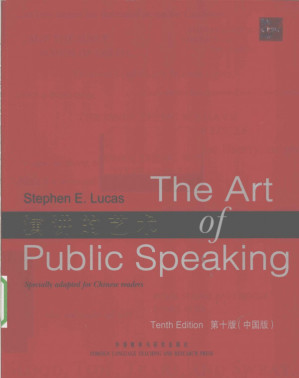
lgli/Stephen E. Lucas(美)卢卡斯 - The Art of Public Speaking (adapted for Chinese readers) 演讲的艺术第十版(中国版) (2010, 外语教学与研究出版社).pdf
The Art of Public Speaking (adapted for Chinese readers) 演讲的艺术第十版(中国版) 🔍
Stephen E. Lucas(美)卢卡斯
北京:外语教学与研究出版社, 2010, 2010
中文 [zh] · PDF · 101.8MB · 2010 · 📘 非小说类图书 · 🚀/duxiu/lgli/zlib · Save
描述
Wilma Subra had no intention of becoming a public speaker.
备用文件名
zlib/no-category/Stephen E. Lucas(美)卢卡斯/The Art of Public Speaking (adapted for Chinese readers) 演讲的艺术第十版(中国版)_21451321.pdf
备选标题
The art of speech - 10th edition- (Chinese version)- one CD-ROM inside (Chinese Edition)
备选标题
The art of public speaking: Yan jiang de yi shu
备选标题
演讲的艺术 : 第十版(中国版)
备选标题
演讲的艺术 中国版 英文
备选作者
Stephen E. Lucas with Yin Suya; Stephen Lucas; Yin Suya
备选作者
(美)Stephen E.Lucas著; 卢卡斯
备选作者
Lu Ka Si
备选作者
(美)卢卡斯著
备用出版商
Foreign Language Teaching and Research Press ; McGraw-Hill Education (Asia)
备用出版商
Foreign Languages Teaching and Research Press
备用版本
10th edition specially adapted for Chinese readers, Beijing, [Singapore], China, January 1998
备用版本
10 ban, zhong guo ban, Beijing, [Singapore, 2010
备用版本
Di 1 ban, Beijing, [Singapore, 2010
备用版本
China, People's Republic, China
元数据中的注释
Reprint. Originally publish: Boston : McGraw-Hill Higher Education,2009, 10th ed.
Partial text in Chinese.
Partial text in Chinese.
元数据中的注释
Bookmarks: p1 (p2): PART 1 INTRODUCTION TO PUBLIC SPEAKING
p1-1 (p2): CHAPTER 1 Speaking in Public
p1-1-1 (p3): The Power of Public Speaking
p1-1-2 (p5): The Tradition of Public Speaking
p1-1-3 (p6): Public Speaking and Intercultural Communicative Competence
p1-1-4 (p7): Public Speaking and Critical Thinking
p1-1-5 (p8): Public Speaking and Conversation
p1-1-5-1 (p8): Similarities Between Public Speaking and Conversation
p1-1-5-2 (p9): Differences Between Public Speaking and Conversation
p1-1-6 (p10): The Speech Communication Process
p1-1-6-1 (p10): Speaker
p1-1-6-2 (p10): Message
p1-1-6-3 (p10): Channel
p1-1-6-4 (p11): Listener
p1-1-6-5 (p11): Feedback
p1-1-6-6 (p11): Interference
p1-1-6-7 (p12): Situation
p1-1-6-8 (p12): The Speech Communication Process:Example with Commentary
p1-2 (p16): CHAPTER 2 Speaking Confidently and Ethically
p1-2-1 (p17): Becoming a Confident Speaker
p1-2-1-1 (p17): Nervousness Is Normal
p1-2-1-2 (p18): Dealing with Nervousness
p1-2-2 (p23): Being an Ethical Speaker
p1-2-2-1 (p24): Guidelines for Ethical Speaking
p1-2-2-2 (p26): Plagiarism
p1-3 (p32): CHAPTER 3 Giving Your First Speech
p1-3-1 (p33): Preparing Your Speech
p1-3-1-1 (p33): Developing the Speech
p1-3-1-2 (p34): Organizing the Speech
p1-3-2 (p36): Delivering Your Speech
p1-3-2-1 (p36): Speaking Extemporaneously
p1-3-2-2 (p37): Rehearsing the Speech
p1-3-2-3 (p38): Presenting the Speech
p1-3-3 (p38): Sample Speeches with Commentary
p2 (p44): PART 2 SPEECH PREPARATION:GETTING STARTED
p2-1 (p44): CHAPTER 4 Selecting a Topic and a Purpose
p2-1-1 (p45): Choosing a Topic
p2-1-1-1 (p46): Topics You Know a Lot About
p2-1-1-2 (p46): Topics You Want to Know More About
p2-1-1-3 (p46): Brainstorming for Topics
p2-1-2 (p49): Determining the General Purpose
p2-1-3 (p49): Determining the Specific Purpose
p2-1-4 (p53): Phrasing the Central Idea
p2-2 (p58): CHAPTER 5 Analyzing the Audience
p2-2-1 (p59): Audience-Centeredness
p2-2-2 (p60): The Psychology of Audiences
p2-2-3 (p60): Factors in Audience Analysis
p2-2-3-1 (p60): Size
p2-2-3-2 (p61): Physical Setting
p2-2-3-3 (p62): Demographic Traits
p2-2-3-4 (p62): Disposition Toward the Topic
p2-2-3-5 (p64): Disposition Toward the Speaker
p2-2-3-6 (p64): Disposition Toward the Occasion
p2-2-4 (p64): Getting Information About the Audience
p2-2-5 (p67): Adapting to the Audience
p2-2-5-1 (p67): Audience Adaptation Before the Speech
p2-2-5-2 (p69): Audience Adaptation During the Speech
p2-2-5-3 (p69): Audience Adaptation After the Speech
p2-3 (p72): CHAPTER 6 Supporting Your Ideas
p2-3-1 (p73): Examples
p2-3-1-1 (p73): Brief Examples
p2-3-1-2 (p74): Extended Examples
p2-3-1-3 (p74): Hypothetical Examples
p2-3-1-4 (p75): Tips for Using Examples
p2-3-2 (p76): Statistics
p2-3-2-1 (p76): Single Statistics
p2-3-2-2 (p77): Multiple Statistics
p2-3-2-3 (p77): Tips for Using Statistics
p2-3-3 (p79): Testimony
p2-3-3-1 (p80): Expert Testimony
p2-3-3-2 (p80): Peer Testimony
p2-3-3-3 (p80): Tips for Using Testimony
p2-3-4 (p83): Sample Speech with Commentary
p3 (p88): PART 3 SPEECH PREPARATION:ORGANIZING AND OUTLING
p3-1 (p88): CHAPTER 7 Organizing the Body of the Speech
p3-1-1 (p89): Main Points
p3-1-1-1 (p90): Strategic Order of Main Points
p3-1-1-2 (p95): Tips for Preparing Main Points
p3-1-2 (p96): Supporting Materials
p3-1-3 (p97): Connectives
p3-1-3-1 (p97): Transitions
p3-1-3-2 (p98): Internal Previews
p3-1-3-3 (p98): Internal Summaries
p3-1-3-4 (p99): Signposts
p3-2 (p102): CHAPTER 8 Beginning and Ending the Speech
p3-2-1 (p103): The Introduction
p3-2-1-1 (p103): Get Attention and Interest
p3-2-1-2 (p108): Create a Positive Relationship with the Audience
p3-2-1-3 (p108): Establish Credibility
p3-2-1-4 (p109): Preview the Body of the Speech
p3-2-1-5 (p110): Sample Introduction with Commentary
p3-2-1-6 (p111): Tips for the Introduction
p3-2-2 (p111): The Conclusion
p3-2-2-1 (p112): Signal the End of the Speech
p3-2-2-2 (p113): Reinforce the Central Idea
p3-2-2-3 (p115): Sample Conclusion with Commentary
p3-2-2-4 (p116): Tips for the Conclusion
p3-3 (p118): CHAPTER 9 Outlining the Speech
p3-3-1 (p119): The Preparation Outline
p3-3-1-1 (p119): Guidelines for the Preparation Outline
p3-3-1-2 (p122): Sample Preparation Outline with Commentary
p3-3-2 (p124): The Speaking Outline
p3-3-2-1 (p124): Guidelines for the Speaking Outline
p3-3-2-2 (p126): Sample Speaking Outline with Commentary
p4 (p130): PART 4 PRESENTING THE SPEECH
p4-1 (p130): CHAPTER 10 Using Language
p4-1-1 (p131): Using Language Accurately
p4-1-2 (p132): Using Language Clearly
p4-1-2-1 (p132): Use Familiar Words
p4-1-2-2 (p133): Choose Concrete Words
p4-1-2-3 (p134): Eliminate Clutter
p4-1-3 (p135): Using Language Vividly
p4-1-3-1 (p136): Imagery
p4-1-3-2 (p137): Rhythm
p4-1-4 (p139): Using Language Appropriately
p4-1-4-1 (p139): Appropriateness to the Occasion
p4-1-4-2 (p140): Appropriateness to the Audience
p4-1-4-3 (p140): Appropriateness to the Topic
p4-1-4-4 (p140): Appropriateness to the Speaker
p4-1-5 (p141): Using Language Inclusively
p4-2 (p146): CHAPTER 11 Delivering the Speech
p4-2-1 (p147): What Is Good Delivery?
p4-2-2 (p147): Methods of Delivery
p4-2-2-1 (p147): Reading from a Manuscript
p4-2-2-2 (p148): Reciting from Memory
p4-2-2-3 (p148): Speaking Impromptu
p4-2-2-4 (p149): Speaking Extemporaneously
p4-2-3 (p150): The Speaker's Voice
p4-2-3-1 (p150): Volume
p4-2-3-2 (p150): Pitch
p4-2-3-3 (p150): Rate
p4-2-3-4 (p151): Pauses
p4-2-3-5 (p151): Vocal Variety
p4-2-3-6 (p152): Pronunciation
p4-2-3-7 (p152): Articulation
p4-2-4 (p153): The Speaker's Body
p4-2-4-1 (p153): Personal Appearance
p4-2-4-2 (p154): Eye Contact
p4-2-4-3 (p154): Gestures
p4-2-4-4 (p154): Movement
p4-2-5 (p155): Practicing Delivery
p4-3 (p160): CHAPTER 12 Using Visual Aids
p4-3-1 (p161): Kinds of Visual Aids
p4-3-1-1 (p161): Objects and Models
p4-3-1-2 (p161): Photographs and Drawings
p4-3-1-3 (p162): Graphs
p4-3-1-4 (p163): Charts
p4-3-1-5 (p164): Video
p4-3-1-6 (p164): The Speaker
p4-3-1-7 (p165): PowerPoint
p4-3-2 (p166): Tips for Preparing Visual Aids
p4-3-2-1 (p166): Keep Visual Aids Simple
p4-3-2-2 (p167): Make Sure Visual Aids Are Large Enough
p4-3-2-3 (p167): Use Fonts That Are Easy to Read
p4-3-2-4 (p167): Use Color Effectively
p4-3-3 (p168): Tips for Presenting Visual Aids
p4-3-3-1 (p168): Display Visual Aids Where Listeners Can See Them
p4-3-3-2 (p169): Explain Visual Aids
p4-3-3-3 (p169): Avoid Passing Visual Aids Among the Audience
p4-3-3-4 (p170): Display Visual Aids Only While Discussing Them
p4-3-3-5 (p170): Talk to Your Audience,Not to Your Visual Aids
p4-3-3-6 (p170): Practice with Your Visual Aids
p4-3-3-7 (p170): Check the Room and Equipment
p4-3-3-8 (p171): Develop a Backup Plan
p4-3-4 (p172): Sample Speech with Commentary
p5 (p176): PART 5 VARIETIES OF PUBLIC SPEAKING
p5-1 (p176): CHAPTER 13 Speaking to Inform
p5-1-1 (p177): Types of Informative Speeches:Analysis and Organization
p5-1-1-1 (p177): Speeches About Objects
p5-1-1-2 (p179): Speeches About Processes
p5-1-1-3 (p181): Speeches About Events
p5-1-1-4 (p182): Speeches About Concepts
p5-1-2 (p184): Tips for Informative Speaking
p5-1-2-1 (p184): Don't Overestimate What the Audience Knows
p5-1-2-2 (p185): Don't Be Too Technical
p5-1-2-3 (p185): Personalize Your Ideas
p5-1-2-4 (p186): Avoid Abstractions
p5-1-2-5 (p187): Be Creative
p5-1-3 (p187): Sample Speech with Commentary
p5-2 (p192): CHAPTER 14 Speaking to Persuade
p5-2-1 (p193): The Psychology of Persuasion
p5-2-2 (p194): The Target Audience
p5-2-3 (p195): Persuasive Speeches on Questions of Fact
p5-2-3-1 (p195): Analyzing Questions of Fact
p5-2-3-2 (p196): Organizing Speeches on Questions of Fact
p5-2-4 (p197): Persuasive Speeches on Questions of Value
p5-2-4-1 (p197): Analyzing Questions of Value
p5-2-4-2 (p198): Organizing Speeches on Questions of Value
p5-2-5 (p199): Persuasive Speeches on Questions of Policy
p5-2-5-1 (p199): Types of Speeches on Questions of Policy
p5-2-5-2 (p200): Organizing Speeches on Questions of Policy
p5-2-6 (p205): Methods of Persuasion
p5-2-6-1 (p205): Building Credibility
p5-2-6-2 (p208): Using Evidence
p5-2-6-3 (p209): Reasoning
p5-2-6-4 (p215): Appealing to Emotions
p5-2-7 (p216): Sample Speech with Commentary
p5-3 (p222): CHAPTER 15 Speaking on Special Occasions
p5-3-1 (p223): Speeches of Introduction
p5-3-2 (p225): Speeches of Presentation
p5-3-3 (p226): Speeches of Acceptance
p5-3-4 (p227): Toasts
p5-3-5 (p229): Commemorative Speeches
p5-4 (p234): CHAPTER 16 Speaking in Competitions
p5-4-1 (p235): Competitions as Communication
p5-4-2 (p236): Prepared Speech
p5-4-2-1 (p236): Preparation and Presentation
p5-4-2-2 (p236): Creativity
p5-4-2-3 (p237): Sample Speech with Commentary
p5-4-3 (p239): Impromptu Speech
p5-4-3-1 (p240): Preparation and Presentation
p5-4-3-2 (p240): Developing a Fund of Knowledge
p5-4-3-3 (p242): Sample Speeches with Commentary
p5-4-4 (p243): Question-and-Answer Session
p5-4-4-1 (p244): Preparation and Presentation
p5-4-4-2 (p245): Sample Speech with Commentary
p5-4-5 (p246): Debate
p5-4-5-1 (p246): Strategies and Techniques
p5-4-5-2 (p248): Preparation and Practice
p5-4-5-3 (p249): Sample Speech with Commentary
p1-1 (p2): CHAPTER 1 Speaking in Public
p1-1-1 (p3): The Power of Public Speaking
p1-1-2 (p5): The Tradition of Public Speaking
p1-1-3 (p6): Public Speaking and Intercultural Communicative Competence
p1-1-4 (p7): Public Speaking and Critical Thinking
p1-1-5 (p8): Public Speaking and Conversation
p1-1-5-1 (p8): Similarities Between Public Speaking and Conversation
p1-1-5-2 (p9): Differences Between Public Speaking and Conversation
p1-1-6 (p10): The Speech Communication Process
p1-1-6-1 (p10): Speaker
p1-1-6-2 (p10): Message
p1-1-6-3 (p10): Channel
p1-1-6-4 (p11): Listener
p1-1-6-5 (p11): Feedback
p1-1-6-6 (p11): Interference
p1-1-6-7 (p12): Situation
p1-1-6-8 (p12): The Speech Communication Process:Example with Commentary
p1-2 (p16): CHAPTER 2 Speaking Confidently and Ethically
p1-2-1 (p17): Becoming a Confident Speaker
p1-2-1-1 (p17): Nervousness Is Normal
p1-2-1-2 (p18): Dealing with Nervousness
p1-2-2 (p23): Being an Ethical Speaker
p1-2-2-1 (p24): Guidelines for Ethical Speaking
p1-2-2-2 (p26): Plagiarism
p1-3 (p32): CHAPTER 3 Giving Your First Speech
p1-3-1 (p33): Preparing Your Speech
p1-3-1-1 (p33): Developing the Speech
p1-3-1-2 (p34): Organizing the Speech
p1-3-2 (p36): Delivering Your Speech
p1-3-2-1 (p36): Speaking Extemporaneously
p1-3-2-2 (p37): Rehearsing the Speech
p1-3-2-3 (p38): Presenting the Speech
p1-3-3 (p38): Sample Speeches with Commentary
p2 (p44): PART 2 SPEECH PREPARATION:GETTING STARTED
p2-1 (p44): CHAPTER 4 Selecting a Topic and a Purpose
p2-1-1 (p45): Choosing a Topic
p2-1-1-1 (p46): Topics You Know a Lot About
p2-1-1-2 (p46): Topics You Want to Know More About
p2-1-1-3 (p46): Brainstorming for Topics
p2-1-2 (p49): Determining the General Purpose
p2-1-3 (p49): Determining the Specific Purpose
p2-1-4 (p53): Phrasing the Central Idea
p2-2 (p58): CHAPTER 5 Analyzing the Audience
p2-2-1 (p59): Audience-Centeredness
p2-2-2 (p60): The Psychology of Audiences
p2-2-3 (p60): Factors in Audience Analysis
p2-2-3-1 (p60): Size
p2-2-3-2 (p61): Physical Setting
p2-2-3-3 (p62): Demographic Traits
p2-2-3-4 (p62): Disposition Toward the Topic
p2-2-3-5 (p64): Disposition Toward the Speaker
p2-2-3-6 (p64): Disposition Toward the Occasion
p2-2-4 (p64): Getting Information About the Audience
p2-2-5 (p67): Adapting to the Audience
p2-2-5-1 (p67): Audience Adaptation Before the Speech
p2-2-5-2 (p69): Audience Adaptation During the Speech
p2-2-5-3 (p69): Audience Adaptation After the Speech
p2-3 (p72): CHAPTER 6 Supporting Your Ideas
p2-3-1 (p73): Examples
p2-3-1-1 (p73): Brief Examples
p2-3-1-2 (p74): Extended Examples
p2-3-1-3 (p74): Hypothetical Examples
p2-3-1-4 (p75): Tips for Using Examples
p2-3-2 (p76): Statistics
p2-3-2-1 (p76): Single Statistics
p2-3-2-2 (p77): Multiple Statistics
p2-3-2-3 (p77): Tips for Using Statistics
p2-3-3 (p79): Testimony
p2-3-3-1 (p80): Expert Testimony
p2-3-3-2 (p80): Peer Testimony
p2-3-3-3 (p80): Tips for Using Testimony
p2-3-4 (p83): Sample Speech with Commentary
p3 (p88): PART 3 SPEECH PREPARATION:ORGANIZING AND OUTLING
p3-1 (p88): CHAPTER 7 Organizing the Body of the Speech
p3-1-1 (p89): Main Points
p3-1-1-1 (p90): Strategic Order of Main Points
p3-1-1-2 (p95): Tips for Preparing Main Points
p3-1-2 (p96): Supporting Materials
p3-1-3 (p97): Connectives
p3-1-3-1 (p97): Transitions
p3-1-3-2 (p98): Internal Previews
p3-1-3-3 (p98): Internal Summaries
p3-1-3-4 (p99): Signposts
p3-2 (p102): CHAPTER 8 Beginning and Ending the Speech
p3-2-1 (p103): The Introduction
p3-2-1-1 (p103): Get Attention and Interest
p3-2-1-2 (p108): Create a Positive Relationship with the Audience
p3-2-1-3 (p108): Establish Credibility
p3-2-1-4 (p109): Preview the Body of the Speech
p3-2-1-5 (p110): Sample Introduction with Commentary
p3-2-1-6 (p111): Tips for the Introduction
p3-2-2 (p111): The Conclusion
p3-2-2-1 (p112): Signal the End of the Speech
p3-2-2-2 (p113): Reinforce the Central Idea
p3-2-2-3 (p115): Sample Conclusion with Commentary
p3-2-2-4 (p116): Tips for the Conclusion
p3-3 (p118): CHAPTER 9 Outlining the Speech
p3-3-1 (p119): The Preparation Outline
p3-3-1-1 (p119): Guidelines for the Preparation Outline
p3-3-1-2 (p122): Sample Preparation Outline with Commentary
p3-3-2 (p124): The Speaking Outline
p3-3-2-1 (p124): Guidelines for the Speaking Outline
p3-3-2-2 (p126): Sample Speaking Outline with Commentary
p4 (p130): PART 4 PRESENTING THE SPEECH
p4-1 (p130): CHAPTER 10 Using Language
p4-1-1 (p131): Using Language Accurately
p4-1-2 (p132): Using Language Clearly
p4-1-2-1 (p132): Use Familiar Words
p4-1-2-2 (p133): Choose Concrete Words
p4-1-2-3 (p134): Eliminate Clutter
p4-1-3 (p135): Using Language Vividly
p4-1-3-1 (p136): Imagery
p4-1-3-2 (p137): Rhythm
p4-1-4 (p139): Using Language Appropriately
p4-1-4-1 (p139): Appropriateness to the Occasion
p4-1-4-2 (p140): Appropriateness to the Audience
p4-1-4-3 (p140): Appropriateness to the Topic
p4-1-4-4 (p140): Appropriateness to the Speaker
p4-1-5 (p141): Using Language Inclusively
p4-2 (p146): CHAPTER 11 Delivering the Speech
p4-2-1 (p147): What Is Good Delivery?
p4-2-2 (p147): Methods of Delivery
p4-2-2-1 (p147): Reading from a Manuscript
p4-2-2-2 (p148): Reciting from Memory
p4-2-2-3 (p148): Speaking Impromptu
p4-2-2-4 (p149): Speaking Extemporaneously
p4-2-3 (p150): The Speaker's Voice
p4-2-3-1 (p150): Volume
p4-2-3-2 (p150): Pitch
p4-2-3-3 (p150): Rate
p4-2-3-4 (p151): Pauses
p4-2-3-5 (p151): Vocal Variety
p4-2-3-6 (p152): Pronunciation
p4-2-3-7 (p152): Articulation
p4-2-4 (p153): The Speaker's Body
p4-2-4-1 (p153): Personal Appearance
p4-2-4-2 (p154): Eye Contact
p4-2-4-3 (p154): Gestures
p4-2-4-4 (p154): Movement
p4-2-5 (p155): Practicing Delivery
p4-3 (p160): CHAPTER 12 Using Visual Aids
p4-3-1 (p161): Kinds of Visual Aids
p4-3-1-1 (p161): Objects and Models
p4-3-1-2 (p161): Photographs and Drawings
p4-3-1-3 (p162): Graphs
p4-3-1-4 (p163): Charts
p4-3-1-5 (p164): Video
p4-3-1-6 (p164): The Speaker
p4-3-1-7 (p165): PowerPoint
p4-3-2 (p166): Tips for Preparing Visual Aids
p4-3-2-1 (p166): Keep Visual Aids Simple
p4-3-2-2 (p167): Make Sure Visual Aids Are Large Enough
p4-3-2-3 (p167): Use Fonts That Are Easy to Read
p4-3-2-4 (p167): Use Color Effectively
p4-3-3 (p168): Tips for Presenting Visual Aids
p4-3-3-1 (p168): Display Visual Aids Where Listeners Can See Them
p4-3-3-2 (p169): Explain Visual Aids
p4-3-3-3 (p169): Avoid Passing Visual Aids Among the Audience
p4-3-3-4 (p170): Display Visual Aids Only While Discussing Them
p4-3-3-5 (p170): Talk to Your Audience,Not to Your Visual Aids
p4-3-3-6 (p170): Practice with Your Visual Aids
p4-3-3-7 (p170): Check the Room and Equipment
p4-3-3-8 (p171): Develop a Backup Plan
p4-3-4 (p172): Sample Speech with Commentary
p5 (p176): PART 5 VARIETIES OF PUBLIC SPEAKING
p5-1 (p176): CHAPTER 13 Speaking to Inform
p5-1-1 (p177): Types of Informative Speeches:Analysis and Organization
p5-1-1-1 (p177): Speeches About Objects
p5-1-1-2 (p179): Speeches About Processes
p5-1-1-3 (p181): Speeches About Events
p5-1-1-4 (p182): Speeches About Concepts
p5-1-2 (p184): Tips for Informative Speaking
p5-1-2-1 (p184): Don't Overestimate What the Audience Knows
p5-1-2-2 (p185): Don't Be Too Technical
p5-1-2-3 (p185): Personalize Your Ideas
p5-1-2-4 (p186): Avoid Abstractions
p5-1-2-5 (p187): Be Creative
p5-1-3 (p187): Sample Speech with Commentary
p5-2 (p192): CHAPTER 14 Speaking to Persuade
p5-2-1 (p193): The Psychology of Persuasion
p5-2-2 (p194): The Target Audience
p5-2-3 (p195): Persuasive Speeches on Questions of Fact
p5-2-3-1 (p195): Analyzing Questions of Fact
p5-2-3-2 (p196): Organizing Speeches on Questions of Fact
p5-2-4 (p197): Persuasive Speeches on Questions of Value
p5-2-4-1 (p197): Analyzing Questions of Value
p5-2-4-2 (p198): Organizing Speeches on Questions of Value
p5-2-5 (p199): Persuasive Speeches on Questions of Policy
p5-2-5-1 (p199): Types of Speeches on Questions of Policy
p5-2-5-2 (p200): Organizing Speeches on Questions of Policy
p5-2-6 (p205): Methods of Persuasion
p5-2-6-1 (p205): Building Credibility
p5-2-6-2 (p208): Using Evidence
p5-2-6-3 (p209): Reasoning
p5-2-6-4 (p215): Appealing to Emotions
p5-2-7 (p216): Sample Speech with Commentary
p5-3 (p222): CHAPTER 15 Speaking on Special Occasions
p5-3-1 (p223): Speeches of Introduction
p5-3-2 (p225): Speeches of Presentation
p5-3-3 (p226): Speeches of Acceptance
p5-3-4 (p227): Toasts
p5-3-5 (p229): Commemorative Speeches
p5-4 (p234): CHAPTER 16 Speaking in Competitions
p5-4-1 (p235): Competitions as Communication
p5-4-2 (p236): Prepared Speech
p5-4-2-1 (p236): Preparation and Presentation
p5-4-2-2 (p236): Creativity
p5-4-2-3 (p237): Sample Speech with Commentary
p5-4-3 (p239): Impromptu Speech
p5-4-3-1 (p240): Preparation and Presentation
p5-4-3-2 (p240): Developing a Fund of Knowledge
p5-4-3-3 (p242): Sample Speeches with Commentary
p5-4-4 (p243): Question-and-Answer Session
p5-4-4-1 (p244): Preparation and Presentation
p5-4-4-2 (p245): Sample Speech with Commentary
p5-4-5 (p246): Debate
p5-4-5-1 (p246): Strategies and Techniques
p5-4-5-2 (p248): Preparation and Practice
p5-4-5-3 (p249): Sample Speech with Commentary
开源日期
2022-05-02
🚀 快速下载
成为会员以支持书籍、论文等的长期保存。为了感谢您对我们的支持,您将获得高速下载权益。❤️
如果您在本月捐款,您将获得双倍的快速下载次数。
🐢 低速下载
由可信的合作方提供。 更多信息请参见常见问题解答。 (可能需要验证浏览器——无限次下载!)
- 低速服务器(合作方提供) #1 (稍快但需要排队)
- 低速服务器(合作方提供) #2 (稍快但需要排队)
- 低速服务器(合作方提供) #3 (稍快但需要排队)
- 低速服务器(合作方提供) #4 (稍快但需要排队)
- 低速服务器(合作方提供) #5 (无需排队,但可能非常慢)
- 低速服务器(合作方提供) #6 (无需排队,但可能非常慢)
- 低速服务器(合作方提供) #7 (无需排队,但可能非常慢)
- 低速服务器(合作方提供) #8 (无需排队,但可能非常慢)
- 低速服务器(合作方提供) #9 (无需排队,但可能非常慢)
- 下载后: 在我们的查看器中打开
所有选项下载的文件都相同,应该可以安全使用。即使这样,从互联网下载文件时始终要小心。例如,确保您的设备更新及时。
外部下载
-
对于大文件,我们建议使用下载管理器以防止中断。
推荐的下载管理器:JDownloader -
您将需要一个电子书或 PDF 阅读器来打开文件,具体取决于文件格式。
推荐的电子书阅读器:Anna的档案在线查看器、ReadEra和Calibre -
使用在线工具进行格式转换。
推荐的转换工具:CloudConvert和PrintFriendly -
您可以将 PDF 和 EPUB 文件发送到您的 Kindle 或 Kobo 电子阅读器。
推荐的工具:亚马逊的“发送到 Kindle”和djazz 的“发送到 Kobo/Kindle” -
支持作者和图书馆
✍️ 如果您喜欢这个并且能够负担得起,请考虑购买原版,或直接支持作者。
📚 如果您当地的图书馆有这本书,请考虑在那里免费借阅。
下面的文字仅以英文继续。
总下载量:
“文件的MD5”是根据文件内容计算出的哈希值,并且基于该内容具有相当的唯一性。我们这里索引的所有影子图书馆都主要使用MD5来标识文件。
一个文件可能会出现在多个影子图书馆中。有关我们编译的各种数据集的信息,请参见数据集页面。
有关此文件的详细信息,请查看其JSON 文件。 Live/debug JSON version. Live/debug page.