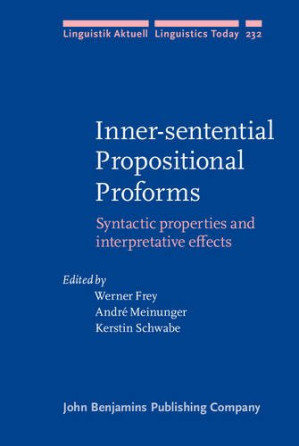
Inner-sentential Propositional Proforms : Syntactic Properties and Interpretative Effects 🔍
Werner Frey, André Meinunger, Kerstin Schwabe,John Benjamins Publishing Company
John Benjamins Publishing Company, Linguistik Aktuell/Linguistics Today, Linguistik Aktuell/Linguistics Today, 232, 2016
英语 [en] · PDF · 2.1MB · 2016 · 📘 非小说类图书 · 🚀/duxiu/lgli/lgrs/nexusstc/upload/zlib · Save
描述
This book deals with sentential proforms and their relationship to their associated clauses. Sentential proforms are highly interesting from the point of view of grammatical theory, since their occurrence is determined not only by syntax, but also by prosody and semantics. The present volume contributes to a better understanding of the interfaces between these different levels. By providing syntactic, prosodic, semantic, psycholinguistic and corpus-based support, this book underpins the claim that there exist different sentential proform types in German and Dutch, that these proform types correlate with different verb classes, and that their associated related clauses are located in different syntactic positions. The present volume also looks at a Hungarian sentential proform construction, which is similar to the German(ic) structure, but, at the same time, is different in its licensing conditions.
备用文件名
nexusstc/Inner-sentential Propositional Proforms: Syntactic properties and interpretative effects/9cbfb5650c91058469e91d4a056f69ec.pdf
备用文件名
lgli/Inner-sentential Propositional Proforms 978 90 272 5715 4.pdf
备用文件名
lgrsnf/Inner-sentential Propositional Proforms 978 90 272 5715 4.pdf
备用文件名
zlib/Languages/Grammar, dictionaries & phrasebooks/Werner Frey, André Meinunger, Kerstin Schwabe/Inner-sentential Propositional Proforms: Syntactic properties and interpretative effects_2855666.pdf
备选标题
Inner-sentential Propositional Proforms (Linguistik Aktuell/Linguistics Today)
备选作者
Frey, Werner (editor);Meinunger, André (editor);Schwabe, Kerstin (editor)
备选作者
Werner Frey (German linguist); André Meinunger; Kerstin Schwabe
备用出版商
Benjamins Publishing Company, John
备用版本
Linguistik Aktuell/Linguistics Today, Amsterdam, 2016
备用版本
Linguistik Aktuell/Linguistics Today, vol. 232, 2016
备用版本
Linguistik aktuell, volume 232, Amsterdam, 2016
备用版本
John Benjamins Publishing Co., Amsterdam, 2016
备用版本
John Benjamins Publishing Company
备用版本
Netherlands, Netherlands
备用版本
UK ed., PS, 2016
备用版本
2016 jul 11
元数据中的注释
0
元数据中的注释
lg1612669
元数据中的注释
{"container_title":"Linguistik Aktuell/Linguistics Today","isbns":["9027257159","9027266948","9789027257154","9789027266941"],"issns":["0166-0829"],"last_page":284,"publisher":"John Benjamins Publishing Company","series":"Linguistik Aktuell/Linguistics Today","volume":"232"}
备用描述
Inner-sentential Propositional Proforms 2
Editorial page 3
Title page 4
LCC data 5
Table of contents 6
Sentential proforms 8
1. The outset 8
2. Recent approaches to sentential proforms and relating clauses 10
2.1 Es-proforms 10
2.1.1 Hybrid approaches 11
2.1.2 Uniform approaches 12
2.1.3 Relationship between es-items and relating clauses 12
2.2 Prepositional correlates (ProPPs) 13
2.2.1 Hybrid approaches 14
2.2.2 Uniform approaches 15
2.2.3 Relationship between ProPPs and relating clauses 16
3. Longstanding questions and new contributions 16
3.1 Correlates and pro-forms 16
3.2 Complex DP- and PP-shells and the position of the related clause 17
3.3 Missing sentential proforms 18
3.4 Influence of sentential proforms on the sentence meaning 19
3.5 Difference between es- and das-proforms 20
3.6 Proforms and corresponding complex nouns 20
3.7 Lexical entries for sentential proforms 20
3.8 Crosslinguistic variation 21
4. The chapters 22
4.1 Theoretical and empirical arguments in favor of the hybrid approach 23
4.2 Special topics of proform constructions 25
References 26
Correlates of object clauses in German and Dutch 30
1. Introduction 30
2. Correlate-es in German 31
3. Correlate-es as an expletive? 33
4. Syntactic properties of correlate-es 33
5. Types of matrix verbs 40
6. Information structure 45
7. Dutch 50
8. Summary and open questions 53
References 53
Correlative es vs. das in German 56
1. Introduction 56
2. The correlative elements es/das in constructions with
argument clauses 57
2.1 Grammatical differences between es and das 57
2.2 Verb-class dependency 59
3. Experimental evidence for the distinction between placeholders and pro-forms 61
3.1 Acceptability ratings of es vs. das (Experiment 1) 62
3.1.1 Material 63
3.1.2 Procedure 64
3.1.3 Participants 64
3.1.4 Results and discussion 64
3.2 Es vs. das in a self-paced reading study (Experiment 2) 66
3.2.1 Material 66
3.2.2 Procedure 66
3.2.3 Participants 66
3.2.4 Results and discussion 66
4. The distinction between placeholder-es- and non-placeholder-es-taking verbs: Combining corpus and experimental evidence 68
4.1 Corpus study 69
4.1.1 Procedure 69
4.1.2 Results and discussion 70
4.2 An acceptability rating experiment on the verb-class-dependent use of placeholder es vs. anaphoric es (Experiment 3) 73
4.2.1 Material and procedure 73
4.2.2 Participants 74
4.2.3 Results and discussion 75
5. Summary 76
References 77
Appendix 78
On properties differentiating constructions with inner-sentential pro-forms for clauses 80
1. Various constructions with an inner-sentential clausal pro-form 80
2. The construction of the bedauern-class 83
3. The construction of the behaupten-class 90
4. The constructions with a prepositional adverb 94
5. The construction of the überraschen-class 101
6. Overview of the observed characteristics of the five constructions 105
7. The possibility of root phenomena in the dependent clause 106
8. Summary 108
References 109
Some distinctions in the right periphery of the German clause* 112
0. Introduction 112
1. A prosodic distinction between extraposition and right dislocation 113
1.1 Default stress in German 113
1.2 The prosodic effects of focus and of givenness 115
1.3 A prosodic distinction between extraposition and right dislocation/afterthought 116
1.4 An information structure distinction between extraposition and right dislocation/afterthought 120
2. On the prosody of correlate constructions in German 123
2.1 PPs with da- 123
2.2 Right dislocation of clauses 124
2.3 Genuine correlates 126
2.4 Coindexed subject expletives 128
3. Analysis of the distinctions in prosody and information structure between extraposition, right dislocation, and afterthought 130
3.1 A deletion account of right dislocation and afterthought 130
3.2 Root sentences, sentence stress, and focus 133
3.3 Analysis of extraposition, RD, and AT 141
3.4 On the interaction of stress-assignment and deletion in RD and AT 143
4. Summary 147
References 148
Phonological, morphosyntactic and semantic properties of es 154
1. Introduction 154
2. Basic assumptions 157
3. Lexical entries 158
3.1 Positional es 159
3.2 Quasi-argument es 159
3.3 “Anaphoric” pronouns and pro-forms es, dessen, dem, das, da(r) 159
Anchor 91 160
3.4 The related item of anaphoric pronouns and pro-forms 161
3.5 The correlate es and its suppletive forms 163
4. Right dislocation vs. extraposition 166
5. Matrix-predicate types 168
6. Complex anaphoric and cataphoric DPs 170
7. Concluding remarks 174
References 175
On the formation of prepositional adverbs in Modern German 178
1. Introduction 178
2. The adverbial basis 183
3. The prepositional bases 185
3.1 ‘Below a location (static)’ 189
3.2 ‘Below a location (dynamic)’ 193
3.3 ‘Below a degree (static)’ 195
3.4 ‘Below a degree (dynamic)’ 196
3.5 ‘Identifiable by a linguistic or conceptual unit (static)’ 196
3.6 ‘Identifiable by a linguistic or conceptual unit (dynamic)’ 198
3.7 ‘Under a location (static)’ 198
3.8 ‘Under a location (dynamic)’ 200
3.9 ‘Caused by a burdening state of affairs’ 201
3.10 ‘Among a multitude (static)’ 203
3.11 ‘Among a multitude (dynamic)’ 204
4. The prepositional adverbs 204
4.1 ‘Below a location there (static)’ 207
4.2 ‘Caused by a burdening state of affairs there’ 211
4.3 ‘Among a multitude there (static)’ 212
5. Results 212
References 214
List of sources 216
Sentential proforms and argument conditionals 218
1. Introduction 218
2. Syntactic remarks on proforms and argument wenn-clauses 220
2.1 Construction types 220
2.2 Adverbial approach or complement approach 222
2.2.1 Pre-sentential argument wenn-clauses 223
2.2.2 Post-sentential argument wenn-clauses 225
2.2.3 Question-answer pairs and argument wenn-clauses 228
2.3 Proforms of pre- and post-sentential wenn-clauses 230
3. Syntactic structure of constructions with argument wenn-clauses 232
3.1 Pre-sentential argument wenn-clauses 233
3.2 Post-sentential argument wenn-clauses 235
3.3 Missing proforms 238
4. Conclusion 243
References 244
Rethinking clausal asymmetries 248
1. Introduction 248
2. The data: Propositional pronoun insertion in Hungarian 250
3. The syntax of pronoun insertion 252
3.1 The EF-analysis: The role of SpecCP 254
4. On the notion of predicationality 256
4.1 Predication vs. assertion 256
4.2 Predicational vs. non-predicational complements 259
5. The Predicationality Hypothesis 261
5.1 Pronoun insertion and predicationality 262
5.2 Summary 265
6. Information-structural consequences 266
6.1 Propositional (cataphoric) pronoun – Focusing 266
6.2 Propositional (anaphoric) pronoun – Backgrounding 268
6.3 Summary 270
7. Supporting evidence 270
7.1 Wh-expletives – Asymmetry 270
7.2 Extraction data – No asymmetry 271
8. Concluding remarks 273
References 274
Name Index 278
Subject Index 280
Editorial page 3
Title page 4
LCC data 5
Table of contents 6
Sentential proforms 8
1. The outset 8
2. Recent approaches to sentential proforms and relating clauses 10
2.1 Es-proforms 10
2.1.1 Hybrid approaches 11
2.1.2 Uniform approaches 12
2.1.3 Relationship between es-items and relating clauses 12
2.2 Prepositional correlates (ProPPs) 13
2.2.1 Hybrid approaches 14
2.2.2 Uniform approaches 15
2.2.3 Relationship between ProPPs and relating clauses 16
3. Longstanding questions and new contributions 16
3.1 Correlates and pro-forms 16
3.2 Complex DP- and PP-shells and the position of the related clause 17
3.3 Missing sentential proforms 18
3.4 Influence of sentential proforms on the sentence meaning 19
3.5 Difference between es- and das-proforms 20
3.6 Proforms and corresponding complex nouns 20
3.7 Lexical entries for sentential proforms 20
3.8 Crosslinguistic variation 21
4. The chapters 22
4.1 Theoretical and empirical arguments in favor of the hybrid approach 23
4.2 Special topics of proform constructions 25
References 26
Correlates of object clauses in German and Dutch 30
1. Introduction 30
2. Correlate-es in German 31
3. Correlate-es as an expletive? 33
4. Syntactic properties of correlate-es 33
5. Types of matrix verbs 40
6. Information structure 45
7. Dutch 50
8. Summary and open questions 53
References 53
Correlative es vs. das in German 56
1. Introduction 56
2. The correlative elements es/das in constructions with
argument clauses 57
2.1 Grammatical differences between es and das 57
2.2 Verb-class dependency 59
3. Experimental evidence for the distinction between placeholders and pro-forms 61
3.1 Acceptability ratings of es vs. das (Experiment 1) 62
3.1.1 Material 63
3.1.2 Procedure 64
3.1.3 Participants 64
3.1.4 Results and discussion 64
3.2 Es vs. das in a self-paced reading study (Experiment 2) 66
3.2.1 Material 66
3.2.2 Procedure 66
3.2.3 Participants 66
3.2.4 Results and discussion 66
4. The distinction between placeholder-es- and non-placeholder-es-taking verbs: Combining corpus and experimental evidence 68
4.1 Corpus study 69
4.1.1 Procedure 69
4.1.2 Results and discussion 70
4.2 An acceptability rating experiment on the verb-class-dependent use of placeholder es vs. anaphoric es (Experiment 3) 73
4.2.1 Material and procedure 73
4.2.2 Participants 74
4.2.3 Results and discussion 75
5. Summary 76
References 77
Appendix 78
On properties differentiating constructions with inner-sentential pro-forms for clauses 80
1. Various constructions with an inner-sentential clausal pro-form 80
2. The construction of the bedauern-class 83
3. The construction of the behaupten-class 90
4. The constructions with a prepositional adverb 94
5. The construction of the überraschen-class 101
6. Overview of the observed characteristics of the five constructions 105
7. The possibility of root phenomena in the dependent clause 106
8. Summary 108
References 109
Some distinctions in the right periphery of the German clause* 112
0. Introduction 112
1. A prosodic distinction between extraposition and right dislocation 113
1.1 Default stress in German 113
1.2 The prosodic effects of focus and of givenness 115
1.3 A prosodic distinction between extraposition and right dislocation/afterthought 116
1.4 An information structure distinction between extraposition and right dislocation/afterthought 120
2. On the prosody of correlate constructions in German 123
2.1 PPs with da- 123
2.2 Right dislocation of clauses 124
2.3 Genuine correlates 126
2.4 Coindexed subject expletives 128
3. Analysis of the distinctions in prosody and information structure between extraposition, right dislocation, and afterthought 130
3.1 A deletion account of right dislocation and afterthought 130
3.2 Root sentences, sentence stress, and focus 133
3.3 Analysis of extraposition, RD, and AT 141
3.4 On the interaction of stress-assignment and deletion in RD and AT 143
4. Summary 147
References 148
Phonological, morphosyntactic and semantic properties of es 154
1. Introduction 154
2. Basic assumptions 157
3. Lexical entries 158
3.1 Positional es 159
3.2 Quasi-argument es 159
3.3 “Anaphoric” pronouns and pro-forms es, dessen, dem, das, da(r) 159
Anchor 91 160
3.4 The related item of anaphoric pronouns and pro-forms 161
3.5 The correlate es and its suppletive forms 163
4. Right dislocation vs. extraposition 166
5. Matrix-predicate types 168
6. Complex anaphoric and cataphoric DPs 170
7. Concluding remarks 174
References 175
On the formation of prepositional adverbs in Modern German 178
1. Introduction 178
2. The adverbial basis 183
3. The prepositional bases 185
3.1 ‘Below a location (static)’ 189
3.2 ‘Below a location (dynamic)’ 193
3.3 ‘Below a degree (static)’ 195
3.4 ‘Below a degree (dynamic)’ 196
3.5 ‘Identifiable by a linguistic or conceptual unit (static)’ 196
3.6 ‘Identifiable by a linguistic or conceptual unit (dynamic)’ 198
3.7 ‘Under a location (static)’ 198
3.8 ‘Under a location (dynamic)’ 200
3.9 ‘Caused by a burdening state of affairs’ 201
3.10 ‘Among a multitude (static)’ 203
3.11 ‘Among a multitude (dynamic)’ 204
4. The prepositional adverbs 204
4.1 ‘Below a location there (static)’ 207
4.2 ‘Caused by a burdening state of affairs there’ 211
4.3 ‘Among a multitude there (static)’ 212
5. Results 212
References 214
List of sources 216
Sentential proforms and argument conditionals 218
1. Introduction 218
2. Syntactic remarks on proforms and argument wenn-clauses 220
2.1 Construction types 220
2.2 Adverbial approach or complement approach 222
2.2.1 Pre-sentential argument wenn-clauses 223
2.2.2 Post-sentential argument wenn-clauses 225
2.2.3 Question-answer pairs and argument wenn-clauses 228
2.3 Proforms of pre- and post-sentential wenn-clauses 230
3. Syntactic structure of constructions with argument wenn-clauses 232
3.1 Pre-sentential argument wenn-clauses 233
3.2 Post-sentential argument wenn-clauses 235
3.3 Missing proforms 238
4. Conclusion 243
References 244
Rethinking clausal asymmetries 248
1. Introduction 248
2. The data: Propositional pronoun insertion in Hungarian 250
3. The syntax of pronoun insertion 252
3.1 The EF-analysis: The role of SpecCP 254
4. On the notion of predicationality 256
4.1 Predication vs. assertion 256
4.2 Predicational vs. non-predicational complements 259
5. The Predicationality Hypothesis 261
5.1 Pronoun insertion and predicationality 262
5.2 Summary 265
6. Information-structural consequences 266
6.1 Propositional (cataphoric) pronoun – Focusing 266
6.2 Propositional (anaphoric) pronoun – Backgrounding 268
6.3 Summary 270
7. Supporting evidence 270
7.1 Wh-expletives – Asymmetry 270
7.2 Extraction data – No asymmetry 271
8. Concluding remarks 273
References 274
Name Index 278
Subject Index 280
开源日期
2017-01-16
🚀 快速下载
成为会员以支持书籍、论文等的长期保存。为了感谢您对我们的支持,您将获得高速下载权益。❤️
如果您在本月捐款,您将获得双倍的快速下载次数。
🐢 低速下载
由可信的合作方提供。 更多信息请参见常见问题解答。 (可能需要验证浏览器——无限次下载!)
- 低速服务器(合作方提供) #1 (稍快但需要排队)
- 低速服务器(合作方提供) #2 (稍快但需要排队)
- 低速服务器(合作方提供) #3 (稍快但需要排队)
- 低速服务器(合作方提供) #4 (稍快但需要排队)
- 低速服务器(合作方提供) #5 (无需排队,但可能非常慢)
- 低速服务器(合作方提供) #6 (无需排队,但可能非常慢)
- 低速服务器(合作方提供) #7 (无需排队,但可能非常慢)
- 低速服务器(合作方提供) #8 (无需排队,但可能非常慢)
- 低速服务器(合作方提供) #9 (无需排队,但可能非常慢)
- 下载后: 在我们的查看器中打开
所有选项下载的文件都相同,应该可以安全使用。即使这样,从互联网下载文件时始终要小心。例如,确保您的设备更新及时。
外部下载
-
对于大文件,我们建议使用下载管理器以防止中断。
推荐的下载管理器:JDownloader -
您将需要一个电子书或 PDF 阅读器来打开文件,具体取决于文件格式。
推荐的电子书阅读器:Anna的档案在线查看器、ReadEra和Calibre -
使用在线工具进行格式转换。
推荐的转换工具:CloudConvert和PrintFriendly -
您可以将 PDF 和 EPUB 文件发送到您的 Kindle 或 Kobo 电子阅读器。
推荐的工具:亚马逊的“发送到 Kindle”和djazz 的“发送到 Kobo/Kindle” -
支持作者和图书馆
✍️ 如果您喜欢这个并且能够负担得起,请考虑购买原版,或直接支持作者。
📚 如果您当地的图书馆有这本书,请考虑在那里免费借阅。
下面的文字仅以英文继续。
总下载量:
“文件的MD5”是根据文件内容计算出的哈希值,并且基于该内容具有相当的唯一性。我们这里索引的所有影子图书馆都主要使用MD5来标识文件。
一个文件可能会出现在多个影子图书馆中。有关我们编译的各种数据集的信息,请参见数据集页面。
有关此文件的详细信息,请查看其JSON 文件。 Live/debug JSON version. Live/debug page.