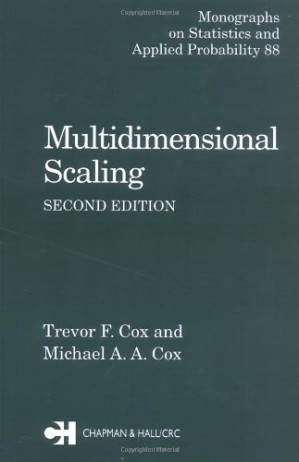
upload/misc_2025_10/1kU41Zi4WnhIGXbP9wH8/59) Multidimensional Scaling by Trevor F. Cox, Michael A. A. Cox.pdf
Multidimensional Scaling, Second Edition 🔍
Trevor F. Cox, Michael A. A. Cox
Chapman and Hall\/CRC, Monographs on Statistics and Applied Probability, 2, 2000
英语 [en] · PDF · 13.6MB · 2000 · 📘 非小说类图书 · 🚀/lgli/lgrs/nexusstc/upload/zlib · Save
描述
Multidimensional scaling covers a variety of statistical techniques in the area of multivariate data analysis. Geared toward dimensional reduction and graphical representation of data, it arose within the field of the behavioral sciences, but now holds techniques widely used in many disciplines. Multidimensional Scaling, Second Edition extends the popular first edition and brings it up to date. It concisely but comprehensively covers the area, summarizing the mathematical ideas behind the various techniques and illustrating the techniques with real-life examples. A computer disk containing programs and data sets accompanies the book.
Booknews University of Newcastle Upon Tyne scholars Trevor (statistics) and Michael (business management) review a wide range of topics relating to multidimensional scaling, which covers a variety of statistical techniques with multivariate data analysis, and is spreading from its origin in the behavioral sciences to applications in many disciplines. They do not note a date for the first edition, but here extend it with recent references, a new chapter on biplots, a section on the Gifi system of nonlinear multivariate analysis, and an extended version of the suite of computer programs. They assume readers have a background in statistics. The disk, for DOS or Windows, contains programs and data sets for hands-on practice. Annotation c. Book News, Inc., Portland, OR (booknews.com)
Booknews University of Newcastle Upon Tyne scholars Trevor (statistics) and Michael (business management) review a wide range of topics relating to multidimensional scaling, which covers a variety of statistical techniques with multivariate data analysis, and is spreading from its origin in the behavioral sciences to applications in many disciplines. They do not note a date for the first edition, but here extend it with recent references, a new chapter on biplots, a section on the Gifi system of nonlinear multivariate analysis, and an extended version of the suite of computer programs. They assume readers have a background in statistics. The disk, for DOS or Windows, contains programs and data sets for hands-on practice. Annotation c. Book News, Inc., Portland, OR (booknews.com)
备用文件名
lgli/D:\!genesis\library.nu\9c\_313686.9c13751fc2d70d710588b94000dba400.pdf
备用文件名
lgrsnf/D:\!genesis\library.nu\9c\_313686.9c13751fc2d70d710588b94000dba400.pdf
备用文件名
nexusstc/Multidimensional Scaling/9c13751fc2d70d710588b94000dba400.pdf
备用文件名
zlib/Mathematics/Trevor F. Cox, Michael A. A. Cox/Multidimensional Scaling_945959.pdf
备选作者
Trevor F. Cox and Michael A.A. Cox
备选作者
Cox, Trevor F., Cox, M.A.A.
备用出版商
CRC Press LLC
备用版本
Monographs on statistics and applied probability ;, 88, 2nd ed., Boca Raton, Florida, 2001
备用版本
Monographs on statistics and applied probability (Series), 88, 2nd ed, Boca Raton, ©2001
备用版本
United States, United States of America
备用版本
2 edition, September 28, 2000
备用版本
Second Edition, PS, 2000
元数据中的注释
до 2011-01
元数据中的注释
lg521453
元数据中的注释
{"edition":"2","isbns":["1584880945","9781584880943"],"last_page":294,"publisher":"Chapman and Hall\\/CRC","series":"Monographs on Statistics and Applied Probability"}
元数据中的注释
Includes bibliographical references (p. [271]-292) and indexes.
备用描述
Monographs on statistics and applied probability
1
Multidimensional Scaling 4
Copyright 5
Contents 6
Preface 11
CHAPTER 1: Introduction 12
1.1 Introduction 12
1.2 A look at data and models 14
1.2.1 Types of data 14
Nominal scale 14
Ordinal scale 14
Interval scale 15
Ratio scale 15
Number of modes 15
Number of ways 15
1.2.2 Multidimensional scaling models 16
Classical scaling 17
Metric least squares scaling 17
Unidimensional scaling 17
Nonrnetric scaling 18
Procrustes analysis 18
Biplots 18
Unfolding 18
Indvidual differences 19
Gifi 19
1.3 Proximities 19
1.3.1 Similarity/ dissimilarity coefficients for mixed data 25
I.3.2 Distribution of proximity coeficients 29
I.3.3 Similarity of species populations 29
I.3.4 Transforming from similarities to dissimilarities 32
I.3.5 The metric nature of dissimilarities 32
1.3.6 Dissimilarity of variables 33
1.3.7 Similarity measures on fuzzy sets 35
Example 35
Quantitative data 23
Binary data 23
Nominal and ordinal data 23
1.4 Matrix results 36
1.4.1 The spectral decomposition 37
1.4.2 The singular value decomposition 37
An example 38
Generalized SVD 39
1.4.3 The Moore-Penrose inverse 40
CHAPTER 2: Metric multidimensional scaling 41
2.1 Introduction 41
2.2 Classical scaling 41
2.2.1 Recovery of coordinates 42
2.2.2 Dissimilarities as Euclidean distances 44
2.2.3 Classical scaling in practice 46
2.2.4 How many dimensions? 48
2.2.5 A practical algorithm for classical scaling 48
2.2.6 A grave example 49
2.2.7 Classical scaling and principal components 53
Optimal transformations of the variables 54
2.2.8 The additive constant problem 55
2.3 Robustness 59
2.4 Metric least squares scaling 59
Least squares scaling of the skulls 61
Least absolute residuals 62
2.5 Critchley’s intermediate method 62
2.6 Unidimensional scaling 63
2.6.1 A classic example 65
2.7 Grouped dissimilarities 67
2.8 Inverse scaling 68
CHAPTER 3: Nonmetric multidimensional scaling 71
3.1 Introduction 71
A simple example 72
3.1.1 Rp space and the Minkowski metric 73
3.2 Kruskal’s approach 74
3.2.1 Minimising S with respect to the disparities 75
3.2.2 A configuration with minimum stress 78
3.2.3 Kruskal's iterative technique 79
3.2.4 Nonmetric scaling of breakfast cereals 81
3.2.5 STRESS l/2, monotonicity, ties and missing data 83
3.3 The Guttman approach 85
3.4 A further look at stress 86
Differentiability of stress 86
Limits for stress 87
3.4.1 Interpretation of stress 89
3.5 How many dimensions? 98
3.6 Starting configurations 99
3.7 Interesting axes in the configuration 100
CHAPTER 4: Further aspects of rnultidirnensional scaling 103
4.1 Other formulations of MDS 103
4.2 MDS Diagnostics 104
4.3 Robust MDS 106
Robust parameter estimation 106
Robust index of fit 108
4.4 Interactive MDS 108
4.5 Dynamic MDS 109
An example 111
4.6 Constrained MDS 113
4.6.1 Spherical MDS 115
An example 117
4.7 Statistical inference for MDS 117
Asymptotic confidence regions 120
4.8 Asymmetric dissimilarities 126
CHAPTER 5: Procrustes analysis 132
5.1 Introduction 132
5.2 Procrustes analysis 133
Optimal dilation 135
Optimal rotation 135
5.2.1 Procrustes analysis in practice 136
5.2.2 The projection case 138
5.3 Historic maps 139
5.4 Some generalizations 141
5.4.1 Weighted Procrustes rotation 141
5.4.2 Generalized Procrustes analpsis 144
5.4.3 The coefficient of congruence 146
5.4.4 Oblique Procrustes problem 147
5.4.5 Perturbation analysis 148
CHAPTER 6: Monkeys, whisky and other applications 150
6.1 Introduction 150
6.2 Monkeys 150
6.3 Whisky 152
6.4 Aeroplanes 155
6.5 Yoghurts 157
6.6 Bees 158
CHAPTER 7: Biplots 161
7.1 Introduction 161
7.2 The classic biplot 161
7.2.1 An example 162
7.2.2 Principal component biplots 165
7.3 Another approach 167
7.4 Categorical variables 170
CHAPTER 8: Unfolding 172
8.1 Introduction 172
8.2 Nonmetric unidimensional unfolding 173
8.3 Nonmetric multidimensional unfolding 176
8.4 Metric multidimensional unfolding 180
8.4.1 The rating of nations 184
CHAPTER 9: Correspondence analysis 187
9.1 Introduction 187
9.2 Analysis of two- way contingency tables 187
9.2.1 Distances between rows (columns) in a contingency table 190
9.3 The theory of correspondence analysis 191
9.3.1 The cancer example 193
A single plot 196
9.3.2 Inertia 197
9.4 Reciprocal averaging 199
9.4.1 Algorithm for solution 199
9.4.2 An example: the Munsingen data 200
9.4.3 The whisky data 201
9.4.4 The correspondence analysis connection 203
9.4.5 Two-way weighted dissimilarity coefficients 204
9.5 Multiple correspondence analysis 206
9.5.1 A three-way example 208
CHAPTER 10: Individual differences models 210
10.1 Introduction 210
10.2 The Tucker-Messick model 210
10.3 INDSCAL 211
10.3.1 The algorithm for solution 211
Normalization 213
10.3.2 Identifying groundwater populations 213
10.3.3 Extended INDSCAL models 215
10.4 IDIOSCAL 216
INDSCAL 216
Carroll-Chang decomposition of W i 216
Tucker-Harshman decomposition of Wi 217
Tucker’s 3-mode scaling 217
10.5 PINDIS 217
CHAPTER 11: ALSCAL, SMACOF and Gifi 221
11.1 ALSCAL 221
11.1.1 The theory 221
Process restrictions 222
Level constraints 222
Conditionality constraints 223
11.1.2 Minimising SSTRESS 223
The optimal scaling phase 223
Model estimation phase 224
11.2 SMACOF 225
11.2. I The majorization algorithm 226
11.2.2 The majorizing method for nonmetric MDS 229
11.2.3 Tunnelling for a global minimum 230
11.3 Gifi 230
11.3.1 Homogeneity 231
HOMALS 232
CHAPTER 12: Further m-mode, n-way models 237
12.1 CANDECOMP, PARAFAC and CANDELINC 237
12.2 DEDICOM and GIPSCAL 239
12.3 The Tucker models 240
12.3.1 Relataonship to other models 242
12.4 One-mode, n-way models 242
12.5 Two-mode, three-way asymmetric scaling 247
12.6 Three-way unfolding 249
APPENDIX: Computer programs for multidimensional scaling 272
A.l Computer programs 272
A.2 The accompanying CD-ROM 273
Minimum system requirements 273
A.2.1 Installation instructions 274
Windows Users 274
DOS Users 274
A.2.2 Data and output 275
Data provided 275
A.2.3 To run the menu 275
A.2.4 Program descriptions 276
Data manipulation programs 276
MDS techniques 277
Plotting and menus 277
A.3 The data provided 277
The data sets 277
Figures in the text 278
A.4 To manipulate and analyse data 280
Example 1: Classical scaling of the skull data 280
Example 2: Nonmetric MDS of the Kellog data 281
Example 3: Least squares scaling and Procrustes analysis of the Kellog data 282
Example 4: Individual differences scaling of groundwater samples 282
Example 5: Biplot of the Renaissance painters 283
Example 6: Reciprocal Averaging of the Munsingen data 283
A.5 Inputting user data 284
A.5.1 Data format 284
Dissimilarities for Individual Differences Scaling 285
Contingency tables 286
Indicator Matrix 286
A.6 Error messages 287
BIPLOT 287
CLSCAL 287
DAT2TRAN 287
DAT2UNF 287
HISTORY 288
IND2CON 288
INDSCAL 288
LEAST-SQ 288
LINEAR 288
MAT2DISS 289
MDSCAL-2 289
MDSCAL-3 289
MDSCAL-T 289
MDS-INPU 290
MENU 290
MENU-DAT 290
MOVIE-MD 290
NONLIN 290
PROCRUST 291
RAND-CAT 291
RAN-DATS 291
RAN-VECG 291
RECAVDIS 291
RECIPEIG 292
SHEP-PLO 292
THETA-PL 292
UNFOLDIN 292
UNI-SCAL 293
VEC2CSV 293
VEC2DISS 293
VEC2GOWE 293
VECJOIN 293
VEC-PLOT 294
CRC Press Downloads and Updates -1
References 250
Multidimensional Scaling 4
Copyright 5
Contents 6
Preface 11
CHAPTER 1: Introduction 12
1.1 Introduction 12
1.2 A look at data and models 14
1.2.1 Types of data 14
Nominal scale 14
Ordinal scale 14
Interval scale 15
Ratio scale 15
Number of modes 15
Number of ways 15
1.2.2 Multidimensional scaling models 16
Classical scaling 17
Metric least squares scaling 17
Unidimensional scaling 17
Nonrnetric scaling 18
Procrustes analysis 18
Biplots 18
Unfolding 18
Indvidual differences 19
Gifi 19
1.3 Proximities 19
1.3.1 Similarity/ dissimilarity coefficients for mixed data 25
I.3.2 Distribution of proximity coeficients 29
I.3.3 Similarity of species populations 29
I.3.4 Transforming from similarities to dissimilarities 32
I.3.5 The metric nature of dissimilarities 32
1.3.6 Dissimilarity of variables 33
1.3.7 Similarity measures on fuzzy sets 35
Example 35
Quantitative data 23
Binary data 23
Nominal and ordinal data 23
1.4 Matrix results 36
1.4.1 The spectral decomposition 37
1.4.2 The singular value decomposition 37
An example 38
Generalized SVD 39
1.4.3 The Moore-Penrose inverse 40
CHAPTER 2: Metric multidimensional scaling 41
2.1 Introduction 41
2.2 Classical scaling 41
2.2.1 Recovery of coordinates 42
2.2.2 Dissimilarities as Euclidean distances 44
2.2.3 Classical scaling in practice 46
2.2.4 How many dimensions? 48
2.2.5 A practical algorithm for classical scaling 48
2.2.6 A grave example 49
2.2.7 Classical scaling and principal components 53
Optimal transformations of the variables 54
2.2.8 The additive constant problem 55
2.3 Robustness 59
2.4 Metric least squares scaling 59
Least squares scaling of the skulls 61
Least absolute residuals 62
2.5 Critchley’s intermediate method 62
2.6 Unidimensional scaling 63
2.6.1 A classic example 65
2.7 Grouped dissimilarities 67
2.8 Inverse scaling 68
CHAPTER 3: Nonmetric multidimensional scaling 71
3.1 Introduction 71
A simple example 72
3.1.1 Rp space and the Minkowski metric 73
3.2 Kruskal’s approach 74
3.2.1 Minimising S with respect to the disparities 75
3.2.2 A configuration with minimum stress 78
3.2.3 Kruskal's iterative technique 79
3.2.4 Nonmetric scaling of breakfast cereals 81
3.2.5 STRESS l/2, monotonicity, ties and missing data 83
3.3 The Guttman approach 85
3.4 A further look at stress 86
Differentiability of stress 86
Limits for stress 87
3.4.1 Interpretation of stress 89
3.5 How many dimensions? 98
3.6 Starting configurations 99
3.7 Interesting axes in the configuration 100
CHAPTER 4: Further aspects of rnultidirnensional scaling 103
4.1 Other formulations of MDS 103
4.2 MDS Diagnostics 104
4.3 Robust MDS 106
Robust parameter estimation 106
Robust index of fit 108
4.4 Interactive MDS 108
4.5 Dynamic MDS 109
An example 111
4.6 Constrained MDS 113
4.6.1 Spherical MDS 115
An example 117
4.7 Statistical inference for MDS 117
Asymptotic confidence regions 120
4.8 Asymmetric dissimilarities 126
CHAPTER 5: Procrustes analysis 132
5.1 Introduction 132
5.2 Procrustes analysis 133
Optimal dilation 135
Optimal rotation 135
5.2.1 Procrustes analysis in practice 136
5.2.2 The projection case 138
5.3 Historic maps 139
5.4 Some generalizations 141
5.4.1 Weighted Procrustes rotation 141
5.4.2 Generalized Procrustes analpsis 144
5.4.3 The coefficient of congruence 146
5.4.4 Oblique Procrustes problem 147
5.4.5 Perturbation analysis 148
CHAPTER 6: Monkeys, whisky and other applications 150
6.1 Introduction 150
6.2 Monkeys 150
6.3 Whisky 152
6.4 Aeroplanes 155
6.5 Yoghurts 157
6.6 Bees 158
CHAPTER 7: Biplots 161
7.1 Introduction 161
7.2 The classic biplot 161
7.2.1 An example 162
7.2.2 Principal component biplots 165
7.3 Another approach 167
7.4 Categorical variables 170
CHAPTER 8: Unfolding 172
8.1 Introduction 172
8.2 Nonmetric unidimensional unfolding 173
8.3 Nonmetric multidimensional unfolding 176
8.4 Metric multidimensional unfolding 180
8.4.1 The rating of nations 184
CHAPTER 9: Correspondence analysis 187
9.1 Introduction 187
9.2 Analysis of two- way contingency tables 187
9.2.1 Distances between rows (columns) in a contingency table 190
9.3 The theory of correspondence analysis 191
9.3.1 The cancer example 193
A single plot 196
9.3.2 Inertia 197
9.4 Reciprocal averaging 199
9.4.1 Algorithm for solution 199
9.4.2 An example: the Munsingen data 200
9.4.3 The whisky data 201
9.4.4 The correspondence analysis connection 203
9.4.5 Two-way weighted dissimilarity coefficients 204
9.5 Multiple correspondence analysis 206
9.5.1 A three-way example 208
CHAPTER 10: Individual differences models 210
10.1 Introduction 210
10.2 The Tucker-Messick model 210
10.3 INDSCAL 211
10.3.1 The algorithm for solution 211
Normalization 213
10.3.2 Identifying groundwater populations 213
10.3.3 Extended INDSCAL models 215
10.4 IDIOSCAL 216
INDSCAL 216
Carroll-Chang decomposition of W i 216
Tucker-Harshman decomposition of Wi 217
Tucker’s 3-mode scaling 217
10.5 PINDIS 217
CHAPTER 11: ALSCAL, SMACOF and Gifi 221
11.1 ALSCAL 221
11.1.1 The theory 221
Process restrictions 222
Level constraints 222
Conditionality constraints 223
11.1.2 Minimising SSTRESS 223
The optimal scaling phase 223
Model estimation phase 224
11.2 SMACOF 225
11.2. I The majorization algorithm 226
11.2.2 The majorizing method for nonmetric MDS 229
11.2.3 Tunnelling for a global minimum 230
11.3 Gifi 230
11.3.1 Homogeneity 231
HOMALS 232
CHAPTER 12: Further m-mode, n-way models 237
12.1 CANDECOMP, PARAFAC and CANDELINC 237
12.2 DEDICOM and GIPSCAL 239
12.3 The Tucker models 240
12.3.1 Relataonship to other models 242
12.4 One-mode, n-way models 242
12.5 Two-mode, three-way asymmetric scaling 247
12.6 Three-way unfolding 249
APPENDIX: Computer programs for multidimensional scaling 272
A.l Computer programs 272
A.2 The accompanying CD-ROM 273
Minimum system requirements 273
A.2.1 Installation instructions 274
Windows Users 274
DOS Users 274
A.2.2 Data and output 275
Data provided 275
A.2.3 To run the menu 275
A.2.4 Program descriptions 276
Data manipulation programs 276
MDS techniques 277
Plotting and menus 277
A.3 The data provided 277
The data sets 277
Figures in the text 278
A.4 To manipulate and analyse data 280
Example 1: Classical scaling of the skull data 280
Example 2: Nonmetric MDS of the Kellog data 281
Example 3: Least squares scaling and Procrustes analysis of the Kellog data 282
Example 4: Individual differences scaling of groundwater samples 282
Example 5: Biplot of the Renaissance painters 283
Example 6: Reciprocal Averaging of the Munsingen data 283
A.5 Inputting user data 284
A.5.1 Data format 284
Dissimilarities for Individual Differences Scaling 285
Contingency tables 286
Indicator Matrix 286
A.6 Error messages 287
BIPLOT 287
CLSCAL 287
DAT2TRAN 287
DAT2UNF 287
HISTORY 288
IND2CON 288
INDSCAL 288
LEAST-SQ 288
LINEAR 288
MAT2DISS 289
MDSCAL-2 289
MDSCAL-3 289
MDSCAL-T 289
MDS-INPU 290
MENU 290
MENU-DAT 290
MOVIE-MD 290
NONLIN 290
PROCRUST 291
RAND-CAT 291
RAN-DATS 291
RAN-VECG 291
RECAVDIS 291
RECIPEIG 292
SHEP-PLO 292
THETA-PL 292
UNFOLDIN 292
UNI-SCAL 293
VEC2CSV 293
VEC2DISS 293
VEC2GOWE 293
VECJOIN 293
VEC-PLOT 294
CRC Press Downloads and Updates -1
References 250
备用描述
Monographs on statistics and applied probability
......Page 1
Multidimensional Scaling......Page 4
Copyright ......Page 5
Contents......Page 6
Preface......Page 11
1.1 Introduction......Page 12
Ordinal scale......Page 14
Number of ways......Page 15
1.2.2 Multidimensional scaling models......Page 16
Unidimensional scaling......Page 17
Unfolding......Page 18
1.3 Proximities......Page 19
1.3.1 Similarity/ dissimilarity coefficients for mixed data......Page 25
I.3.3 Similarity of species populations......Page 29
I.3.5 The metric nature of dissimilarities......Page 32
1.3.6 Dissimilarity of variables......Page 33
Example......Page 35
Nominal and ordinal data......Page 23
1.4 Matrix results......Page 36
1.4.2 The singular value decomposition......Page 37
An example......Page 38
Generalized SVD......Page 39
1.4.3 The Moore-Penrose inverse......Page 40
2.2 Classical scaling......Page 41
2.2.1 Recovery of coordinates......Page 42
2.2.2 Dissimilarities as Euclidean distances......Page 44
2.2.3 Classical scaling in practice......Page 46
2.2.5 A practical algorithm for classical scaling......Page 48
2.2.6 A grave example......Page 49
2.2.7 Classical scaling and principal components......Page 53
Optimal transformations of the variables......Page 54
2.2.8 The additive constant problem......Page 55
2.4 Metric least squares scaling......Page 59
Least squares scaling of the skulls......Page 61
2.5 Critchley’s intermediate method......Page 62
2.6 Unidimensional scaling......Page 63
2.6.1 A classic example......Page 65
2.7 Grouped dissimilarities......Page 67
2.8 Inverse scaling......Page 68
3.1 Introduction......Page 71
A simple example......Page 72
3.1.1 Rp space and the Minkowski metric......Page 73
3.2 Kruskal’s approach......Page 74
3.2.1 Minimising S with respect to the disparities......Page 75
3.2.2 A configuration with minimum stress......Page 78
3.2.3 Kruskal's iterative technique......Page 79
3.2.4 Nonmetric scaling of breakfast cereals......Page 81
3.2.5 STRESS l/2, monotonicity, ties and missing data......Page 83
3.3 The Guttman approach......Page 85
Differentiability of stress......Page 86
Limits for stress......Page 87
3.4.1 Interpretation of stress......Page 89
3.5 How many dimensions?......Page 98
3.6 Starting configurations......Page 99
3.7 Interesting axes in the configuration......Page 100
4.1 Other formulations of MDS......Page 103
4.2 MDS Diagnostics......Page 104
Robust parameter estimation......Page 106
4.4 Interactive MDS......Page 108
4.5 Dynamic MDS......Page 109
An example......Page 111
4.6 Constrained MDS......Page 113
4.6.1 Spherical MDS......Page 115
4.7 Statistical inference for MDS......Page 117
Asymptotic confidence regions......Page 120
4.8 Asymmetric dissimilarities......Page 126
5.1 Introduction......Page 132
5.2 Procrustes analysis......Page 133
Optimal rotation......Page 135
5.2.1 Procrustes analysis in practice......Page 136
5.2.2 The projection case......Page 138
5.3 Historic maps......Page 139
5.4.1 Weighted Procrustes rotation......Page 141
5.4.2 Generalized Procrustes analpsis......Page 144
5.4.3 The coefficient of congruence......Page 146
5.4.4 Oblique Procrustes problem......Page 147
5.4.5 Perturbation analysis......Page 148
6.2 Monkeys......Page 150
6.3 Whisky......Page 152
6.4 Aeroplanes......Page 155
6.5 Yoghurts......Page 157
6.6 Bees......Page 158
7.2 The classic biplot......Page 161
7.2.1 An example......Page 162
7.2.2 Principal component biplots......Page 165
7.3 Another approach......Page 167
7.4 Categorical variables......Page 170
8.1 Introduction......Page 172
8.2 Nonmetric unidimensional unfolding......Page 173
8.3 Nonmetric multidimensional unfolding......Page 176
8.4 Metric multidimensional unfolding......Page 180
8.4.1 The rating of nations......Page 184
9.2 Analysis of two- way contingency tables......Page 187
9.2.1 Distances between rows (columns) in a contingency table......Page 190
9.3 The theory of correspondence analysis......Page 191
9.3.1 The cancer example......Page 193
A single plot......Page 196
9.3.2 Inertia......Page 197
9.4.1 Algorithm for solution......Page 199
9.4.2 An example: the Munsingen data......Page 200
9.4.3 The whisky data......Page 201
9.4.4 The correspondence analysis connection......Page 203
9.4.5 Two-way weighted dissimilarity coefficients......Page 204
9.5 Multiple correspondence analysis......Page 206
9.5.1 A three-way example......Page 208
10.2 The Tucker-Messick model......Page 210
10.3.1 The algorithm for solution......Page 211
10.3.2 Identifying groundwater populations......Page 213
10.3.3 Extended INDSCAL models......Page 215
Carroll-Chang decomposition of W i......Page 216
10.5 PINDIS......Page 217
11.1.1 The theory......Page 221
Level constraints......Page 222
The optimal scaling phase......Page 223
Model estimation phase......Page 224
11.2 SMACOF......Page 225
11.2. I The majorization algorithm......Page 226
11.2.2 The majorizing method for nonmetric MDS......Page 229
11.3 Gifi......Page 230
11.3.1 Homogeneity......Page 231
HOMALS......Page 232
12.1 CANDECOMP, PARAFAC and CANDELINC......Page 237
12.2 DEDICOM and GIPSCAL......Page 239
12.3 The Tucker models......Page 240
12.4 One-mode, n-way models......Page 242
12.5 Two-mode, three-way asymmetric scaling......Page 247
12.6 Three-way unfolding......Page 249
A.l Computer programs......Page 272
Minimum system requirements......Page 273
DOS Users......Page 274
A.2.3 To run the menu......Page 275
Data manipulation programs......Page 276
The data sets......Page 277
Figures in the text......Page 278
Example 1: Classical scaling of the skull data......Page 280
Example 2: Nonmetric MDS of the Kellog data......Page 281
Example 4: Individual differences scaling of groundwater samples......Page 282
Example 6: Reciprocal Averaging of the Munsingen data......Page 283
A.5.1 Data format......Page 284
Dissimilarities for Individual Differences Scaling......Page 285
Indicator Matrix......Page 286
DAT2UNF......Page 287
LINEAR......Page 288
MDSCAL-T......Page 289
NONLIN......Page 290
RECAVDIS......Page 291
UNFOLDIN......Page 292
VECJOIN......Page 293
VEC-PLOT......Page 294
CRC Press Downloads and Updates......Page 0
References......Page 250
Multidimensional Scaling......Page 4
Copyright ......Page 5
Contents......Page 6
Preface......Page 11
1.1 Introduction......Page 12
Ordinal scale......Page 14
Number of ways......Page 15
1.2.2 Multidimensional scaling models......Page 16
Unidimensional scaling......Page 17
Unfolding......Page 18
1.3 Proximities......Page 19
1.3.1 Similarity/ dissimilarity coefficients for mixed data......Page 25
I.3.3 Similarity of species populations......Page 29
I.3.5 The metric nature of dissimilarities......Page 32
1.3.6 Dissimilarity of variables......Page 33
Example......Page 35
Nominal and ordinal data......Page 23
1.4 Matrix results......Page 36
1.4.2 The singular value decomposition......Page 37
An example......Page 38
Generalized SVD......Page 39
1.4.3 The Moore-Penrose inverse......Page 40
2.2 Classical scaling......Page 41
2.2.1 Recovery of coordinates......Page 42
2.2.2 Dissimilarities as Euclidean distances......Page 44
2.2.3 Classical scaling in practice......Page 46
2.2.5 A practical algorithm for classical scaling......Page 48
2.2.6 A grave example......Page 49
2.2.7 Classical scaling and principal components......Page 53
Optimal transformations of the variables......Page 54
2.2.8 The additive constant problem......Page 55
2.4 Metric least squares scaling......Page 59
Least squares scaling of the skulls......Page 61
2.5 Critchley’s intermediate method......Page 62
2.6 Unidimensional scaling......Page 63
2.6.1 A classic example......Page 65
2.7 Grouped dissimilarities......Page 67
2.8 Inverse scaling......Page 68
3.1 Introduction......Page 71
A simple example......Page 72
3.1.1 Rp space and the Minkowski metric......Page 73
3.2 Kruskal’s approach......Page 74
3.2.1 Minimising S with respect to the disparities......Page 75
3.2.2 A configuration with minimum stress......Page 78
3.2.3 Kruskal's iterative technique......Page 79
3.2.4 Nonmetric scaling of breakfast cereals......Page 81
3.2.5 STRESS l/2, monotonicity, ties and missing data......Page 83
3.3 The Guttman approach......Page 85
Differentiability of stress......Page 86
Limits for stress......Page 87
3.4.1 Interpretation of stress......Page 89
3.5 How many dimensions?......Page 98
3.6 Starting configurations......Page 99
3.7 Interesting axes in the configuration......Page 100
4.1 Other formulations of MDS......Page 103
4.2 MDS Diagnostics......Page 104
Robust parameter estimation......Page 106
4.4 Interactive MDS......Page 108
4.5 Dynamic MDS......Page 109
An example......Page 111
4.6 Constrained MDS......Page 113
4.6.1 Spherical MDS......Page 115
4.7 Statistical inference for MDS......Page 117
Asymptotic confidence regions......Page 120
4.8 Asymmetric dissimilarities......Page 126
5.1 Introduction......Page 132
5.2 Procrustes analysis......Page 133
Optimal rotation......Page 135
5.2.1 Procrustes analysis in practice......Page 136
5.2.2 The projection case......Page 138
5.3 Historic maps......Page 139
5.4.1 Weighted Procrustes rotation......Page 141
5.4.2 Generalized Procrustes analpsis......Page 144
5.4.3 The coefficient of congruence......Page 146
5.4.4 Oblique Procrustes problem......Page 147
5.4.5 Perturbation analysis......Page 148
6.2 Monkeys......Page 150
6.3 Whisky......Page 152
6.4 Aeroplanes......Page 155
6.5 Yoghurts......Page 157
6.6 Bees......Page 158
7.2 The classic biplot......Page 161
7.2.1 An example......Page 162
7.2.2 Principal component biplots......Page 165
7.3 Another approach......Page 167
7.4 Categorical variables......Page 170
8.1 Introduction......Page 172
8.2 Nonmetric unidimensional unfolding......Page 173
8.3 Nonmetric multidimensional unfolding......Page 176
8.4 Metric multidimensional unfolding......Page 180
8.4.1 The rating of nations......Page 184
9.2 Analysis of two- way contingency tables......Page 187
9.2.1 Distances between rows (columns) in a contingency table......Page 190
9.3 The theory of correspondence analysis......Page 191
9.3.1 The cancer example......Page 193
A single plot......Page 196
9.3.2 Inertia......Page 197
9.4.1 Algorithm for solution......Page 199
9.4.2 An example: the Munsingen data......Page 200
9.4.3 The whisky data......Page 201
9.4.4 The correspondence analysis connection......Page 203
9.4.5 Two-way weighted dissimilarity coefficients......Page 204
9.5 Multiple correspondence analysis......Page 206
9.5.1 A three-way example......Page 208
10.2 The Tucker-Messick model......Page 210
10.3.1 The algorithm for solution......Page 211
10.3.2 Identifying groundwater populations......Page 213
10.3.3 Extended INDSCAL models......Page 215
Carroll-Chang decomposition of W i......Page 216
10.5 PINDIS......Page 217
11.1.1 The theory......Page 221
Level constraints......Page 222
The optimal scaling phase......Page 223
Model estimation phase......Page 224
11.2 SMACOF......Page 225
11.2. I The majorization algorithm......Page 226
11.2.2 The majorizing method for nonmetric MDS......Page 229
11.3 Gifi......Page 230
11.3.1 Homogeneity......Page 231
HOMALS......Page 232
12.1 CANDECOMP, PARAFAC and CANDELINC......Page 237
12.2 DEDICOM and GIPSCAL......Page 239
12.3 The Tucker models......Page 240
12.4 One-mode, n-way models......Page 242
12.5 Two-mode, three-way asymmetric scaling......Page 247
12.6 Three-way unfolding......Page 249
A.l Computer programs......Page 272
Minimum system requirements......Page 273
DOS Users......Page 274
A.2.3 To run the menu......Page 275
Data manipulation programs......Page 276
The data sets......Page 277
Figures in the text......Page 278
Example 1: Classical scaling of the skull data......Page 280
Example 2: Nonmetric MDS of the Kellog data......Page 281
Example 4: Individual differences scaling of groundwater samples......Page 282
Example 6: Reciprocal Averaging of the Munsingen data......Page 283
A.5.1 Data format......Page 284
Dissimilarities for Individual Differences Scaling......Page 285
Indicator Matrix......Page 286
DAT2UNF......Page 287
LINEAR......Page 288
MDSCAL-T......Page 289
NONLIN......Page 290
RECAVDIS......Page 291
UNFOLDIN......Page 292
VECJOIN......Page 293
VEC-PLOT......Page 294
CRC Press Downloads and Updates......Page 0
References......Page 250
备用描述
"Multidimensional Scaling, Second Edition extends the popular first edition, bringing it up to date with current material and references. It concisely but comprehensively covers the area, including chapters on classical scaling, nonmetric scaling, Procrustes analysis, biplots, unfolding, correspondence analysis, individual differences models, and other m-mode, n-way models. The authors summarise the mathematical ideas behind the various techniques and illustrate the techniques with real-life examples."--Résumé de l'éditeur
备用描述
"Multidimensional Scaling, Second Edition extends the popular first edition, bringing it up to date with current material and references. It concisely but comprehensively covers the area, including chapters on classical scaling, nonmetric scaling, Procrustes analysis, biplots, unfolding, correspondence analysis, individual differences models, and other m-mode, n-way models.
The authors summarise the mathematical ideas behind the various techniques and illustrate the techniques with real-life examples."--BOOK JACKET.
The authors summarise the mathematical ideas behind the various techniques and illustrate the techniques with real-life examples."--BOOK JACKET.
备用描述
Multidimensional scaling is a branch of multivariate data analysis geared towards dimensional reduction and graphical representation of data. This book gives a concise account of multidimensional scaling, giving the theory and illustrations of the various techniques from a neutral standpoint. It includes chapters on classical scaling, nonmetric scaling. Procrustes analysis, correspondence analysis, unfolding, individual difference models and other m-mode, n-way models.
备用描述
Suppose a set of n objects is under consideration and between each pair of objects (r, s) there is a measurement rs of the "dissimilarity" between the two objects.
开源日期
2011-06-04
🚀 快速下载
成为会员以支持书籍、论文等的长期保存。为了感谢您对我们的支持,您将获得高速下载权益。❤️
🐢 低速下载
由可信的合作方提供。 更多信息请参见常见问题解答。 (可能需要验证浏览器——无限次下载!)
- 低速服务器(合作方提供) #1 (稍快但需要排队)
- 低速服务器(合作方提供) #2 (稍快但需要排队)
- 低速服务器(合作方提供) #3 (稍快但需要排队)
- 低速服务器(合作方提供) #4 (稍快但需要排队)
- 低速服务器(合作方提供) #5 (无需排队,但可能非常慢)
- 低速服务器(合作方提供) #6 (无需排队,但可能非常慢)
- 低速服务器(合作方提供) #7 (无需排队,但可能非常慢)
- 低速服务器(合作方提供) #8 (无需排队,但可能非常慢)
- 低速服务器(合作方提供) #9 (无需排队,但可能非常慢)
- 下载后: 在我们的查看器中打开
所有选项下载的文件都相同,应该可以安全使用。即使这样,从互联网下载文件时始终要小心。例如,确保您的设备更新及时。
外部下载
-
对于大文件,我们建议使用下载管理器以防止中断。
推荐的下载管理器:JDownloader -
您将需要一个电子书或 PDF 阅读器来打开文件,具体取决于文件格式。
推荐的电子书阅读器:Anna的档案在线查看器、ReadEra和Calibre -
使用在线工具进行格式转换。
推荐的转换工具:CloudConvert和PrintFriendly -
您可以将 PDF 和 EPUB 文件发送到您的 Kindle 或 Kobo 电子阅读器。
推荐的工具:亚马逊的“发送到 Kindle”和djazz 的“发送到 Kobo/Kindle” -
支持作者和图书馆
✍️ 如果您喜欢这个并且能够负担得起,请考虑购买原版,或直接支持作者。
📚 如果您当地的图书馆有这本书,请考虑在那里免费借阅。
下面的文字仅以英文继续。
总下载量:
“文件的MD5”是根据文件内容计算出的哈希值,并且基于该内容具有相当的唯一性。我们这里索引的所有影子图书馆都主要使用MD5来标识文件。
一个文件可能会出现在多个影子图书馆中。有关我们编译的各种数据集的信息,请参见数据集页面。
有关此文件的详细信息,请查看其JSON 文件。 Live/debug JSON version. Live/debug page.