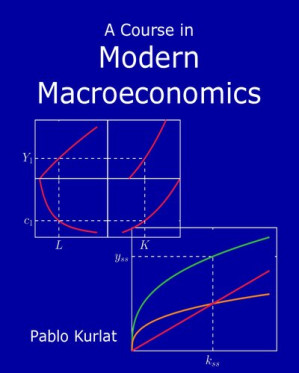
A Course in Modern Macroeconomics 🔍
Pablo Kurlat
publisher not identified, Primera edición, Los Angeles, California, 2020
英语 [en] · PDF · 11.2MB · 2020 · 📘 非小说类图书 · 🚀/lgli/lgrs/nexusstc/zlib · Save
描述
"This book started as a collection of my teaching notes for the ECON 52 course that I taught at Stanford University. The objective of that course, and of this book, is to introduce students to the ideas and way of thinking of modern macroeconomics in a unified way that is accessible with a moderate amount of maths. Modern macroeconomics emphasizes explicit microeconomic foundations and general equilibrium analysis, combined with various kinds of constraints and market imperfections. When preparing the class I thought none of the existing textbooks conveyed this in a way that I liked, so I prepared my own notes, which then grew into this book. While mostly self-contained, the book is probably most useful to students who are familiar with the basics of multivariable calculus and have taken a calculus-based microeconomics class."
备用文件名
lgli/Pablo Kurlat - A Course in Modern Macroeconomics.pdf
备用文件名
lgrsnf/Pablo Kurlat - A Course in Modern Macroeconomics.pdf
备用文件名
zlib/Business & Economics/Mathematical Economics/Pablo Kurlat/A Course in Modern Macroeconomics_21405824.pdf
备选作者
Kurlat, Pablo
备用出版商
Independently published
备用版本
Primera edición, Los Angeles, California, 2020
备用版本
United States, United States of America
备用版本
Jan 14, 2020
元数据中的注释
{"isbns":["1073566714","9781073566716"]}
备用描述
I GDP and Living Standards
GDP
GDP Accounting
Making Comparisons
Beyond GDP
The Human Development Index
Beyond GDP
II Economic Growth
Basic Facts about Economic Growth
The Very Long Run
The Kaldor Facts
Growth Across Countries
The Solow Growth Model
Ingredients of the Model
Mechanics
The Golden Rule
Markets
Technological Progress
Theory and Evidence
The Kaldor Facts Again
Putting Numbers on the Model
The Capital Accumulation Hypothesis
Growth Accounting
TFP Differences
III Microeconomic Foundations
Consumption and Saving
Keynesian
Two Period Model
Many periods
Behavioral Theories
Labor and Leisure
Measuring the Labor Market
Static Model
Evidence
A Dynamic Model
Equilibrium in the Labor Market
Investment
Present Values
Risk
MPK and Investment
General Equilibrium
Two-Period Economy
First Welfare Theorem
Infinite-Period Economy
IV Money and Inflation
Money
What is Money?
The Supply of Money
Changing the Supply of Money
The Demand for Money
The Price Level and Inflation
Measurement
Equilibrium
Seignorage
The Cost of Inflation
V Business Cycles
Business Cycle Facts
What are Business Cycles?
Patterns
Who cares?
The RBC Model
A Two-Period Model
Markets
Productivity Shocks
Other Shocks
Assessment
The New Keynesian Model
A Historical and Methodological Note
Monopoly Power
Sticky Prices
IS-LM
Shocks
Simplified
Partially Sticky Prices
Fiscal and Monetary Policy
Fiscal Policy
Monetary Policy
Monetary Policy Regimes
The Liquidity Trap
GDP
GDP Accounting
Making Comparisons
Beyond GDP
The Human Development Index
Beyond GDP
II Economic Growth
Basic Facts about Economic Growth
The Very Long Run
The Kaldor Facts
Growth Across Countries
The Solow Growth Model
Ingredients of the Model
Mechanics
The Golden Rule
Markets
Technological Progress
Theory and Evidence
The Kaldor Facts Again
Putting Numbers on the Model
The Capital Accumulation Hypothesis
Growth Accounting
TFP Differences
III Microeconomic Foundations
Consumption and Saving
Keynesian
Two Period Model
Many periods
Behavioral Theories
Labor and Leisure
Measuring the Labor Market
Static Model
Evidence
A Dynamic Model
Equilibrium in the Labor Market
Investment
Present Values
Risk
MPK and Investment
General Equilibrium
Two-Period Economy
First Welfare Theorem
Infinite-Period Economy
IV Money and Inflation
Money
What is Money?
The Supply of Money
Changing the Supply of Money
The Demand for Money
The Price Level and Inflation
Measurement
Equilibrium
Seignorage
The Cost of Inflation
V Business Cycles
Business Cycle Facts
What are Business Cycles?
Patterns
Who cares?
The RBC Model
A Two-Period Model
Markets
Productivity Shocks
Other Shocks
Assessment
The New Keynesian Model
A Historical and Methodological Note
Monopoly Power
Sticky Prices
IS-LM
Shocks
Simplified
Partially Sticky Prices
Fiscal and Monetary Policy
Fiscal Policy
Monetary Policy
Monetary Policy Regimes
The Liquidity Trap
开源日期
2022-04-26
🚀 快速下载
成为会员以支持书籍、论文等的长期保存。为了感谢您对我们的支持,您将获得高速下载权益。❤️
如果您在本月捐款,您将获得双倍的快速下载次数。
🐢 低速下载
由可信的合作方提供。 更多信息请参见常见问题解答。 (可能需要验证浏览器——无限次下载!)
- 低速服务器(合作方提供) #1 (稍快但需要排队)
- 低速服务器(合作方提供) #2 (稍快但需要排队)
- 低速服务器(合作方提供) #3 (稍快但需要排队)
- 低速服务器(合作方提供) #4 (稍快但需要排队)
- 低速服务器(合作方提供) #5 (无需排队,但可能非常慢)
- 低速服务器(合作方提供) #6 (无需排队,但可能非常慢)
- 低速服务器(合作方提供) #7 (无需排队,但可能非常慢)
- 低速服务器(合作方提供) #8 (无需排队,但可能非常慢)
- 低速服务器(合作方提供) #9 (无需排队,但可能非常慢)
- 下载后: 在我们的查看器中打开
所有选项下载的文件都相同,应该可以安全使用。即使这样,从互联网下载文件时始终要小心。例如,确保您的设备更新及时。
外部下载
-
对于大文件,我们建议使用下载管理器以防止中断。
推荐的下载管理器:JDownloader -
您将需要一个电子书或 PDF 阅读器来打开文件,具体取决于文件格式。
推荐的电子书阅读器:Anna的档案在线查看器、ReadEra和Calibre -
使用在线工具进行格式转换。
推荐的转换工具:CloudConvert和PrintFriendly -
您可以将 PDF 和 EPUB 文件发送到您的 Kindle 或 Kobo 电子阅读器。
推荐的工具:亚马逊的“发送到 Kindle”和djazz 的“发送到 Kobo/Kindle” -
支持作者和图书馆
✍️ 如果您喜欢这个并且能够负担得起,请考虑购买原版,或直接支持作者。
📚 如果您当地的图书馆有这本书,请考虑在那里免费借阅。
下面的文字仅以英文继续。
总下载量:
“文件的MD5”是根据文件内容计算出的哈希值,并且基于该内容具有相当的唯一性。我们这里索引的所有影子图书馆都主要使用MD5来标识文件。
一个文件可能会出现在多个影子图书馆中。有关我们编译的各种数据集的信息,请参见数据集页面。
有关此文件的详细信息,请查看其JSON 文件。 Live/debug JSON version. Live/debug page.