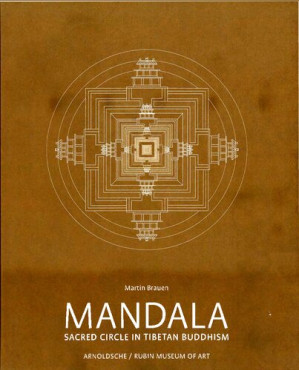
Mandala sacred circle in Tibetan Buddhism; [publ. on the occasion of the exhibition "Mandala: The Perfect Circle", organized by and presented at the Rubin Museum of Art from August 14, 2009 through January 11, 2010 🔍
Martin Brauen; Karl Debreczeny; Rubin Museum of Art
Arnoldsche Verlagsanstalt / Rubin Museum of Art, 2nd, 2009
英语 [en] · PDF · 68.1MB · 2009 · 📘 非小说类图书 · 🚀/lgli/lgrs/nexusstc/zlib · Save
描述
Numerous digital models of the mandala describe it structurally and elucidate this complex form of Tantric practice in understandable terms.**The search for order in this chaotic universe of ours has occupied my thoughts more and more as time passes (although I must admit I have been known to cause my fair share of chaos). I am drawn to the Buddhist mándala for its intricate and inspiring representation of an orderly cosmos.The mandala, as so finely explained in the chapters of this catalog, is in its most basic form a palace of a buddha, a diagram of the god in the center of his buddhafield, with all associated deities and beings around him. It is a ritual object, an image for contemplation, and, more to my heart, the subject of often breathtaking art.The Swiss psychologist Carl Gustav Jung famously adopted the mandala to illustrate his theories of the human mind. For Jung the circle and the quaternity - as in the Christian Cross - are symbols deeply rooted in the human soul, symbols that apparently emerged independently in several different times and places. This view allowed him to appropriate the mandala without concerning himself too much with its Indian and Tibetan traditions. He gave us a universal mandala, a map that at once revealed the human mind and the infinite.Yet we still have much to learn from the Buddhist, Jain, and Hindu concepts and use of the mandala, and with this in mind I am extremely grateful to Martin Brauen for this catalog. I encourage all readers to pay as close attention to the images as to Martin’s excellent scholarship - there is great reward in the calm contemplation of the art. (Donald Rubin, Founder, New York)The Mandala book of Martin Brauen first was published in German (Das Mandala. Der Heilige Kreis im tantrischen Buddhismus. Mit Photographien von Peter Nebel und Doro Röthlisberger. DuMont Buchverlag, Köln 1992.) then the 1st English edition in the title of The Maṇdala. Sacred Circle in Tibetan Buddhism. (Translated by Martin Wilson. With photographies by Peter Nebel and Doro Rothlis Berger: Serinda 1997.) This one is the 2nd English edition. All editions are a catalogue for the exhibitions with the same title. The official online version of this book: https://issuu.com/rmanyc/docs/2._mandala
备用文件名
lgli/9783897903050---9644f0defa609b716e4353c841e96edc.pdf
备用文件名
lgrsnf/9783897903050---9644f0defa609b716e4353c841e96edc.pdf
备用文件名
zlib/Arts/History & Criticism/Martin Brauen/Mandala: Sacred Circle in Tibetan Buddhism_5388881.pdf
备选标题
Mandala sacred circle in Tibetan buddhism ; [publ. in conjunction with the exhibition Mandala - the perfect circle org. and presented by the Rubin Museum of Art, New York, August 14, 2009 - January 11, 2010
备选作者
Brauen, Martin
备用出版商
Rubin Museum of Art ; Arnoldsche Art Publishers
备用出版商
Arnoldsche Art Publishers; Rubin Museum of Art
备用出版商
ARNOLDSCHE Verlagsanstalt GmbH
备用版本
Rev. and updated ed, New York, Stuttgart, ©2009
备用版本
New York, Stuttgart, New York State, 2009
备用版本
y First edition, PS, 2009
备用版本
Germany, Germany
元数据中的注释
{"isbns":["3897903059","9783897903050"],"last_page":255,"publisher":"Arnoldsche Art Publishers; Rubin Museum of Art"}
元数据中的注释
"This catalog is published in conjunction with the exhibition Mandala: The Perfect Circle organized and presented by the Rubin Museum of Art, New York, August 14, 2009-January 11, 2010."
Includes bibliographical references and index.
Includes bibliographical references and index.
备用描述
Ein Kosmos aus Sand Noch nie wurde in so einfühlsamer und detaillierter Art und Weise die Welt der Mandalas beschrieben. Wie bereits der XIV. Dalai Lama im Vor-wort des Buches andeutet, wurden Mandalas aus Unwissenheit über viele Jahre hinweg einfach nur als Kunstwerke gesehen. Diese simple Interpre-tation von heiligen Zeichen führte zu zahlreichen Missverständnissen. Martin Brauen legt in seinem Buch „MANDALA - Sacred Circle in Tibetan Buddhism“ daher den Schwerpunkt auf den Zusammenhang zwischen der heiligen Lehre und den Meditationsbildern. Nach einer grundlegenden Einführung in den „Buddhistischen Weg“ sind die Sinne des Betrachters für das Wesentliche geschärft. Die zahlreichen Beschreibungen der Mandalas werden so zu einem kulturellen Augenschmaus, der zugleich Einblicke in die buddhistische Lehre ermöglicht: So steht etwa im Zentrum eines der vorgestellten Mandalas die heilige Gottheit Śrī Hevajra mit seinen Füßen auf Untergottheiten, während er mit zwei seiner zahlreichen Arme seine Partnerin Nairātmā umrahmt. In einem anderen öffnet sich ein dreidimen-sionales Lotus-Mandala, das im geschlossenen Zustand soeben noch an einen Kerzenständer erinnerte. Im Innersten seiner Kupferblätter birgt es aber kleine Statuen der Gottheit Hevajra, umgeben von den acht großen Siddhas, den Erleuchteten. Ihren Höhepunkt findet diese heilige Kunst in den Sandmandalas. Sie wer-den von den mit rot-orangefarbenen Tuniken bekleideten Mönchen in tagelangen Zeremonien mit Farbpigmenten auf ein Tuch aufgestreut. Doch das Ergebnis ist nicht, wie angenommen werden könnte, eine grobe An-ordnung von Farbfeldern. Nein, bis ins feinste Detail zeichnen die Mön-che mit buntem Sand die Figuren, Schriftzeichen und Muster. Die prunk-volle Ornamentik entführt in eine andere Welt. Doch kaum gibt man sich diesem Kosmos aus Sand hin, gehört er schon der Vergangenheit an. Denn zum Schicksal zahlreicher Mandalas gehört auch deren Zerstörung, um den Kreislauf der Transformation zu durchlaufen. Das 264 Seiten umfassende Buch lebt von seinen fundierten Texten und den vielen großformatigen Abbildungen in brillanter Farbqualität, die es erlauben, auch den unendlichen Detail-reichtum der Mandalas gebührend zu würdigen. Ein Katalog-teil mit 38 hochkarätigen Objekten aus internationalen Muse-en sowie viele Schaubilder, Tabellen und Tafeln zur Erläute-rung der Welt der Mandalas machen das Buch zu einem be-sonders verständlichen Werk über diese „heiligen Kreise“, die nach buddhistischem Verständnis auf immer wieder neue Weise die Einheit von Mensch und Kosmos thematisieren.
Erscheinungsdatum: 13.08.2009
Erscheinungsdatum: 13.08.2009
备用描述
"Buddhists view the mandala as an allegory and symbol of the totality of man and of the cosmos, and practitioners use it in meditation that is to lead to enlightenment. Numerous illustrations of mandalas, drawings, and figures describe it structurally and elucidate this complex form of Tantric practice in understandable terms." "This book by Martin Brauen is the updated and extensively expanded edition of his 1992 publication, which has long been out of print and is regarded as one of the most comprehensive works on the mandala. The present publication contains texts, illustrations, and tables that provide manifold approaches to and interpretations of this sacred symbol." --Book Jacket
备用描述
Tantric Buddhism views the mandala as an allegory and symbol of man's relationship with the cosmos and uses it in meditation that is to lead to enlightenment. This book focuses on the mandala. It contains texts, illustrations and tables that provide manifold approaches to and interpretations of this sacred symbol.
备用描述
Named a Choice Outstanding Academic Book of 1997, and featuring a foreword by the Dalai Lama, a lavish study of a Tibetan Buddhist initiation ritual includes diagrams, photographs, and visual representations of the mandala principle. Reprint.
备用描述
Approaching the mandala
The center of the Buddhist Wheel of the Teaching: basic ideas
Outer mandala: the cosmos
Plates
Inner mandala: the person
The other mandala: the tantric method
The mandala and the West.
The center of the Buddhist Wheel of the Teaching: basic ideas
Outer mandala: the cosmos
Plates
Inner mandala: the person
The other mandala: the tantric method
The mandala and the West.
开源日期
2021-09-27
🚀 快速下载
成为会员以支持书籍、论文等的长期保存。为了感谢您对我们的支持,您将获得高速下载权益。❤️
如果您在本月捐款,您将获得双倍的快速下载次数。
🐢 低速下载
由可信的合作方提供。 更多信息请参见常见问题解答。 (可能需要验证浏览器——无限次下载!)
- 低速服务器(合作方提供) #1 (稍快但需要排队)
- 低速服务器(合作方提供) #2 (稍快但需要排队)
- 低速服务器(合作方提供) #3 (稍快但需要排队)
- 低速服务器(合作方提供) #4 (稍快但需要排队)
- 低速服务器(合作方提供) #5 (无需排队,但可能非常慢)
- 低速服务器(合作方提供) #6 (无需排队,但可能非常慢)
- 低速服务器(合作方提供) #7 (无需排队,但可能非常慢)
- 低速服务器(合作方提供) #8 (无需排队,但可能非常慢)
- 低速服务器(合作方提供) #9 (无需排队,但可能非常慢)
- 下载后: 在我们的查看器中打开
所有选项下载的文件都相同,应该可以安全使用。即使这样,从互联网下载文件时始终要小心。例如,确保您的设备更新及时。
外部下载
-
对于大文件,我们建议使用下载管理器以防止中断。
推荐的下载管理器:JDownloader -
您将需要一个电子书或 PDF 阅读器来打开文件,具体取决于文件格式。
推荐的电子书阅读器:Anna的档案在线查看器、ReadEra和Calibre -
使用在线工具进行格式转换。
推荐的转换工具:CloudConvert和PrintFriendly -
您可以将 PDF 和 EPUB 文件发送到您的 Kindle 或 Kobo 电子阅读器。
推荐的工具:亚马逊的“发送到 Kindle”和djazz 的“发送到 Kobo/Kindle” -
支持作者和图书馆
✍️ 如果您喜欢这个并且能够负担得起,请考虑购买原版,或直接支持作者。
📚 如果您当地的图书馆有这本书,请考虑在那里免费借阅。
下面的文字仅以英文继续。
总下载量:
“文件的MD5”是根据文件内容计算出的哈希值,并且基于该内容具有相当的唯一性。我们这里索引的所有影子图书馆都主要使用MD5来标识文件。
一个文件可能会出现在多个影子图书馆中。有关我们编译的各种数据集的信息,请参见数据集页面。
有关此文件的详细信息,请查看其JSON 文件。 Live/debug JSON version. Live/debug page.