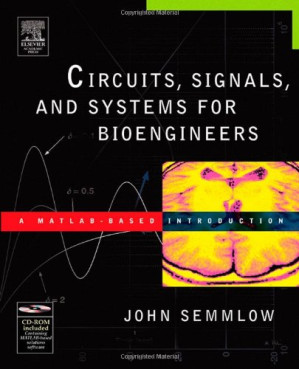
nexusstc/Circuits, Signals, and Systems for Bioengineers: A MATLAB-Based Introduction (Biomedical Engineering)/8bc7c1bcd22fc54035851a96f6d8d312.pdf
Circuits, Signals, and Systems for Bioengineers: A MATLAB-Based Introduction (Biomedical Engineering) 🔍
John L Semmlow; NetLibrary, Inc
Elsevier Academic Press, Academic Press series in biomedical engineering, Amsterdam, Boston, Netherlands, 2005
英语 [en] · PDF · 3.6MB · 2005 · 📘 非小说类图书 · 🚀/lgli/lgrs/nexusstc/zlib · Save
描述
Approaches such as the Transfer Function and the Fourier and the Laplace transforms are important tools for bioengineers that often considered borrowed from electrical engineering. This text allows bioengineering students and bioengineers the ability to foster a sense of ownership of these tools by providing them with a solid foundation in the concepts of linear systems analysis. Circuits, Signals and Systems for Bioengineers guides readers through the basic engineering concepts that underlie biological systems, medical devices, biocontrol, and biosignal analysis. Material important to their study and traditionally taught in an electrical engineering service course can now be embraced by bioengineers. To further enhance the effectiveness of the book, instructive illustrations and MATLAB routines and examples are provided throughout the book with additional material available on a CD-ROM. · Translates important electrical engineering tools such as Fourier Transform, Laplace Transform, analog modeling, systems modeling, and other linear systems analysis techniques for bioengineering students. · Includes MATLAB examples and problems. · Includes CD-Rom with PowerPoint presentations, extra examples, figures, and support routines.
备用文件名
lgli/Academic Press - Circuits, Systems and Signals for BioengineersISBN0-12-08-8493-3.pdf
备用文件名
lgrsnf/Academic Press - Circuits, Systems and Signals for BioengineersISBN0-12-08-8493-3.pdf
备用文件名
zlib/Engineering/John Semmlow/Circuits, Signals, and Systems for Bioengineers: A MATLAB-Based Introduction_634516.pdf
备选标题
Circuits, systems and signals for bioengineers : a MATLAB-based introduction
备选作者
Semmlow, John
备用出版商
Academic Press, Incorporated
备用出版商
Morgan Kaufmann Publishers
备用出版商
Ebsco Publishing
备用出版商
Brooks/Cole
备用版本
Academic Press series in biomedical engineering, Burlington, MA, Massachusetts, 2005
备用版本
Academic Press series in biomedical engineering, Oxford, 2005
备用版本
United States, United States of America
备用版本
Elsevier Ltd., Oxford, 2005
备用版本
1, PT, 2005
元数据中的注释
lg206771
元数据中的注释
{"isbns":["0120884933","1423708202","9780120884933","9781423708209"],"last_page":464,"publisher":"Academic Press","series":"Biomedical Engineering"}
元数据中的注释
Includes bibliographical references (p. [437]) and index.
备用描述
CIRCUITS, SIGNALS, AND SYSTEMS FOR BIOENGINEERS......Page 1
PREFACE......Page 8
TABLE OF CONTENTS......Page 10
1. BIOENGINEERING SIGNALS AND SYSTEMS......Page 16
2.1 Basic Signals: The Sinusoidal Waveform......Page 46
2.1.1 Sinusoidal Arithmetic......Page 49
2.1.2 Complex Representation......Page 51
2.2 Signal Properties: Basic Measurements......Page 53
2.2.1 Decibels......Page 57
2.3 Advanced Measurements: Correlations and Covariances......Page 59
2.3.1 Standard Correlation and Covariance......Page 60
2.3.2 Autocorrelation and Cross-Correlation......Page 63
2.4.1 Mean, Variance, and Standard Deviation......Page 69
2.4.2 Ensemble Averaging......Page 72
2.4.3 Covariance and Correlation......Page 73
2.4.4 Autocorrelation and Cross-Correlation......Page 76
2.5 Summary......Page 80
Problems......Page 81
3. FREQUENCY TRANSFORMATIONS......Page 84
3.1 Useful Properties of the Sinusoidal Signal......Page 87
3.2 Fourier Series Analysis......Page 90
3.2.1 Symmetry......Page 94
3.3 Frequency Representation......Page 95
3.4 Complex Representation......Page 97
3.5 The Continuous Fourier Transform......Page 100
3.6 Discrete Data: The Discrete Fourier Transform......Page 102
3.6.1 Data Sampling: Sampling Theorem......Page 103
3.6.2 Amplitude Slicing: Quantization (Optional)......Page 108
3.6.3 Data Length: Truncation......Page 110
3.7 Power Spectrum......Page 112
3.7.1 Spectral Averaging......Page 114
3.8 Signal Bandwidth......Page 116
3.9 MATLAB Implementation......Page 117
3.10 Summary......Page 130
Problems......Page 131
4.1 Circuits and Analog Systems......Page 136
4.2 System Variables and Elements......Page 138
4.2.1 Electrical Variables......Page 140
4.2.2 Electrical Elements......Page 142
4.2.3 Active Elements......Page 150
4.2.4 The Fluid Analogy......Page 152
4.3 Phasor Analysis......Page 154
4.3.1 Phasor Representation: Electrical Elements......Page 159
4.4 Mechanical Elements......Page 162
4.4.1 Passive Elements......Page 163
4.4.2 Elasticity......Page 166
4.4.3 Sources......Page 168
4.5 Summary......Page 172
Problems......Page 173
5.1 Conservation Laws: Kirchhoff’s Voltage Law......Page 176
5.1.1 Mesh Analysis: Single Loops......Page 177
5.1.2 Mesh Analysis: Multiple Loops......Page 183
5.1.3 Mesh Analysis: MATLAB Implementation......Page 186
5.2 Conservation Laws: Kirchhoff’s Current Law—Nodal Analysis......Page 188
5.3 Conservation Laws: Newton’s Law—Mechanical Systems......Page 193
5.4 Summary......Page 201
Problems......Page 202
6.1 The Circuit or Mechanical System as a Process......Page 208
6.1.1 Superposition......Page 210
6.1.2 The Transfer Function......Page 211
6.1.3 Transfer Function Characteristics......Page 212
6.2 Transfer Function Frequency Plots: The Bode Plot......Page 213
6.2.1 Frequency Characteristics of Bode Plot Primitives......Page 216
6.3 Filters......Page 228
6.3.1 Filter Types......Page 229
6.3.2 Filter Bandwidth......Page 230
6.3.3 Filter Order......Page 231
6.3.5 Evaluating Filter Frequency Characteritics......Page 232
6.3.6 Filter Design......Page 234
6.4.1 Transfer Function......Page 236
6.4.2 System Identification......Page 242
6.4.3 The Transfer Function and Fourier Series Decomposition......Page 245
Problems......Page 249
7.1 System Simplifications: Passive Network Reduction......Page 254
7.1.1 Series Electrical Elements......Page 255
7.1.2 Parallel Elements......Page 257
7.1.3 Network Reduction: Passive Networks......Page 259
7.2.1 The Voltage–Current or v-i Plot......Page 267
7.2.2 Real Voltage Sources: The Thévenin Source......Page 270
7.2.3 Real Current Sources: The Norton Source......Page 273
7.2.4 Thévenin and Norton Circuit Conversion......Page 276
7.3 Thévenin and Norton Theorems: Network Reduction with Sources......Page 279
7.4 Measurement Loading......Page 284
7.4.1 Ideal and Real Measurement Devices......Page 285
7.4.2 Maximum Power Transfer......Page 288
7.5 Mechanical Systems......Page 290
7.6 Multiple Sources: Revisited......Page 296
Problems......Page 298
8.1 The Laplace Transform......Page 304
8.1.1 Definition of the Laplace Transform......Page 305
8.1.2 Laplace Representation of Elements: Calculus Operations in the Laplace Domain......Page 307
8.1.3 Initial Conditions......Page 308
8.1.4 Voltage–Current and Force–Velocity Relationships in the Laplace Domain......Page 309
8.1.5 Sources: Common Signals in the Laplace Domain......Page 311
8.1.6 Converting the Laplace Transform to the Frequency Domain......Page 313
8.1.7 The Time-Delay Element......Page 314
8.2 Laplace Analysis: The Laplace Transfer Function......Page 315
8.2.1 First-Order Processes......Page 317
8.2.2 Second-Order Processes......Page 321
8.3 Nonzero Initial Conditions......Page 331
8.4 Initial and Final Value Theorems......Page 335
8.5 The Laplace Domain and the Frequency Domain......Page 336
Problems......Page 345
9.1 The System Model......Page 350
9.1.1 Feedback......Page 352
9.2 The Convolution Integral......Page 355
9.2.1 MATLAB Implementation......Page 358
9.3 Resonance......Page 369
9.3.2 Resonant Bandwidth, Q......Page 370
9.4 Summary......Page 380
Problems......Page 382
10. BASIC ANALOG ELECTRONICS: OPERATIONAL AMPLIFIERS......Page 386
10.1 The Amplifier......Page 387
10.2 The Operational Amplifier......Page 389
10.3 The Noninverting Amplifier......Page 391
10.4 The Inverting Amplifier......Page 394
10.5 Practical Operational Amplifiers......Page 396
10.5.1 Limitations in Transfer Characteristics of Real Operational Amplifiers......Page 397
10.5.2 Input Characteristics......Page 404
10.5.3 Output Characteristics......Page 411
10.6 Power Supply......Page 413
10.7 Operational Amplifier Circuits, or 101 Things to Do with an Operational Amplifier......Page 414
10.7.1 The Differential Amplifier......Page 415
10.7.2 The Adder......Page 416
10.7.3 The Buffer Amplifier......Page 417
10.7.4 The Transconductance Amplifier......Page 418
10.7.5 Analog Filters......Page 420
10.7.6 Instrumentation Amplifier......Page 422
Problems......Page 426
A.1 Derivation of Euler’s Formula......Page 430
A.2 Confirmation of the Fourier Series......Page 431
A.3 Derivation of the Transfer Function of a Second-Order Op Amp Filter......Page 432
A.4 Derivation of the Transfer Function of an Instrumentation Amplifier......Page 433
APPENDIX B: Laplace Transforms......Page 436
APPENDIX C: Trigonometric and Other Formulas......Page 438
APPENDIX D: Units......Page 440
APPENDIX E: Complex Arithmetic......Page 444
E.1.2 Multiplication and Division......Page 445
APPENDIX F: LF 356 Specifications......Page 448
APPENDIX G: Determinants and Cramer’s Rule......Page 450
BIBLIOGRAPHY......Page 452
INDEX......Page 454
PREFACE......Page 8
TABLE OF CONTENTS......Page 10
1. BIOENGINEERING SIGNALS AND SYSTEMS......Page 16
2.1 Basic Signals: The Sinusoidal Waveform......Page 46
2.1.1 Sinusoidal Arithmetic......Page 49
2.1.2 Complex Representation......Page 51
2.2 Signal Properties: Basic Measurements......Page 53
2.2.1 Decibels......Page 57
2.3 Advanced Measurements: Correlations and Covariances......Page 59
2.3.1 Standard Correlation and Covariance......Page 60
2.3.2 Autocorrelation and Cross-Correlation......Page 63
2.4.1 Mean, Variance, and Standard Deviation......Page 69
2.4.2 Ensemble Averaging......Page 72
2.4.3 Covariance and Correlation......Page 73
2.4.4 Autocorrelation and Cross-Correlation......Page 76
2.5 Summary......Page 80
Problems......Page 81
3. FREQUENCY TRANSFORMATIONS......Page 84
3.1 Useful Properties of the Sinusoidal Signal......Page 87
3.2 Fourier Series Analysis......Page 90
3.2.1 Symmetry......Page 94
3.3 Frequency Representation......Page 95
3.4 Complex Representation......Page 97
3.5 The Continuous Fourier Transform......Page 100
3.6 Discrete Data: The Discrete Fourier Transform......Page 102
3.6.1 Data Sampling: Sampling Theorem......Page 103
3.6.2 Amplitude Slicing: Quantization (Optional)......Page 108
3.6.3 Data Length: Truncation......Page 110
3.7 Power Spectrum......Page 112
3.7.1 Spectral Averaging......Page 114
3.8 Signal Bandwidth......Page 116
3.9 MATLAB Implementation......Page 117
3.10 Summary......Page 130
Problems......Page 131
4.1 Circuits and Analog Systems......Page 136
4.2 System Variables and Elements......Page 138
4.2.1 Electrical Variables......Page 140
4.2.2 Electrical Elements......Page 142
4.2.3 Active Elements......Page 150
4.2.4 The Fluid Analogy......Page 152
4.3 Phasor Analysis......Page 154
4.3.1 Phasor Representation: Electrical Elements......Page 159
4.4 Mechanical Elements......Page 162
4.4.1 Passive Elements......Page 163
4.4.2 Elasticity......Page 166
4.4.3 Sources......Page 168
4.5 Summary......Page 172
Problems......Page 173
5.1 Conservation Laws: Kirchhoff’s Voltage Law......Page 176
5.1.1 Mesh Analysis: Single Loops......Page 177
5.1.2 Mesh Analysis: Multiple Loops......Page 183
5.1.3 Mesh Analysis: MATLAB Implementation......Page 186
5.2 Conservation Laws: Kirchhoff’s Current Law—Nodal Analysis......Page 188
5.3 Conservation Laws: Newton’s Law—Mechanical Systems......Page 193
5.4 Summary......Page 201
Problems......Page 202
6.1 The Circuit or Mechanical System as a Process......Page 208
6.1.1 Superposition......Page 210
6.1.2 The Transfer Function......Page 211
6.1.3 Transfer Function Characteristics......Page 212
6.2 Transfer Function Frequency Plots: The Bode Plot......Page 213
6.2.1 Frequency Characteristics of Bode Plot Primitives......Page 216
6.3 Filters......Page 228
6.3.1 Filter Types......Page 229
6.3.2 Filter Bandwidth......Page 230
6.3.3 Filter Order......Page 231
6.3.5 Evaluating Filter Frequency Characteritics......Page 232
6.3.6 Filter Design......Page 234
6.4.1 Transfer Function......Page 236
6.4.2 System Identification......Page 242
6.4.3 The Transfer Function and Fourier Series Decomposition......Page 245
Problems......Page 249
7.1 System Simplifications: Passive Network Reduction......Page 254
7.1.1 Series Electrical Elements......Page 255
7.1.2 Parallel Elements......Page 257
7.1.3 Network Reduction: Passive Networks......Page 259
7.2.1 The Voltage–Current or v-i Plot......Page 267
7.2.2 Real Voltage Sources: The Thévenin Source......Page 270
7.2.3 Real Current Sources: The Norton Source......Page 273
7.2.4 Thévenin and Norton Circuit Conversion......Page 276
7.3 Thévenin and Norton Theorems: Network Reduction with Sources......Page 279
7.4 Measurement Loading......Page 284
7.4.1 Ideal and Real Measurement Devices......Page 285
7.4.2 Maximum Power Transfer......Page 288
7.5 Mechanical Systems......Page 290
7.6 Multiple Sources: Revisited......Page 296
Problems......Page 298
8.1 The Laplace Transform......Page 304
8.1.1 Definition of the Laplace Transform......Page 305
8.1.2 Laplace Representation of Elements: Calculus Operations in the Laplace Domain......Page 307
8.1.3 Initial Conditions......Page 308
8.1.4 Voltage–Current and Force–Velocity Relationships in the Laplace Domain......Page 309
8.1.5 Sources: Common Signals in the Laplace Domain......Page 311
8.1.6 Converting the Laplace Transform to the Frequency Domain......Page 313
8.1.7 The Time-Delay Element......Page 314
8.2 Laplace Analysis: The Laplace Transfer Function......Page 315
8.2.1 First-Order Processes......Page 317
8.2.2 Second-Order Processes......Page 321
8.3 Nonzero Initial Conditions......Page 331
8.4 Initial and Final Value Theorems......Page 335
8.5 The Laplace Domain and the Frequency Domain......Page 336
Problems......Page 345
9.1 The System Model......Page 350
9.1.1 Feedback......Page 352
9.2 The Convolution Integral......Page 355
9.2.1 MATLAB Implementation......Page 358
9.3 Resonance......Page 369
9.3.2 Resonant Bandwidth, Q......Page 370
9.4 Summary......Page 380
Problems......Page 382
10. BASIC ANALOG ELECTRONICS: OPERATIONAL AMPLIFIERS......Page 386
10.1 The Amplifier......Page 387
10.2 The Operational Amplifier......Page 389
10.3 The Noninverting Amplifier......Page 391
10.4 The Inverting Amplifier......Page 394
10.5 Practical Operational Amplifiers......Page 396
10.5.1 Limitations in Transfer Characteristics of Real Operational Amplifiers......Page 397
10.5.2 Input Characteristics......Page 404
10.5.3 Output Characteristics......Page 411
10.6 Power Supply......Page 413
10.7 Operational Amplifier Circuits, or 101 Things to Do with an Operational Amplifier......Page 414
10.7.1 The Differential Amplifier......Page 415
10.7.2 The Adder......Page 416
10.7.3 The Buffer Amplifier......Page 417
10.7.4 The Transconductance Amplifier......Page 418
10.7.5 Analog Filters......Page 420
10.7.6 Instrumentation Amplifier......Page 422
Problems......Page 426
A.1 Derivation of Euler’s Formula......Page 430
A.2 Confirmation of the Fourier Series......Page 431
A.3 Derivation of the Transfer Function of a Second-Order Op Amp Filter......Page 432
A.4 Derivation of the Transfer Function of an Instrumentation Amplifier......Page 433
APPENDIX B: Laplace Transforms......Page 436
APPENDIX C: Trigonometric and Other Formulas......Page 438
APPENDIX D: Units......Page 440
APPENDIX E: Complex Arithmetic......Page 444
E.1.2 Multiplication and Division......Page 445
APPENDIX F: LF 356 Specifications......Page 448
APPENDIX G: Determinants and Cramer’s Rule......Page 450
BIBLIOGRAPHY......Page 452
INDEX......Page 454
备用描述
<p>Approaches such as the Transfer Function and the Fourier and the Laplace transforms are important tools for bioengineers that often considered borrowed from electrical engineering. This text allows bioengineering students and bioengineers the ability to foster a sense of ownership of these tools by providing them with a solid foundation in the concepts of linear systems analysis. <i>Circuits, Signals and Systems for Bioengineers</i> guides readers through the basic engineering concepts that underlie biological systems, medical devices, biocontrol, and biosignal analysis. Material important to their study and traditionally taught in an electrical engineering service course can now be embraced by bioengineers. Instructive illustrations and MATLAB routines and examples are provided throughout the book.</p> <p>All disc-based content for this title is now available on the Web.</p><br><br>· Translates important electrical engineering tools such as Fourier Transform, Laplace Transform, analog modeling, systems modeling, and other linear systems analysis techniques for bioengineering students. <br><br>· Includes MATLAB examples and problems. <br><br>· Includes companion website with PowerPoint presentations, extra examples, figures, and support routines.
开源日期
2010-02-18
🚀 快速下载
成为会员以支持书籍、论文等的长期保存。为了感谢您对我们的支持,您将获得高速下载权益。❤️
如果您在本月捐款,您将获得双倍的快速下载次数。
🐢 低速下载
由可信的合作方提供。 更多信息请参见常见问题解答。 (可能需要验证浏览器——无限次下载!)
- 低速服务器(合作方提供) #1 (稍快但需要排队)
- 低速服务器(合作方提供) #2 (稍快但需要排队)
- 低速服务器(合作方提供) #3 (稍快但需要排队)
- 低速服务器(合作方提供) #4 (稍快但需要排队)
- 低速服务器(合作方提供) #5 (无需排队,但可能非常慢)
- 低速服务器(合作方提供) #6 (无需排队,但可能非常慢)
- 低速服务器(合作方提供) #7 (无需排队,但可能非常慢)
- 低速服务器(合作方提供) #8 (无需排队,但可能非常慢)
- 低速服务器(合作方提供) #9 (无需排队,但可能非常慢)
- 下载后: 在我们的查看器中打开
所有选项下载的文件都相同,应该可以安全使用。即使这样,从互联网下载文件时始终要小心。例如,确保您的设备更新及时。
外部下载
-
对于大文件,我们建议使用下载管理器以防止中断。
推荐的下载管理器:JDownloader -
您将需要一个电子书或 PDF 阅读器来打开文件,具体取决于文件格式。
推荐的电子书阅读器:Anna的档案在线查看器、ReadEra和Calibre -
使用在线工具进行格式转换。
推荐的转换工具:CloudConvert和PrintFriendly -
您可以将 PDF 和 EPUB 文件发送到您的 Kindle 或 Kobo 电子阅读器。
推荐的工具:亚马逊的“发送到 Kindle”和djazz 的“发送到 Kobo/Kindle” -
支持作者和图书馆
✍️ 如果您喜欢这个并且能够负担得起,请考虑购买原版,或直接支持作者。
📚 如果您当地的图书馆有这本书,请考虑在那里免费借阅。
下面的文字仅以英文继续。
总下载量:
“文件的MD5”是根据文件内容计算出的哈希值,并且基于该内容具有相当的唯一性。我们这里索引的所有影子图书馆都主要使用MD5来标识文件。
一个文件可能会出现在多个影子图书馆中。有关我们编译的各种数据集的信息,请参见数据集页面。
有关此文件的详细信息,请查看其JSON 文件。 Live/debug JSON version. Live/debug page.