nexusstc/An Introduction to Multilevel Modeling Techniques: MLM and SEM Approaches/85293a1177ccbf7e92f5bc201d026da4.pdf
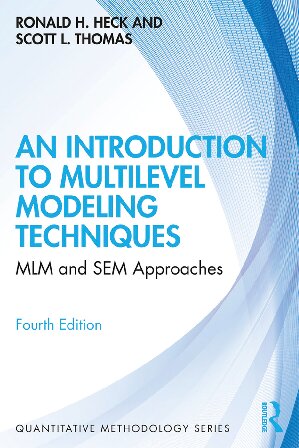
An Introduction to Multilevel Modeling Techniques: MLM and SEM Approaches (Quantitative Methodology Series) 🔍
Ronald H. Heck; Scott Loring Thomas
Routledge, Taylor & Francis Group, Quantitative Methodology Series, 4, 2020
英语 [en] · PDF · 37.9MB · 2020 · 📘 非小说类图书 · 🚀/lgli/lgrs/nexusstc/zlib · Save
描述
Multilevel modelling is a data analysis method that is frequently used to investigate hierarchal data structures in educational, behavioural, health, and social sciences disciplines. Multilevel data analysis exploits data structures that cannot be adequately investigated using single-level analytic methods such as multiple regression, path analysis, and structural modelling. This text offers a comprehensive treatment of multilevel models for univariate and multivariate outcomes. It explores their similarities and differences and demonstrates why one model may be more appropriate than another, given the research objectives.
New to this edition:
An expanded focus on the nature of different types of multilevel data structures (e.g., cross-sectional, longitudinal, cross-classified, etc.) for addressing specific research goals;
Varied modelling methods for examining longitudinal data including random-effect and fixed-effect approaches;
Expanded coverage illustrating different model-building sequences and how to use results to identify possible model improvements;
An expanded set of applied examples used throughout the text;
Use of four different software packages (i.e., Mplus, R, SPSS, Stata), with selected examples of model-building input files included in the chapter appendices and a more complete set of files available online.
This is an ideal text for graduate courses on multilevel, longitudinal, latent variable modelling, multivariate statistics, or advanced quantitative techniques taught in psychology, business, education, health, and sociology. Recommended prerequisites are introductory univariate and multivariate statistics.
New to this edition:
An expanded focus on the nature of different types of multilevel data structures (e.g., cross-sectional, longitudinal, cross-classified, etc.) for addressing specific research goals;
Varied modelling methods for examining longitudinal data including random-effect and fixed-effect approaches;
Expanded coverage illustrating different model-building sequences and how to use results to identify possible model improvements;
An expanded set of applied examples used throughout the text;
Use of four different software packages (i.e., Mplus, R, SPSS, Stata), with selected examples of model-building input files included in the chapter appendices and a more complete set of files available online.
This is an ideal text for graduate courses on multilevel, longitudinal, latent variable modelling, multivariate statistics, or advanced quantitative techniques taught in psychology, business, education, health, and sociology. Recommended prerequisites are introductory univariate and multivariate statistics.
备用文件名
lgli/An Introduction to Multilevel Modeling Techniques.pdf
备用文件名
lgrsnf/An Introduction to Multilevel Modeling Techniques.pdf
备用文件名
zlib/Mathematics/Ronald H. Heck, Scott L. Thomas/An Introduction to Multilevel Modeling Techniques: MLM and SEM Approaches_5524766.pdf
备选作者
Heck, Ronald H., Thomas, Scott L.
备用出版商
Taylor & Francis Ltd
备用出版商
Psychology Press Ltd
备用出版商
CRC Press
备用版本
Quantitative methodology series, Fourth edition, New York, NY, 2020
备用版本
Taylor & Francis (Unlimited), New York, NY, 2020
备用版本
United Kingdom and Ireland, United Kingdom
备用版本
4, 2020-04-07
元数据中的注释
lg2525229
元数据中的注释
{"edition":"4","isbns":["0367182424","9780367182427"],"last_page":404,"publisher":"Routledge","series":"Quantitative Methodology Series"}
备用描述
Cover
Half Title
Series Information
Title Page
Copyright Page
Table of contents
Acknowledgments
Preface
1 Introduction
Providing a Conceptual Overview
Contrasting Linear Models
Univariate Analysis
Multiple Regression
Analysis of Variance
Multivariate Analysis
Multivariate Analysis of Variance
Structural Equation Modeling
Multilevel Data Structures
Multilevel Multivariate Model
Multilevel Structural Model
Summary
Appendix
References
2 Getting Started with Multilevel Analysis
Introduction
The Big Picture
From Single-level to Multilevel Analysis
Summarizing Some Differences between Single-level and Multilevel Analyses
Developing a General Multilevel Modeling Strategy
Step 1: Partitioning the Variance in an Outcome
Step 2: Adding Level-1 Predictors to Explain Variability in Intercepts
Step 3: Adding Level-2 Predictors to Explain Variability in Intercepts
Step 4: Examining Possible Variation in Level-1 Slopes
Step 5: Adding Predictors to Explain Variation in Slopes
Specifying the Basic Two-level Model with Path Diagrams
Model Estimation
Maximum Likelihood Estimation
Model Convergence and Fit
Considerations for ML Estimation
An ML Illustration
Bayesian Estimation
Bayesian and ML Estimation with a Limited Number of Groups
Summary
Appendix
References
3 Multilevel Regression Models
Introduction
Building a Model to Explain Employee Morale
Model 1: One-way ANOVA or Null Model
Model 2: Random-Intercept with Level-1 Predictors
Model 3: Specifying a Level-1 Random Slope
Model 4: Explaining Variation in the Level-2 Intercept and Slope
Model 4 Output
Examining Residuals
Centering Predictors
Centering Predictors in Models with Random Slopes
Summary
Appendix
Notes
References
4 Extending the Two-level Regression Model
Introduction
Three-level Univariate Model
Developing a Three-level Univariate Model
Research Questions
Data
Model 1: Null (No Predictors) Model
Model 2: Defining Predictors at Level 1
Model 3: Defining Predictors at Level 2
Model 4: Examining an Interaction at Level 2
Model 5: Examining a Randomly Varying Slope at Level 3
Model 6: Adding Level-3 Predictors
Accounting for Variance
Cross-classified Data Structures
Students Cross-classified in High Schools and Postsecondary Institutions
Research Questions
Model 1: Developing a Null Model
Model 2: Adding Within-cell (Level-1) Predictors
Model 3: Adding Between-cell Predictors
Model 4: Adding a Randomly Varying Level-1 Slope
Model 5: Explaining Variability in Random Slopes
Summary
Appendix
Note
References
5 Methods for Examining Individual and Organizational Change
Introduction
Analyzing Longitudinal Data
Repeated Measures ANOVA
Growth Modeling and Other Approaches
Random-coefficients Growth Modeling
Defining the Level-1 Model
Defining the Level-2 Model
Extending the Model to Examine Changes Between Groups
Examining Changes in Students’ Math Scores
Model 1: Unconditional Means Model
Model 2: Unconditional Growth Model
Model 3: Unconditional Growth Model with Random Time Parameter
Investigating Subsets of Individuals’ Trajectories
Model 4: Adding a Quadratic Polynomial Term
Model 5: Adding a Between-subjects Predictor
Model 6: Deciding on the Level-1 Covariance Structure
Building a Two-level Growth Model Using Age
Model 1: Unconditional Growth Model with Random Age Variable
Model 2: Final Growth Model with Between-subjects Predictor
Examining Changes in Institutions’ Graduation Rates
Model 1: Unconditional Means Model
Model 2: Unconditional Growth Model with Random Time Slope
Model 3: Adding a Time-varying Covariate
Model 4: Examining Whether Instructional Support Influences Growth in Graduation
Model 5: Testing a Random Effect for Instructional Support
Model 6: Adding Between-institution Covariates
Developing Piecewise Growth Models
Examining Student Growth in Literacy
Changes Due to a Policy
Fixed-effects Regression Models
Graduation Growth in One Higher Education System
Summary
Appendix
Notes
References
6 Multilevel Models with Categorical Variables
Introduction
Estimating the Models
Specifying Models for Binary, Ordinal, and Nominal Outcomes
Binary Outcome
Logit Link Function
Probit Link Function
Estimating the Intraclass Correlation
Ordinal Logit Outcome
Ordinal Probit Outcome
Mplus Latent Response Formulation
Unordered Categorical (Nominal) Outcome
Explaining Student Persistence
Binary Outcome
Null Model
Ordinal Outcome
Estimating Probabilities from Logit and Probit Coefficients
Dichotomous Outcome: Adding Level-1 and Level-2 Predictors
Ordinal Outcomes: Adding Level-1 and Level-2 Predictors
Examining a Cross-level Interaction with Continuous by Categorical Predictors
Examining a Cross-level Interaction with Two Continuous Variables
Count Data
Building a Level-1 and Level-2 Model
Summary
Appendix
Note
References
7 Multilevel Structural Equation Models
Multilevel Models with Latent Variables
Multilevel Measurement Models
Multilevel Factor Variance Components
Types of Multilevel Factors
Model 1: Individual-level Factor
Model 2: Within-cluster Factor
Model 3: Shared Cluster-level Factor
Model 4: Configural Factor Structure
Model 5: Shared and Configural Factors
Estimating MCFA Models
Developing a Two-level Model
Model 1 and Model 2 Results
Model 3 and Model 4 Results
Extending the CFA Model to Three Levels
Model 5: Defining a Configural Factor Model at Levels 1, 2, and 3
Model 6: Restricting Errors to Zero at Level 2
Multilevel CFA with Ordinal Observed Indicators
Developing a CFA Model
Multilevel Models with Latent Variables and Covariates
Model 1: Specifying a Two-level Latent Factor Model with Covariates
Model 2: Specifying a Random Level-1 Slope
Model 3: Adding a Latent Factor Between Groups
Model 4: Testing an Indirect (or Mediating) Effect
Summary
Appendix
Notes
References
8 Multilevel Latent Growth and Mixture Models
Introduction
Latent Growth Models
Intercept and Slope (IS) and Level and Shape (LS) Models
Defining the Latent Growth Model
Measurement Model
Structural Model
Multilevel Analysis of Growth
Examining Variables that Influence Student Growth in Science
Piecewise Latent Growth Model
Latent Variable Mixture Modeling
Defining Latent Profiles and Classes
An Example Latent Profile Analysis
Two-level Models
Examining Heterogeneity in Intercepts
Investigating Latent Classes for Random Slopes at Level 2
Alternative Model Specification
Growth Mixture Models
Examining Latent Classes in Students’ Growth in Science
Two-level GMM
Summary
Appendix
Notes
References
9 Data Considerations in Examining Multilevel Models
Complex Samples, Design Effects, and Sample Weights
An Example Using Multilevel Weights
Parameter Bias and Statistical Power
Parameter Bias
Power
An Example
Anticipated Effect Size and Power
Mplus Monte Carlo Study
Design Complexity
Missing Data
Missing Data at Level 2
Imputed Data Sets
Concluding Thoughts
Appendix
References
Index
Half Title
Series Information
Title Page
Copyright Page
Table of contents
Acknowledgments
Preface
1 Introduction
Providing a Conceptual Overview
Contrasting Linear Models
Univariate Analysis
Multiple Regression
Analysis of Variance
Multivariate Analysis
Multivariate Analysis of Variance
Structural Equation Modeling
Multilevel Data Structures
Multilevel Multivariate Model
Multilevel Structural Model
Summary
Appendix
References
2 Getting Started with Multilevel Analysis
Introduction
The Big Picture
From Single-level to Multilevel Analysis
Summarizing Some Differences between Single-level and Multilevel Analyses
Developing a General Multilevel Modeling Strategy
Step 1: Partitioning the Variance in an Outcome
Step 2: Adding Level-1 Predictors to Explain Variability in Intercepts
Step 3: Adding Level-2 Predictors to Explain Variability in Intercepts
Step 4: Examining Possible Variation in Level-1 Slopes
Step 5: Adding Predictors to Explain Variation in Slopes
Specifying the Basic Two-level Model with Path Diagrams
Model Estimation
Maximum Likelihood Estimation
Model Convergence and Fit
Considerations for ML Estimation
An ML Illustration
Bayesian Estimation
Bayesian and ML Estimation with a Limited Number of Groups
Summary
Appendix
References
3 Multilevel Regression Models
Introduction
Building a Model to Explain Employee Morale
Model 1: One-way ANOVA or Null Model
Model 2: Random-Intercept with Level-1 Predictors
Model 3: Specifying a Level-1 Random Slope
Model 4: Explaining Variation in the Level-2 Intercept and Slope
Model 4 Output
Examining Residuals
Centering Predictors
Centering Predictors in Models with Random Slopes
Summary
Appendix
Notes
References
4 Extending the Two-level Regression Model
Introduction
Three-level Univariate Model
Developing a Three-level Univariate Model
Research Questions
Data
Model 1: Null (No Predictors) Model
Model 2: Defining Predictors at Level 1
Model 3: Defining Predictors at Level 2
Model 4: Examining an Interaction at Level 2
Model 5: Examining a Randomly Varying Slope at Level 3
Model 6: Adding Level-3 Predictors
Accounting for Variance
Cross-classified Data Structures
Students Cross-classified in High Schools and Postsecondary Institutions
Research Questions
Model 1: Developing a Null Model
Model 2: Adding Within-cell (Level-1) Predictors
Model 3: Adding Between-cell Predictors
Model 4: Adding a Randomly Varying Level-1 Slope
Model 5: Explaining Variability in Random Slopes
Summary
Appendix
Note
References
5 Methods for Examining Individual and Organizational Change
Introduction
Analyzing Longitudinal Data
Repeated Measures ANOVA
Growth Modeling and Other Approaches
Random-coefficients Growth Modeling
Defining the Level-1 Model
Defining the Level-2 Model
Extending the Model to Examine Changes Between Groups
Examining Changes in Students’ Math Scores
Model 1: Unconditional Means Model
Model 2: Unconditional Growth Model
Model 3: Unconditional Growth Model with Random Time Parameter
Investigating Subsets of Individuals’ Trajectories
Model 4: Adding a Quadratic Polynomial Term
Model 5: Adding a Between-subjects Predictor
Model 6: Deciding on the Level-1 Covariance Structure
Building a Two-level Growth Model Using Age
Model 1: Unconditional Growth Model with Random Age Variable
Model 2: Final Growth Model with Between-subjects Predictor
Examining Changes in Institutions’ Graduation Rates
Model 1: Unconditional Means Model
Model 2: Unconditional Growth Model with Random Time Slope
Model 3: Adding a Time-varying Covariate
Model 4: Examining Whether Instructional Support Influences Growth in Graduation
Model 5: Testing a Random Effect for Instructional Support
Model 6: Adding Between-institution Covariates
Developing Piecewise Growth Models
Examining Student Growth in Literacy
Changes Due to a Policy
Fixed-effects Regression Models
Graduation Growth in One Higher Education System
Summary
Appendix
Notes
References
6 Multilevel Models with Categorical Variables
Introduction
Estimating the Models
Specifying Models for Binary, Ordinal, and Nominal Outcomes
Binary Outcome
Logit Link Function
Probit Link Function
Estimating the Intraclass Correlation
Ordinal Logit Outcome
Ordinal Probit Outcome
Mplus Latent Response Formulation
Unordered Categorical (Nominal) Outcome
Explaining Student Persistence
Binary Outcome
Null Model
Ordinal Outcome
Estimating Probabilities from Logit and Probit Coefficients
Dichotomous Outcome: Adding Level-1 and Level-2 Predictors
Ordinal Outcomes: Adding Level-1 and Level-2 Predictors
Examining a Cross-level Interaction with Continuous by Categorical Predictors
Examining a Cross-level Interaction with Two Continuous Variables
Count Data
Building a Level-1 and Level-2 Model
Summary
Appendix
Note
References
7 Multilevel Structural Equation Models
Multilevel Models with Latent Variables
Multilevel Measurement Models
Multilevel Factor Variance Components
Types of Multilevel Factors
Model 1: Individual-level Factor
Model 2: Within-cluster Factor
Model 3: Shared Cluster-level Factor
Model 4: Configural Factor Structure
Model 5: Shared and Configural Factors
Estimating MCFA Models
Developing a Two-level Model
Model 1 and Model 2 Results
Model 3 and Model 4 Results
Extending the CFA Model to Three Levels
Model 5: Defining a Configural Factor Model at Levels 1, 2, and 3
Model 6: Restricting Errors to Zero at Level 2
Multilevel CFA with Ordinal Observed Indicators
Developing a CFA Model
Multilevel Models with Latent Variables and Covariates
Model 1: Specifying a Two-level Latent Factor Model with Covariates
Model 2: Specifying a Random Level-1 Slope
Model 3: Adding a Latent Factor Between Groups
Model 4: Testing an Indirect (or Mediating) Effect
Summary
Appendix
Notes
References
8 Multilevel Latent Growth and Mixture Models
Introduction
Latent Growth Models
Intercept and Slope (IS) and Level and Shape (LS) Models
Defining the Latent Growth Model
Measurement Model
Structural Model
Multilevel Analysis of Growth
Examining Variables that Influence Student Growth in Science
Piecewise Latent Growth Model
Latent Variable Mixture Modeling
Defining Latent Profiles and Classes
An Example Latent Profile Analysis
Two-level Models
Examining Heterogeneity in Intercepts
Investigating Latent Classes for Random Slopes at Level 2
Alternative Model Specification
Growth Mixture Models
Examining Latent Classes in Students’ Growth in Science
Two-level GMM
Summary
Appendix
Notes
References
9 Data Considerations in Examining Multilevel Models
Complex Samples, Design Effects, and Sample Weights
An Example Using Multilevel Weights
Parameter Bias and Statistical Power
Parameter Bias
Power
An Example
Anticipated Effect Size and Power
Mplus Monte Carlo Study
Design Complexity
Missing Data
Missing Data at Level 2
Imputed Data Sets
Concluding Thoughts
Appendix
References
Index
开源日期
2020-05-21
🚀 快速下载
成为会员以支持书籍、论文等的长期保存。为了感谢您对我们的支持,您将获得高速下载权益。❤️
如果您在本月捐款,您将获得双倍的快速下载次数。
🐢 低速下载
由可信的合作方提供。 更多信息请参见常见问题解答。 (可能需要验证浏览器——无限次下载!)
- 低速服务器(合作方提供) #1 (稍快但需要排队)
- 低速服务器(合作方提供) #2 (稍快但需要排队)
- 低速服务器(合作方提供) #3 (稍快但需要排队)
- 低速服务器(合作方提供) #4 (稍快但需要排队)
- 低速服务器(合作方提供) #5 (无需排队,但可能非常慢)
- 低速服务器(合作方提供) #6 (无需排队,但可能非常慢)
- 低速服务器(合作方提供) #7 (无需排队,但可能非常慢)
- 低速服务器(合作方提供) #8 (无需排队,但可能非常慢)
- 低速服务器(合作方提供) #9 (无需排队,但可能非常慢)
- 下载后: 在我们的查看器中打开
所有选项下载的文件都相同,应该可以安全使用。即使这样,从互联网下载文件时始终要小心。例如,确保您的设备更新及时。
外部下载
-
对于大文件,我们建议使用下载管理器以防止中断。
推荐的下载管理器:JDownloader -
您将需要一个电子书或 PDF 阅读器来打开文件,具体取决于文件格式。
推荐的电子书阅读器:Anna的档案在线查看器、ReadEra和Calibre -
使用在线工具进行格式转换。
推荐的转换工具:CloudConvert和PrintFriendly -
您可以将 PDF 和 EPUB 文件发送到您的 Kindle 或 Kobo 电子阅读器。
推荐的工具:亚马逊的“发送到 Kindle”和djazz 的“发送到 Kobo/Kindle” -
支持作者和图书馆
✍️ 如果您喜欢这个并且能够负担得起,请考虑购买原版,或直接支持作者。
📚 如果您当地的图书馆有这本书,请考虑在那里免费借阅。
下面的文字仅以英文继续。
总下载量:
“文件的MD5”是根据文件内容计算出的哈希值,并且基于该内容具有相当的唯一性。我们这里索引的所有影子图书馆都主要使用MD5来标识文件。
一个文件可能会出现在多个影子图书馆中。有关我们编译的各种数据集的信息,请参见数据集页面。
有关此文件的详细信息,请查看其JSON 文件。 Live/debug JSON version. Live/debug page.