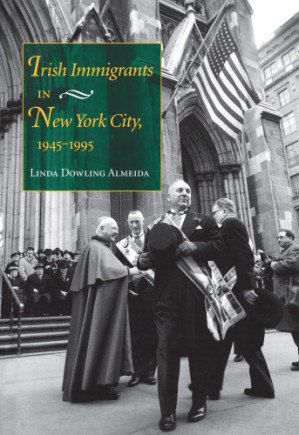
Irish Immigrants in New York City, 1945-1995: 🔍
Almeida, Linda Dowling;
Indiana University Press : Made available through hoopla, 2001;2017
英语 [en] · EPUB · 1.5MB · 2001 · 📘 非小说类图书 · 🚀/lgli/lgrs/nexusstc/upload/zlib · Save
描述
The Irish are everywhere in America, from Frank McCourt (with two books on the bestseller lists), to Riverdance, to PBS specials, to Pierce Brosnan (James Bond is really Irish-American--we knew it all time) to U2, etc. And immigrants are everywhere. This book tells the story of one of the most visible groups of immigrants in the major city of immigrants in the last half of the twentieth-century.
备用文件名
upload/bibliotik/0_Other/2/2001 Irish Immigrants in New York City, 1945-1995.epub
备用文件名
lgli/Z:\Bibliotik_\15\2\2001 Irish Immigrants in New York City, 1945-1995.epub
备用文件名
lgrsnf/Z:\Bibliotik_\15\2\2001 Irish Immigrants in New York City, 1945-1995.epub
备用文件名
nexusstc/Irish Immigrants in New York City, 1945-1995/840b793e4678ad92ced1db7da28e3a47.epub
备用文件名
zlib/History/American Studies/Almeida, Linda Dowling/Irish Immigrants in New York City, 1945-1995_5817464.epub
备选标题
Why We Fought
备选作者
Linda Dowling Almeida; hoopla digital
备选作者
Clinton Hartley Grattan
备选作者
Dowling Almeida, Linda
备用出版商
Quarry Books
备用版本
Book collections on Project MUSE, Bloomington, ©2001
备用版本
Indiana University Press, Bloomington, 2001
备用版本
United States, United States of America
备用版本
Bloomington, Indiana, 2001
备用版本
Bloomington, cop. 2001
备用版本
United States, 2001
备用版本
1st Edition, 2001
备用版本
2, 2001
元数据中的注释
lg2580114
元数据中的注释
{"edition":"1","isbns":["0253108535","0253338433","9780253108531","9780253338433"],"last_page":225,"publisher":"Indiana University Press"}
元数据中的注释
Includes bibliographical references (p. [189]-205) and index.
备用描述
At the beginning of the twenty-first century, it is estimated that one in three New York City residents is an immigrant. No other American city has a population composed of so many different nationalities - more than 100 at last count. Of these 'foreign-born' a relatively small percentage come from Ireland, but the Irish presence in the city (and in America) is ubiquitous. In the 1990 census, forty-four million Americans identified themselves as having Irish ancestry. Of these, over half a million lived in New York City. From a President who has taken a personal role in the Northern Ireland peace process (and who claims Irish ancestry himself); to Frank McCourt and Alice McDermott, whose books top the bestseller lists and captured the Pulitzer Prize and National Book Award; to films like "My Left Foot", "The Crying Game" and "Brothers McMullen"; to singers like Sinead O'Connor, and the bands U2 and Black 47; to the phenomenally successful Riverdance, the Irish presence is everywhere. Ironically, while thousands of books and articles have been written about the Irish in America, relatively little has been published about post-World-War-II immigrants. Hence this book. It identifies two very distinct waves of Catholic Irish immigrants - one in the 1950s and one in the 1980s. These were the largest post-War groups to come out of Ireland and they were the first to leave an independent Ireland. This book grew out of surveys conducted among the 1980s group - the self-proclaimed 'New Irish'. It reveals a tense distance between the eighties immigrants and the established Irish-American and immigrant community. The differences have as much to do with the culture and society from which the New Irish came, as with the economic and social circumstances they found in New York. Even though both migrant communities originated in Ireland, their culture, politics and overall world perspective were quite different. For more than three centuries Irish men and women have crossed the Atlantic to make a new home in North America. The five years from 1845 to 1850 are the most important period in Irish-American history. In that half decade, almost one million Irish entered the United States in the wake of a potato famine that devastated Ireland and eliminated almost two million people from its population. Most of the Famine immigrants came through, if not settled in, New York City. New York City is a metropolis built by and inhabited by immigrants. In 1850, 46 per cent of the population was born abroad. In 1990, 28.4 per cent of the population was born abroad. The primary difference between the two periods is the origin of the foreign population. European immigrants dominated 19th century movement, while Hispanic and Asian natives outnumbered Europeans at the end of the 20th century. However the immigration of the Irish to the United States and to New York City in particular has continued uninterrupted since before the American Revolution. The story of 19th century Irish migration to New York (dramatically retold in this book) not only profiles the mass movement of more than three million Irish across the Atlantic to a new life, new land and new culture, it profiles the development of the modern urban community. The story of the Irish is the story of the 19th century American industrial city. The Irish needed New York as a refuge at mid-century and New York (since before the Famine) needed the Irish and subsequent immigrants to build and maintain the complex urban metropolis that was New York City. Using the two groups of post-World-War II immigrants as examples, Making their way in Twentieth Century America analyses the evolution of ethnic identity as well as the state of modern Irish immigration and the relationship between Ireland and the United States within the context of the long history of migration between the two countries and the changing dynamic of worldwide immigration to the United States
备用描述
<p>Irish Immigrants in New York City,<br>
1945-1995</p>
<p>Linda Dowling Almeida</p>
<p>The story of one of the most visible groups of immigrants in the major city of immigrants in the last half of the 20th century.</p>
<p>"Almeida offers a dynamic portrait of Irish New York, one that keeps reinventing itself under new circumstances."<br>
—Hasia Diner, New York University</p>
<p>"[Almeida’s] close attention to changes in economics, culture, and politics on both sides of the Atlantic makes [this book] one of the more accomplished applications of the ‘new social history’ to a contemporary American ethnic group." —Roger Daniels, University of Cincinnati</p>
<p>It is estimated that one in three New York City residents is an immigrant. No other American city has a population composed of so many different nationalities. Of these "foreign born," a relatively small percentage come directly from Ireland, but the Irish presence in the city—and America—is ubiquitous. In the 1990 census, Irish ancestry was claimed by over half a million New Yorkers and by 44 million nationwide. The Irish presence in popular American culture has also been highly visible.</p>
<p>Yet for all the attention given to Irish Americans, surprisingly little has been said about post–World War II immigrants. Almeida’s research takes important steps toward understanding modern Irish immigration. Comparing 1950s Irish immigrants with the "New Irish" of the 1980s, Almeida provides insights into the evolution of the Irish American identity and addresses the role of the United States and Ireland in shaping it.</p>
<p>She finds, among other things, that social and economic progress in Ireland has heightened expectations for Irish immigrants. But at the same time they face greater challenges in gaining legal residence, a situation that has led the New Irish to reject many organizations that long supported previous generations of Irish immigrants in favor of new ones better-suited to their needs.</p>
<p>Linda Dowling Almeida, Adjunct Professor of History at New York University, has published articles on the "New Irish" in America and is a longtime member of the New York Irish History Roundtable. She also edited Volume 8 of the journal New York Irish History.</p>
<p>March 2001<br>
232 pages, 6 1/8 x 9 1/4, index, append.<br>
cloth 0-253-33843-3 $35.00 s / £26.5</p>
1945-1995</p>
<p>Linda Dowling Almeida</p>
<p>The story of one of the most visible groups of immigrants in the major city of immigrants in the last half of the 20th century.</p>
<p>"Almeida offers a dynamic portrait of Irish New York, one that keeps reinventing itself under new circumstances."<br>
—Hasia Diner, New York University</p>
<p>"[Almeida’s] close attention to changes in economics, culture, and politics on both sides of the Atlantic makes [this book] one of the more accomplished applications of the ‘new social history’ to a contemporary American ethnic group." —Roger Daniels, University of Cincinnati</p>
<p>It is estimated that one in three New York City residents is an immigrant. No other American city has a population composed of so many different nationalities. Of these "foreign born," a relatively small percentage come directly from Ireland, but the Irish presence in the city—and America—is ubiquitous. In the 1990 census, Irish ancestry was claimed by over half a million New Yorkers and by 44 million nationwide. The Irish presence in popular American culture has also been highly visible.</p>
<p>Yet for all the attention given to Irish Americans, surprisingly little has been said about post–World War II immigrants. Almeida’s research takes important steps toward understanding modern Irish immigration. Comparing 1950s Irish immigrants with the "New Irish" of the 1980s, Almeida provides insights into the evolution of the Irish American identity and addresses the role of the United States and Ireland in shaping it.</p>
<p>She finds, among other things, that social and economic progress in Ireland has heightened expectations for Irish immigrants. But at the same time they face greater challenges in gaining legal residence, a situation that has led the New Irish to reject many organizations that long supported previous generations of Irish immigrants in favor of new ones better-suited to their needs.</p>
<p>Linda Dowling Almeida, Adjunct Professor of History at New York University, has published articles on the "New Irish" in America and is a longtime member of the New York Irish History Roundtable. She also edited Volume 8 of the journal New York Irish History.</p>
<p>March 2001<br>
232 pages, 6 1/8 x 9 1/4, index, append.<br>
cloth 0-253-33843-3 $35.00 s / £26.5</p>
备用描述
<P>Irish Immigrants in New York City, <br/>1945-1995</P><P>Linda Dowling Almeida</P><P>The story of one of the most visible groups of immigrants in the major city of immigrants in the last half of the 20th century.</P><P>"Almeida offers a dynamic portrait of Irish New York, one that keeps reinventing itself under new circumstances." <br/>—Hasia Diner, New York University</P><P>"[Almeida's] close attention to changes in economics, culture, and politics on both sides of the Atlantic makes [this book] one of the more accomplished applications of the 'new social history' to a contemporary American ethnic group." —Roger Daniels, University of Cincinnati</P><P>It is estimated that one in three New York City residents is an immigrant. No other American city has a population composed of so many different nationalities. Of these "foreign born," a relatively small percentage come directly from Ireland, but the Irish presence in the city—and America—is ubiquitous. In the 1990 census, Irish ancestry was claimed by over half a million New Yorkers and by 44 million nationwide. The Irish presence in popular American culture has also been highly visible.</P><P>Yet for all the attention given to Irish Americans, surprisingly little has been said about post–World War II immigrants. Almeida's research takes important steps toward understanding modern Irish immigration. Comparing 1950s Irish immigrants with the "New Irish" of the 1980s, Almeida provides insights into the evolution of the Irish American identity and addresses the role of the United States and Ireland in shaping it.</P><P>She finds, among other things, that social and economic progress in Ireland has heightened expectations for Irish immigrants. But at the same time they face greater challenges in gaining legal residence, a situation that has led the New Irish to reject many organizations that long supported previous generations of Irish immigrants in favor of new ones better-suited to their needs.</P><P>Linda Dowling Almeida, Adjunct Professor of History at New York University, has published articles on the "New Irish" in America and is a longtime member of the New York Irish History Roundtable. She also edited Volume 8 of the journal New York Irish History.</P><P>March 2001<br/>232 pages, 6 1/8 x 9 1/4, index, append.<br/>cloth 0-253-33843-3 $35.00 s / £26.5</P>
备用描述
"It is estimated that one in three New York City residents is an immigrant. No other American city has a population composed of so many different nationalities. Of these "foreign born," a relatively small percentage come directly from Ireland, but the Irish presence in the city--and America--is ubiquitous. In the 1990 census, Irish ancestry was claimed by over half a million New Yorkers and by 44 million nationwide. The Irish presence in popular American culture has also been highly visible. Yet for all the attention given to Irish Americans, surprisingly little has been said about post–World War II immigrants. Almeida's research takes important steps toward understanding modern Irish immigration. Comparing 1950s Irish immigrants with the "New Irish" of the 1980s, Almeida provides insights into the evolution of the Irish American identity and addresses the role of the United States and Ireland in shaping it. She finds, among other things, that social and economic progress in Ireland has heightened expectations for Irish immigrants. But at the same time they face greater challenges in gaining legal residence, a situation that has led the New Irish to reject many organizations that long supported previous generations of Irish immigrants in favor of new ones better-suited to their needs." -- Publisher's description
备用描述
Preliminary Table of Contents: AcknowledgmentsIntroductionChapter 1: The Background: When the Irish Ran New YorkChapter 2: The 1950s: "It Was a Great Time in AmericaChapter 3: The 1970s: The InterimChapter 4: The 1980s: The New IrishChapter 5: The Catholic Church: What Parish Are You From?Chapter 6: Who Are the Irish?ConclusionEpilogueBibliography
开源日期
2020-07-26
🚀 快速下载
成为会员以支持书籍、论文等的长期保存。为了感谢您对我们的支持,您将获得高速下载权益。❤️
如果您在本月捐款,您将获得双倍的快速下载次数。
🐢 低速下载
由可信的合作方提供。 更多信息请参见常见问题解答。 (可能需要验证浏览器——无限次下载!)
- 低速服务器(合作方提供) #1 (稍快但需要排队)
- 低速服务器(合作方提供) #2 (稍快但需要排队)
- 低速服务器(合作方提供) #3 (稍快但需要排队)
- 低速服务器(合作方提供) #4 (稍快但需要排队)
- 低速服务器(合作方提供) #5 (无需排队,但可能非常慢)
- 低速服务器(合作方提供) #6 (无需排队,但可能非常慢)
- 低速服务器(合作方提供) #7 (无需排队,但可能非常慢)
- 低速服务器(合作方提供) #8 (无需排队,但可能非常慢)
- 低速服务器(合作方提供) #9 (无需排队,但可能非常慢)
- 下载后: 在我们的查看器中打开
所有选项下载的文件都相同,应该可以安全使用。即使这样,从互联网下载文件时始终要小心。例如,确保您的设备更新及时。
外部下载
-
对于大文件,我们建议使用下载管理器以防止中断。
推荐的下载管理器:JDownloader -
您将需要一个电子书或 PDF 阅读器来打开文件,具体取决于文件格式。
推荐的电子书阅读器:Anna的档案在线查看器、ReadEra和Calibre -
使用在线工具进行格式转换。
推荐的转换工具:CloudConvert和PrintFriendly -
您可以将 PDF 和 EPUB 文件发送到您的 Kindle 或 Kobo 电子阅读器。
推荐的工具:亚马逊的“发送到 Kindle”和djazz 的“发送到 Kobo/Kindle” -
支持作者和图书馆
✍️ 如果您喜欢这个并且能够负担得起,请考虑购买原版,或直接支持作者。
📚 如果您当地的图书馆有这本书,请考虑在那里免费借阅。
下面的文字仅以英文继续。
总下载量:
“文件的MD5”是根据文件内容计算出的哈希值,并且基于该内容具有相当的唯一性。我们这里索引的所有影子图书馆都主要使用MD5来标识文件。
一个文件可能会出现在多个影子图书馆中。有关我们编译的各种数据集的信息,请参见数据集页面。
有关此文件的详细信息,请查看其JSON 文件。 Live/debug JSON version. Live/debug page.