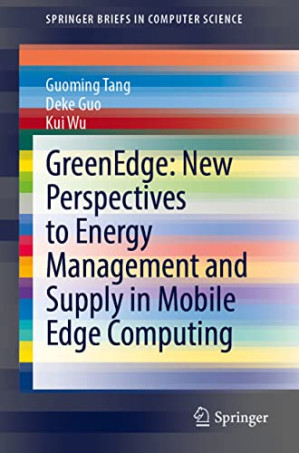
GreenEdge : new perspectives to energy management and supply in mobile edge computing : the first book on green edge computing 🔍
Guoming Tang, Deke Guo, Kui Wu
Springer Nature Singapore : Imprint : Springer, SpringerBriefs in Computer Science, 1st ed. 2022, Singapore, 2022
英语 [en] · PDF · 6.6MB · 2022 · 📘 非小说类图书 · 🚀/lgli/lgrs/zlib · Save
描述
The 5G technology has been commercialized worldwide and is expected to provide superior performance with enhanced mobile broadband, ultra-low latency transmission, and massive IoT connections. Meanwhile, the edge computing paradigm gets popular to provide distributed computing and storage resources in proximity to the users. As edge services and applications prosper, 5G and edge computing will be tightly coupled and continuously promote each other forward.
Embracing this trend, however, mobile users, infrastructure providers, and service providers are all faced with the energy dilemma. On the user side, battery-powered mobile devices are much constrained by battery life, whereas mobile platforms and apps nowadays are usually power-hungry. At the infrastructure and service provider side, the energy cost of edge facilities accounts for a large proportion of operating expenses and has become a huge burden.
This book provides a collection of most recent attempts to tackle the energy issues in mobile edge computing from new and promising perspectives. For example, the book investigates the pervasive low-battery anxiety among modern mobile users and quantifies the anxiety degree and likely behavior concerning the battery status. Based on the quantified model, a low-power video streaming solution is developed accordingly to save mobile devices' energy and alleviate users' low-battery anxiety. In addition to energy management for mobile users, the book also looks into potential opportunities to energy cost saving and carbon emission reduction at edge facilities, particularly the 5G base stations and geo-distributed edge datacenters.
Embracing this trend, however, mobile users, infrastructure providers, and service providers are all faced with the energy dilemma. On the user side, battery-powered mobile devices are much constrained by battery life, whereas mobile platforms and apps nowadays are usually power-hungry. At the infrastructure and service provider side, the energy cost of edge facilities accounts for a large proportion of operating expenses and has become a huge burden.
This book provides a collection of most recent attempts to tackle the energy issues in mobile edge computing from new and promising perspectives. For example, the book investigates the pervasive low-battery anxiety among modern mobile users and quantifies the anxiety degree and likely behavior concerning the battery status. Based on the quantified model, a low-power video streaming solution is developed accordingly to save mobile devices' energy and alleviate users' low-battery anxiety. In addition to energy management for mobile users, the book also looks into potential opportunities to energy cost saving and carbon emission reduction at edge facilities, particularly the 5G base stations and geo-distributed edge datacenters.
备用文件名
lgrsnf/softarchive.is-978-981-16-9690-9.pdf
备用文件名
zlib/Technique/Energy/Guoming Tang, Deke Guo, Kui Wu/GreenEdge: New Perspectives to Energy Management and Supply in Mobile Edge Computing_23325831.pdf
备选作者
Tang, Guoming; Guo, Deke; Wu, Kui
备用出版商
Springer Nature Singapore Pte Ltd Fka Springer Science + Business Media Singapore Pte Ltd
备用版本
Springer Nature, Singapore, 2022
备用版本
Singapore, Singapore
备用版本
uuuu
备用描述
Preface
Contents
1 Introduction
1.1 When 5G Meets Edge Computing
1.2 The Energy Dilemma
1.3 Key Problems and Contributions
1.4 Content Organization
2 Investigating Low-Battery Anxiety of Mobile Users
2.1 Introduction
2.2 Related Work
2.3 A Survey Over 2000+ Mobile Users
2.4 Quantification of Low-Battery Anxiety
2.4.1 Extraction of LBA Curve
2.4.2 Observations and Analysis
2.4.2.1 Overall LBA Curve
2.4.2.2 LBA Curves for Different Age Groups
2.4.2.3 Role of Gender in Battery Charging
2.4.3 Lessons Learnt from LBA Quantification
2.5 Impacts of LBA on Video Watching
2.5.1 Extraction of Video Abandoning Likelihood Curve
2.5.2 Observations and Analysis
2.5.2.1 Overall Video Abandoning Likelihood
2.5.2.2 Video Abandoning Likelihood for Different Age Groups
2.5.2.3 Correlation Between Battery Charging and Video Abandoning
2.5.3 Advice for Video Streaming Services
2.6 Ethics
2.7 Conclusion
3 User Energy and LBA Aware Mobile Video Streaming
3.1 Introduction
3.2 Background and Related Work
3.2.1 Background of Low-Battery Anxiety
3.2.2 Background of Display Power Saving
3.2.2.1 Power Saving for LCD
3.2.2.2 Power Saving for OLED
3.2.3 Work Related to This Work
3.2.3.1 Proxy-Based Energy Saving
3.2.3.2 Energy-Performance Tradeoff
3.3 LBA Survey and Modelling
3.3.1 Data Collection
3.3.2 LBA Curve Extraction
3.3.3 Insights on LBA Alleviation
3.4 LPVS: Low-Power Video Streaming
3.4.1 Scenario Overview
3.4.2 Models for Power Consumption in Video Streaming
3.4.3 Models for Energy Status and Low-Battery Anxiety
3.4.4 Video Streaming Capacity at the Edge
3.4.5 Joint Optimization for Energy Saving and Anxiety Reduction
3.5 Solution Methodology
3.5.1 The Difficulties
3.5.2 Information Compacting
3.5.3 A Two-Phase Heuristic for Joint Optimization
3.5.4 Determine γn with Bayesian Inference
3.6 LBA Model Updating
3.6.1 Analysis of LBA Heterogeneity
3.6.2 Local LBA Model Updating
3.7 Implementations
3.7.1 Real-World Video Streaming Traces
3.7.2 LPVS Emulation and Setups
3.8 Performance Evaluations
3.8.1 LPVS with Sufficient Edge Resource
3.8.1.1 Energy Saving of Mobile Devices
3.8.1.2 Anxiety Reduction of Mobile Users
3.8.2 LPVS with Limited Edge Resource
3.8.2.1 Energy Saving of Mobile Devices
3.8.2.2 Anxiety Reduction of Mobile Users
3.8.3 Impact of LPVS on Low-Battery Users
3.8.4 LPVS with Updated LBA Models
3.8.5 Overhead of LPVS and Impact on Other QoE Metrics
3.9 Conclusion
4 Optimal Backup Power Allocation for 5G Base Stations
4.1 Introduction
4.1.1 Spatial Dimension
4.1.2 Temporal Dimension
4.2 Related Work
4.3 BS Power Measurements and Observations
4.3.1 Power Consumption of 4G and 5G BSs
4.3.2 Power Consumption of 5G BS Major Components
4.3.3 Multiplexing Gain with Backup Power Sharing
4.4 System Model
4.4.1 Scenario Overview
4.4.1.1 Base Stations
4.4.1.2 Backup Batteries
4.4.1.3 Battery Capacity and Deployment
4.4.2 Traffic Load and Power Demand
4.5 Optimal Backup Power Allocation
4.5.1 Analysis of Power Outages and Network Failure
4.5.1.1 Synchronous Outage
4.5.1.2 Asynchronous Outage
4.5.2 Condition of Network Reliability
4.5.3 Backup Power Deployment Constraints
4.5.4 Backup Power Allocation Optimization
4.6 Experimental Evaluations
4.6.1 Experiment Setup
4.6.1.1 Scenario
4.6.1.2 BS Power Demands
4.6.1.3 Benchmarks
4.6.2 Results and Analysis
4.6.2.1 Cost Saving vs. Number of PoPs
4.6.2.2 Cost Saving vs. C and L
4.6.2.3 Case Study
4.7 Conclusion
5 Reusing Backup Batteries for Power Demand Reshaping in 5G
5.1 Introduction
5.2 System Models
5.2.1 Scenario Overview
5.2.2 BS Power Supply and Demand
5.2.3 Battery Specification
5.3 Power Demand Reshaping via BESS Scheduling
5.3.1 Energy Cost with BESS
5.3.2 Battery Degradation Cost
5.3.3 Optimal BESS Operation Scheduling
5.3.3.1 Discharge/Charge Rate Constraint
5.3.3.2 SoC Constraint
5.3.3.3 Battery State Updating
5.3.4 Problem Analysis
5.3.4.1 High Computational Complexity
5.3.4.2 Dynamic Power Demand
5.4 A DRL-Based Approach to Distributed BESS Scheduling
5.4.1 DRL Based BESS Scheduling: Components and Concepts
5.4.2 Reward Function Design
5.4.3 Learning Process Design
5.5 Experimental Evaluations
5.5.1 Experiment Setup
5.5.1.1 BS and Traffic Demand Data
5.5.1.2 Parameter Settings
5.5.1.3 Scenario Settings
5.5.2 General Performance at Cost Reduction with BESS
5.5.2.1 All w/BESS
5.5.2.2 Part w/BESS
5.5.3 Case Studies of DRL-Based BESS Scheduling
5.5.3.1 From an Overall View
5.5.3.2 From Local Views
5.5.4 ROIs of Different BESS Deployments
5.6 Related Work
5.6.1 General System Peak Power Shaving with BESS
5.6.2 DC Peak Power Shaving with Centralized BESS
5.6.3 DC Peak Power Shaving with Distributed BESS
5.7 Conclusion
6 Software-Defined Power Supply to Geo-Distributed Edge DCs
6.1 Introduction
6.2 Architecture of Software-Defined Power Supply (SDPS)
6.2.1 Motivation and Design Rationales
6.2.2 Architecture Design
6.3 Two-Phase Optimization in Software-Defined Power Supply
6.3.1 System Model
6.3.2 Phase-I: Constructing Green Cells
6.3.3 Phase-II: BESS Discharging/Charging Operations
6.4 Experimental Evaluations
6.4.1 Experiments Setup
6.4.2 Performance Comparison
6.5 Conclusion
7 Conclusions and Future Work
7.1 Conclusions
7.2 Future Work
A Questionnaire of LBA Survey and Collected Answers
Bibliography
Contents
1 Introduction
1.1 When 5G Meets Edge Computing
1.2 The Energy Dilemma
1.3 Key Problems and Contributions
1.4 Content Organization
2 Investigating Low-Battery Anxiety of Mobile Users
2.1 Introduction
2.2 Related Work
2.3 A Survey Over 2000+ Mobile Users
2.4 Quantification of Low-Battery Anxiety
2.4.1 Extraction of LBA Curve
2.4.2 Observations and Analysis
2.4.2.1 Overall LBA Curve
2.4.2.2 LBA Curves for Different Age Groups
2.4.2.3 Role of Gender in Battery Charging
2.4.3 Lessons Learnt from LBA Quantification
2.5 Impacts of LBA on Video Watching
2.5.1 Extraction of Video Abandoning Likelihood Curve
2.5.2 Observations and Analysis
2.5.2.1 Overall Video Abandoning Likelihood
2.5.2.2 Video Abandoning Likelihood for Different Age Groups
2.5.2.3 Correlation Between Battery Charging and Video Abandoning
2.5.3 Advice for Video Streaming Services
2.6 Ethics
2.7 Conclusion
3 User Energy and LBA Aware Mobile Video Streaming
3.1 Introduction
3.2 Background and Related Work
3.2.1 Background of Low-Battery Anxiety
3.2.2 Background of Display Power Saving
3.2.2.1 Power Saving for LCD
3.2.2.2 Power Saving for OLED
3.2.3 Work Related to This Work
3.2.3.1 Proxy-Based Energy Saving
3.2.3.2 Energy-Performance Tradeoff
3.3 LBA Survey and Modelling
3.3.1 Data Collection
3.3.2 LBA Curve Extraction
3.3.3 Insights on LBA Alleviation
3.4 LPVS: Low-Power Video Streaming
3.4.1 Scenario Overview
3.4.2 Models for Power Consumption in Video Streaming
3.4.3 Models for Energy Status and Low-Battery Anxiety
3.4.4 Video Streaming Capacity at the Edge
3.4.5 Joint Optimization for Energy Saving and Anxiety Reduction
3.5 Solution Methodology
3.5.1 The Difficulties
3.5.2 Information Compacting
3.5.3 A Two-Phase Heuristic for Joint Optimization
3.5.4 Determine γn with Bayesian Inference
3.6 LBA Model Updating
3.6.1 Analysis of LBA Heterogeneity
3.6.2 Local LBA Model Updating
3.7 Implementations
3.7.1 Real-World Video Streaming Traces
3.7.2 LPVS Emulation and Setups
3.8 Performance Evaluations
3.8.1 LPVS with Sufficient Edge Resource
3.8.1.1 Energy Saving of Mobile Devices
3.8.1.2 Anxiety Reduction of Mobile Users
3.8.2 LPVS with Limited Edge Resource
3.8.2.1 Energy Saving of Mobile Devices
3.8.2.2 Anxiety Reduction of Mobile Users
3.8.3 Impact of LPVS on Low-Battery Users
3.8.4 LPVS with Updated LBA Models
3.8.5 Overhead of LPVS and Impact on Other QoE Metrics
3.9 Conclusion
4 Optimal Backup Power Allocation for 5G Base Stations
4.1 Introduction
4.1.1 Spatial Dimension
4.1.2 Temporal Dimension
4.2 Related Work
4.3 BS Power Measurements and Observations
4.3.1 Power Consumption of 4G and 5G BSs
4.3.2 Power Consumption of 5G BS Major Components
4.3.3 Multiplexing Gain with Backup Power Sharing
4.4 System Model
4.4.1 Scenario Overview
4.4.1.1 Base Stations
4.4.1.2 Backup Batteries
4.4.1.3 Battery Capacity and Deployment
4.4.2 Traffic Load and Power Demand
4.5 Optimal Backup Power Allocation
4.5.1 Analysis of Power Outages and Network Failure
4.5.1.1 Synchronous Outage
4.5.1.2 Asynchronous Outage
4.5.2 Condition of Network Reliability
4.5.3 Backup Power Deployment Constraints
4.5.4 Backup Power Allocation Optimization
4.6 Experimental Evaluations
4.6.1 Experiment Setup
4.6.1.1 Scenario
4.6.1.2 BS Power Demands
4.6.1.3 Benchmarks
4.6.2 Results and Analysis
4.6.2.1 Cost Saving vs. Number of PoPs
4.6.2.2 Cost Saving vs. C and L
4.6.2.3 Case Study
4.7 Conclusion
5 Reusing Backup Batteries for Power Demand Reshaping in 5G
5.1 Introduction
5.2 System Models
5.2.1 Scenario Overview
5.2.2 BS Power Supply and Demand
5.2.3 Battery Specification
5.3 Power Demand Reshaping via BESS Scheduling
5.3.1 Energy Cost with BESS
5.3.2 Battery Degradation Cost
5.3.3 Optimal BESS Operation Scheduling
5.3.3.1 Discharge/Charge Rate Constraint
5.3.3.2 SoC Constraint
5.3.3.3 Battery State Updating
5.3.4 Problem Analysis
5.3.4.1 High Computational Complexity
5.3.4.2 Dynamic Power Demand
5.4 A DRL-Based Approach to Distributed BESS Scheduling
5.4.1 DRL Based BESS Scheduling: Components and Concepts
5.4.2 Reward Function Design
5.4.3 Learning Process Design
5.5 Experimental Evaluations
5.5.1 Experiment Setup
5.5.1.1 BS and Traffic Demand Data
5.5.1.2 Parameter Settings
5.5.1.3 Scenario Settings
5.5.2 General Performance at Cost Reduction with BESS
5.5.2.1 All w/BESS
5.5.2.2 Part w/BESS
5.5.3 Case Studies of DRL-Based BESS Scheduling
5.5.3.1 From an Overall View
5.5.3.2 From Local Views
5.5.4 ROIs of Different BESS Deployments
5.6 Related Work
5.6.1 General System Peak Power Shaving with BESS
5.6.2 DC Peak Power Shaving with Centralized BESS
5.6.3 DC Peak Power Shaving with Distributed BESS
5.7 Conclusion
6 Software-Defined Power Supply to Geo-Distributed Edge DCs
6.1 Introduction
6.2 Architecture of Software-Defined Power Supply (SDPS)
6.2.1 Motivation and Design Rationales
6.2.2 Architecture Design
6.3 Two-Phase Optimization in Software-Defined Power Supply
6.3.1 System Model
6.3.2 Phase-I: Constructing Green Cells
6.3.3 Phase-II: BESS Discharging/Charging Operations
6.4 Experimental Evaluations
6.4.1 Experiments Setup
6.4.2 Performance Comparison
6.5 Conclusion
7 Conclusions and Future Work
7.1 Conclusions
7.2 Future Work
A Questionnaire of LBA Survey and Collected Answers
Bibliography
备用描述
This book provides a collection of most recent attempts to tackle the energy issues in mobile edge computing from new and promising perspectives. For example, the book investigates the pervasive low-battery anxiety among modern mobile users and quantifies the anxiety degree and likely behavior concerning the battery status. Based on the quantified model, a low-power video streaming solution is developed accordingly to save mobile devices' energy and alleviate users' low-battery anxiety. In addition to energy management for mobile users, the book also looks into potential opportunities to energy cost saving and carbon emission reduction at edge facilities, particularly the 5G base stations and geo-distributed edge datacenters.
Erscheinungsdatum: 18.05.2022
Erscheinungsdatum: 18.05.2022
开源日期
2022-10-19
We strongly recommend that you support the author by buying or donating on their personal website, or borrowing in your local library.
🚀 快速下载
成为会员以支持书籍、论文等的长期保存。为了感谢您对我们的支持,您将获得高速下载权益。❤️
如果您在本月捐款,您将获得双倍的快速下载次数。
🐢 低速下载
由可信的合作方提供。 更多信息请参见常见问题解答。 (可能需要验证浏览器——无限次下载!)
- 低速服务器(合作方提供) #1 (稍快但需要排队)
- 低速服务器(合作方提供) #2 (稍快但需要排队)
- 低速服务器(合作方提供) #3 (稍快但需要排队)
- 低速服务器(合作方提供) #4 (稍快但需要排队)
- 低速服务器(合作方提供) #5 (无需排队,但可能非常慢)
- 低速服务器(合作方提供) #6 (无需排队,但可能非常慢)
- 低速服务器(合作方提供) #7 (无需排队,但可能非常慢)
- 低速服务器(合作方提供) #8 (无需排队,但可能非常慢)
- 低速服务器(合作方提供) #9 (无需排队,但可能非常慢)
- 下载后: 在我们的查看器中打开
所有选项下载的文件都相同,应该可以安全使用。即使这样,从互联网下载文件时始终要小心。例如,确保您的设备更新及时。
外部下载
-
对于大文件,我们建议使用下载管理器以防止中断。
推荐的下载管理器:JDownloader -
您将需要一个电子书或 PDF 阅读器来打开文件,具体取决于文件格式。
推荐的电子书阅读器:Anna的档案在线查看器、ReadEra和Calibre -
使用在线工具进行格式转换。
推荐的转换工具:CloudConvert和PrintFriendly -
您可以将 PDF 和 EPUB 文件发送到您的 Kindle 或 Kobo 电子阅读器。
推荐的工具:亚马逊的“发送到 Kindle”和djazz 的“发送到 Kobo/Kindle” -
支持作者和图书馆
✍️ 如果您喜欢这个并且能够负担得起,请考虑购买原版,或直接支持作者。
📚 如果您当地的图书馆有这本书,请考虑在那里免费借阅。
下面的文字仅以英文继续。
总下载量:
“文件的MD5”是根据文件内容计算出的哈希值,并且基于该内容具有相当的唯一性。我们这里索引的所有影子图书馆都主要使用MD5来标识文件。
一个文件可能会出现在多个影子图书馆中。有关我们编译的各种数据集的信息,请参见数据集页面。
有关此文件的详细信息,请查看其JSON 文件。 Live/debug JSON version. Live/debug page.