nexusstc/Sources of East Asian Tradition, Volume 1: Premodern Asia/628942a8d177e30f0d793555b6130d79.djvu
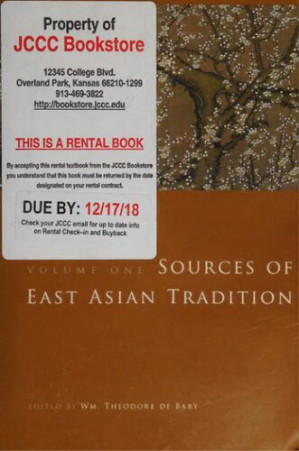
Sources of East Asian tradition (China, Korea, Japan). V.1. Premodern Asia 1 🔍
Wm. Theodore de Bary (editor)
Columbia University Press, Introduction to Asian Civilizations, 1, 2008
英语 [en] · DJVU · 21.1MB · 2008 · 📘 非小说类图书 · 🚀/lgli/lgrs/nexusstc/zlib · Save
描述
"In Sources of East Asian Tradition, Wm. Theodore de Bary offers a selection of essential readings from his immensely popular anthologies Sources of Chinese Tradition, Sources of Korean Tradition, and Sources of Japanese Tradition so readers can experience a concise but no less comprehensive portrait of the social, intellectual, and religious traditions of East Asia. Volume 1 samples writings from the earliest times to 1600, illuminating life in early China and the first imperial age, as well as the profound impact of Daoism, Buddhism, the Confucian revival, and Neo-Confucianism; the origins of Korean culture and political structures, up through the Choson dynasty; and major developments in early and medieval Japan. De Bary maintains his trademark balance of source materials, including seminal readings in the areas of history, society, politics, education, philosophy, and religion, thereby continuing his own tradition of providing an exceptional resource for teachers, scholars, students, and the general reader". --Publisher
备用文件名
lgli/Sources of East Asian tradition (China, Korea, Japan). V.1. Premodern Asia (2008).djvu
备用文件名
lgrsnf/Sources of East Asian tradition (China, Korea, Japan). V.1. Premodern Asia (2008).djvu
备用文件名
zlib/Society, Politics & Philosophy/Anthropology/Wm. Theodore de Bary (editor)/Sources of East Asian Tradition, Volume 1: Premodern Asia_18066163.djvu
备选标题
Sources of East Asian Tradition, Vol. 2: The Modern Period (Introduction to Asian Civilizations)
备选标题
Sources of East Asian Tradition, Vol. 1: Premodern Asia (Introduction to Asian Civilizations)
备选标题
Sources of East Asian Tradition, Volume 1: Premodern Asia
备选作者
Wm Theodore De Bary; Irene Bloom; Donald Keene; Yŏng-ho Chʻoe; Richard John Lufrano; Carol Gluck; George J Tanabe; Peter H Lee; H. Paul Varley; Burton Watson
备选作者
edited by Wm. Theodore de Bary with the collaboration of Yǒng-ho Ch'oe ... [et al.]
备选作者
Wm. Theodore De Bary; William Theodore De Bary
备用出版商
Columbia Business School Publishing
备用出版商
King's Crown Paperbacks
备用版本
Sources of East Asian tradition / ed. by Wm. Theodore de Bary, / ed. by Wm. Theodore de Bary ; Vol. 2, New York, 2008
备用版本
Introduction to Asian civilizations, New York, New York State, 2008
备用版本
Introduction to Asian civilizations, New York ; Chichester, ©2008
备用版本
United States, United States of America
备用版本
Illustrated, 2008-07-15
备用版本
Illustrated, PS, 2008
备用版本
June 13, 2008
备用版本
May 30, 2008
备用版本
May 1, 2008
元数据中的注释
{"isbns":["0231143044","0231143052","0231143222","0231143230","2007028403","9780231143042","9780231143059","9780231143226","9780231143233"],"publisher":"Columbia University Press","series":"Introduction to Asian Civilizations"}
元数据中的注释
Includes bibliographical references and index.
备用描述
Contents
Preface
Acknowledgments
PART ONE. Traditional China
Explanatory Note
Contributors
Chronology
1. The Oracle-Bone Inscriptions of the Late Shang Dynasty. DAVID N. KEIGHTLEY
The Shang Dynasty
The Oracle-Bone Inscriptions
The High God (Di) and Other Powers
Divination and Legitimation
The Legacy of Shang
2. Classical Sources of Chinese Tradition. BURTON WATSON, DAVID S. NIVISON, IRENE BLOOM
The Classic of Documents
The “Canon of Yao” and the “Canon of Shun”
Shao Announcement
The Classic of Odes
From the Greater Odes
3. Confucius and the Analects. IRENE BLOOM
Selections from the Analects
4. Mozi: Utility, Uniformity, and Universal Love. BURTON WATSON
Selections from the Mozi
Section 9: “Honoring the Worthy” (Part 2)
Section 11: “Identifying with the Superior” (Part 1)
Section 16: “Universal Love” (Part 3)
Section 26: “The Will of Heaven” (Part 1)
Section 27: “The Will of Heaven” (Part 2)
Section 39: “Against Confucians” (Part 2)
5. The Way of Laozi and Zhuangzi
Metaphysics and Government in the Laozi (I. Bloom)
From the Daodejing
Transformation and Transcendence in the Zhuangzi (B. Watson, A. C. Graham)
From Chapter 1, “Free and Easy Wandering” (BW)
From Chapter 2, “The Sorting Which Evens Things Out” (ACG, IB)
From Chapter 3, “The Secret of Caring for Life” (BW)
From Chapter 4, Tn the World of Men” (BW)
From Chapter 6, “The Great and Venerable Teacher” (BW)
From Chapter 7, “Fit for Emperors and Kings" (W. T. de Bary)
6. The Evolution of the Confucian Tradition in Antiquity
Mencius (I. Bloom)
Selections from the Mencius
The Duty of Ministers to Reprove a Ruler
The Well-Field System of Landholding
Mencius’ Arguments with Yang Zhu and Mozi
Xunzi (IB)
Selections from the Xunzi
Chapter 1: "Encouraging Learning”
Chapter 2: “Cultivating Oneself”
Chapter 9: “The Regulations of the King”
Chapter 17: “A Discussion of Heaven”
Chapter 19: “A Discussion of Rites”
Chapter 23: “Human Nature as Evil”
The Zuozhuan (B. Watson)
Selection from the Zuozhuan
7. Legalists and Militarists
The Guanzi (W. Allyn Rickett)
The Book of Lord Shang (J. J. L. Duyvendak)
The Han Feizi (B. Watson)
Li Si: Legalist Theories in Practice (BW)
Memorial on the Abolition of the Enfeoffment System
Memorial on the Burning of Books
Memorial on Exercising Heavy Censure
The Military Texts: The Sunzi (K. Smith)
Selections from the Sunzi
8. The Han Reaction to Qin Absolutism
Jia Yi: “The Faults of Qin” (D. W. Y. Kwok)
The Rebellion of Chen She and Wu Guang (B. Watson)
The Rise of Liu Bang, Founder of the Han (BW)
Liu Bang Becomes the First Emperor of the Han Dynasty (BW)
9. Syncretic Visions of State, Society, and Cosmos. HAROLD ROTH, SARAH QUEEN, NATHAN SIVIN
The Theoretical Basis of the Imperial Institution
The Springs and Autumns of Mr. Lu (NS)
The Round Way
The Huang-Lao Silk Manuscripts (HR, SQ)
Book 1: Normative Standards, Part 1
Normative Standards, Part 5
The Guanzi
Techniques of the Mind, I (HR)
The Syncretist Chapters of the Zhuangzi (A. C. Graham, B. Watson)
The World of Thought (BW)
The Huainanzi on Rulership (HR)
Huainanzi 9, "The Techniques of Rulership”
Huainanzi 14, “Inquiring Words”
The Medical Microcosm (NS)
The Divine Pivot
A Syncretist Perspective on the Six Schools
Sima Tan: “On the Six Lineages of Thought” (HR, SQ)
10. The Imperial Order and Han Syntheses
Guidelines for Han Rulers (D. W. Y. Kwok)
Lu Jia: The Natural Order and the Human Order
Jia Yi: The Primacy of the People
DongZhongshu
Luxuriant Gems of the Spring and Autumn Annals (S. Queen)
Deriving Political Norms from Microcosmic and Macrocosmic Models
“The Conduct of Heaven and Earth”
The Responsibilities of Rulership
“Establishing the Primal Numen”
“The Way of the King Penetrates Three”
Defining Human Nature
“An In-Depth Examination of Names and Designations”
Interpreting Omens
“Humaneness Must Precede Wisdom”
Self-Cultivation
“Standards of Humaneness and Rightness”
The Issue of Moral Autonomy
The Codifying of the Confucian Canon (B. Watson)
State Orthodoxy
State University
Civil Service
The Rivalry Between Legalism and Confucianism
The Confucian Canon
The Formation of the Classic of Changes (R. J. Lynn)
The Commentary on the Appended Phrases, Part 1
The Commentary on the Appended Phrases, Part 2
Heaven, Earth, and the Human in the Classic of Filiality (W. T. De Bary)
The Classic of Filiality
The Record of Rites and the Ritual Tradition
The Great Learning (I. Bloom)
The Mean (IB)
“The Meaning of Sacrifices” (IB)
The “Evolution of Rites” (BW)
The “Record of Music” (IB)
Ban Gu: Discourses in the White Tiger Hall
Han Views of the Universal Order (B W)
The Creation of the Universe
From the Huainanzi
The Five Phases
The Reconstruction of Chinese History
The Concept and Marking of Time
11. The Economic Order. BURTON WATSON
Chao Cuo: Memorial on the Encouragement of Agriculture
Dong Zhongshu: Memorial on Land Reform
State Control of Commerce and Industry
The Debate on Salt and Iron
The Reforms of Wang Mang
Wang Mang: Edict on Land Reform
12. The Great Han Historians. BURTON WATSON
The Records of the Grand Historian
Sima Qian: The Sacred Duty of the Historian
The Writing of the First Dynastic History
13. Learning of the Mysterious. RICHARD JOHN LYNN, WING-TSIT CHAN
Wang Bi (RJL)
General Remarks on the Changes of the Zhou (RJL)
The Sage (RJL)
Guo Xiang: Commentary on the Zhuangzi (WTC)
14. Daoist Religion. NATHAN SIVIN, KRISTOFER SCHIPPER
Commandments of Lord Lao (KS)
The Divine Incantations Scripture (NS)
15. The Introduction of Buddhism. LEON HURVITZ, TSAI HENG-TING
Basic Teachings of Buddhism
The Coming of Buddhism to China
Mouzi: Disposing of Error
Huiyuan: “A Monk Does Not Bow Down Before a King”
Admonitions of the Fanwang Sutra (THT)
16, Schools of Buddhist Doctrine. LEON HURVITZ, BURTON WATSON, DANIEL STEVENSON, GEORGE TANABE, WING-TSIT CHAN
The General Character of Doctrinal Buddhism
Schools of Chinese Buddhist Philosophy
The Three-Treatise School
Jizang: The Profound Meaning of the Three Treatises (LH)
The Lotus School: The Tiantai Synthesis (DS)
Excerpts from the Lotus Sutra (BW)
Huisi: The Method of Calming and Contemplation in the Mahayana (LH)
The Flower Garland (Huayan) School (GT)
The Flower Garden Sutra
Buddhism’s Assimilation to Tang Political Culture (C. Orzech)
The Humane King as Protector of Buddhism
17. Schools of Buddhist Practice. LEON HURVITZ, DANIEL STEVENSON, PHILIP B. YAMPOLSKY, CHUN-FANG YU
The Pure Land School
Daochuo: Compendium on the Happy Land (DS, LH)
Shandao: “The Parable of the White Path” (W. T. de Bary)
The Meditation School
The Platform Sutra of the Sixth Patriarch (PY)
The Legend of Baizhang, “Founder” of Chan Monastic Discipline (T. G. Foulk)
Regulations of the Chan School (TGF)
The Chanyuan Monastic Code
Buddhist Rituals and Devotional Practices (CFY)
Zhongfeng Mingben: Admonition on Filiality
18. Social Life and Political Culture in the Tang
The Role of Confucianism in the Tang
House Instructions of Mr. Tan (A. Dien)
The Great Tang Code (W. Johnson)
Zhangsun Wuji: The Tang Code
Han Yu and the Confucian “Way” (C. Hartman)
“Essentials of the Moral Way” (CH)
Memorial on the Bone of Buddha (B. Watson)
Emperor Wuzong’s Edict on the Suppression of Buddhism (BW)
19. The Confucian Revival in the Song. WM. THEODORE DE BARY
The Confucian Program of Reform
The Way as the Basis for Government Policy
Cheng Yi: Memorial to Emperor Renzong
The New Laws of Wang Anshi
Wang Anshi: Memorial to Emperor Renzong
Wang Anshi: In Defense of Five Major Policies
Opposition to the New Laws of Wang Anshi
Sima Guang: A Petition to Do Away with the Most Harmful of the New Laws
“The Learning of the Emperors” and the Classics Mat
Fan Zuyu: The Learning of the Emperors (M. Guarino)
Cheng Yi: Letter to the Empress Dowager Concerning the Classics Mat (MG)
The Writing of History (C. Schirokauer)
Sima Guang: History as Mirror (CS)
Zhu Xi: History and Philosophy in Tandem (B. Watson)
20. Neo-Confucianism: The Philosophy of Human Nature and the Way of the Sage
Zhou Dunyi: The Metaphysics and Practice of Sagehood (Joseph Adler)
“Explanation of the Diagram of the Supreme Polarity”
Penetrating the Classic of Changes
Zhang Zai and the Unity of all Creation (W. T. Chan)
The ‘Western Inscription”
Correcting Youthful Ignorance
The Cheng Brothers: Principle, Human Nature, and the Learning of the Way (WTC)
Principle and the Universe
Human Nature
Cheng Hao’s Reply to Zhang Zai’s Letter on the Stabilizing of Human Nature
Reverent Seriousness and Humanity
On Understanding the Nature of Humanity
The Synthesis of Song Neo-Confucianism in Zhu Xi (W. T. Chan, W. T. de Bary)
Principle and Material-Force
The Supreme Ultimate (Polarity)
Human Nature, the Nature of Things, and Their Destiny
The Nature as Principle
The Psycho-Physical Nature
The Mind-and-Heart
21. Zhu Xi’s Neo-Confucian Program. WM. THEODORE DE BARY
Preface to the Great Learning by Chapter and Phrase
The Great Learning by Chapter and Phrase, Chapter 1
Preface to the Mean by Chapter and Phrase
The Mean by Chapter and Phrase, Chapter 1
Personal Proposals for Schools and Official Recruitment (R. G. Chu)
“Articles of the White Deer Grotto Academy”
Preface to the Family Rituals (Patricia Ebrey)
“Proposal for Community Granaries” (Thomas H.C. Lee)
Proclamation of Instructions (R.G. Chu)
“The Lil Family Community Compact, Amended and Emended” (J. Meskill)
22. Ideological Foundations of Late Imperial China. WM. THEODORE DE BARY, EDWARD FARMER, JOHN DARDESS
Xu Heng and Khubilai Khan (WTdB)
Five Measures Required by the Times
The Examination Debate Under Khubilai
Sage King and Sage Minister: Ouyang Xuan on Khubilai and Xu Heng
Ming Foundations of Late Imperial China
Ming Taizu: August Ming Ancestral Instruction (EF)
Education and Examinations (JD)
Ming Taizu: Placard for the Instruction of the People (EF)
23. Neo-Confucian Education. WM. THEODORE DE BARY
Zhu Xi: Preface to the Elementary Learning
Wang Yinglin: The Three Character Classic
The Standard School Curriculum
Zhen Dexiu: “Instructions for Children” (R. G. Chu)
Women’s Education (T. Kelleher)
Ban Zhao: Admonitions for Women (N. L. Swann)
Madam Cheng: Classic ofFiliality for Women (TK)
Song Ruozhao: Analects for Women (TK)
Empress Xu: Instructions for the Inner Quarters (TK)
24. Self and Society in the Ming
Wang Yangming
Wang Yangmings New Learning of the Mind-and-Heart
Memoir on the Reconstruction of Shanyin Prefectural School (W. T. de Bary)
“Questions on the Great Learning" (W. T. Chan)
The Identification of Mind and Principle
The Unity of Knowing and Acting
The Colloquy at the Tianquan Bridge
Social and Political Measures ofWang Yangming
Fundamental Ideas on Elementary Education (WTC)
The Community Compact for Southern Ganzhou (WTC)
The Wang Yangming School
Wang Gen: The Common Man as Sage (WTdB)
The Huainan Investigation of Things
“Clear Wisdom and Self-Preservation"
Li Zhi: Arch-Individualist (WTdB)
The Childlike Mind-and-Heart
Phony Sages
The Legitimacy of Being Self-Interested
Luo Qinshun and the Philosophy of Qi (I. Bloom)
Monism of Qi
Human Nature
Desires and Feelings
The Practical Learning of Lii Kun (J. H. Smith)
Restoration of Community Schools
Morality Books (R. G. Chu, WTdB)
The Treatise of the Most Exalted One on Moral Retribution (WTC)
The Silent Way of Recompense (WTC)
The Donglin Academy (H. Busch, WTdB)
Gu Xiancheng: Compact for Meetings of the Donglin Academy
Liu Zongzhou on Life and Death (T. Weiming)
“Teaching on Life and Death”
Glossary of Key Terms
Pinyin to Wade-Giles Romanization Chart
PART TWO. Traditional Korea
Explanatory Note
Contributors
Chronology
25. Origins of Korean Culture
The Foundation Myth
Tangun
Korea in the Chinese Dynastic Histories
Accounts of the Eastern Barbarians
26. The Rise of the Three Kingdoms
King ChinhCing’s Monument at Maun Pass
Political Thought
Ch’ang Chori
Social Structure
King Htingddk’s Edict on Clothing, Carts, and Housing
Sol Kyedu
27. The Introduction of Buddhism
Paekche Buddhism
Kydmik and the Disciplinary School
HySngwang and the Lotus Scripture
Silla Buddhism
PSpkong Declares Buddhism the National Faith
Maitreya and Esoteric Buddhism
Maitreya’s Incarnation as a Hwarang
The Hwarang
Origins of the Hwarang
28. Consolidation of the State
Unification of the Three Kingdoms
Account of the Silla-Tang War
Confucian Political Thought
King Sinmun’s Proclamation of His Accession
Confucian Learning
The Royal Confucian Academy
Daoism
Inscription on an Image at Kamsan Monastery (Silla)
29. The Rise of Buddhism
Wdnhyo’s Buddhist Philosophy
Introduction to Exposition of the “Adamantine Absorption Scripture”
Arouse Your Mind and Practice!
Commentary on the Awakening of Faith
Diagram of the Dharmadhatu According to the One Vehicle
Belief in the Pure Land
Ungmyon
30. Local Clans and the Rise of the Meditation School
The Rise of Local Chiefs
Establishment of the Meditation School
The Life of Musang
Toui: Questions and Answers with Chief of Clerics Chiwdn
31. Early Koryo Political Structure
Founding of Koryd
Formation of Government
Wang Kdn: Ten Injunctions
Development of Confucian Polity
Ch’oe Sungno: On Current Affairs
Ch’oe Sungno: On Buddhism
32. Military Rule and Late Koryti Reform
Establishment of Military Rule
Ch’oe Ch’unghfin: The Ten Injunctions
Establishment of the Personnel Authority
Private Armies
Relations with the Mongols
Yi Chehyon: Opposition to Yuan Policies
Late Koryo Reforms
Yi Chehyon: Reform Proposals
Yi Saek: Memorial on Current Affairs
33. Buddhism: The Ch'ont'ae and Chogye Schools
Resurgence of Buddhism
Chinul: The Compact of the Samadhi and Prajna Community
Chinul and the Chogye School
Chinul: Excerpts from the Exposition of the “Flower Garland Scripture”: Preface
Publication of the Tripitaka
Yi Kyubo: Royal Prayer on the Occasion of the Production of the Tripitaka
34. Neo-Confucianism
Yi Saek: The Spread of Neo-Confucianism
Chong Tojon: Philosophical Rebuttal of Buddhism and Daoism
History
Kim Pusik: On Presenting the Historical Record of the Three Kingdoms to the King
35. Political Thought in Early Choson
Ruling the New Dynasty
Kwon Kiln: On Royal Action
New Government
Chong Tojon: On the Prime Minister
The Way of Principle
Cho Kwangjo: On Problems of the Time
Cho Kwangjo: On the Superior Man and the Inferior Man
On Sage Learning
Yi Hwang: Memorial on Six Points
Yi I: Memorial in Ten Thousand Words
36. Culture
Invention of the Korean Alphabet
King Sejong: Preface to Correct Sounds to Instruct the People
Chong Inji: Postscript to Correct Sounds to Instruct the People
Ch’oe Malli: Opposition to the Korean Alphabet
Education and Scholarship
ChSng Tojon: Establishment of Schools
Royal Confucian Academy
White Cloud Grotto Academy
The Recruitment Examinations
Song Hyon: On the Civil Service Examination
Printing Books
Song Hyon: On Printing
37. Social Life
The Role of Rites
Sdng Hy6n: The Fundamental Role of Rites
Yi Chi: On the Establishment of Domestic Shrines
The Position of Women
On Differentiating Between Main Wife and Concubine
On Treating the Main Wife
Prohibition Against Remarriage of Women
Sin Sukchu: House Rules
38. Economy
The Land System
Chong Tojon: On Land
Promotion of Agriculture
King Sejong: Edict for the Promotion of Agriculture
39. Thought
Yi Hwang and the Sage Learning
Ten Diagrams on Sage loaming
Yi I
Letter to Sdng Hon
40. Buddhism
Kihwa
Treatise on Manifesting Rightness
KimSisup
On No-Thought
Hyujong
Secrets of Meditation and Doctrine
PART THREE. Traditional Japan
Explanatory Note
Contributors
Chronology
41. The Earliest Records of Japan
Japan in the Chinese Dynastic Histories
Accounts of the Eastern Barbarians
History of the Kingdom of Wei
History of the Sui Dynasty
The Earliest Japanese Chronicles
Birth of the Land
42. Early Shinto
Legends Concerning Shinto Deities
Birth of the Sun Goddess
Descent of the Divine Grandson with the Three Imperial Regalia
Shinto Prayers
Norito for the Festival of the Sixth Month
The Great Exorcism of the Last Day of the Sixth Month
43. Prince Shotoku and His Constitution
The Reign of Suiko and Rule of Shotoku
The Empress Suiko
The Seventeen-Article Constitution of Prince Shotoku
The Lotus Sutra
The Vimalakirti Sutra
44. Chinese Thought and Institutions in Early Japan
Chinese-Style History and the Imperial Concept
From the Preface to Records of Ancient Matters
Emperor Jinmu
The Reform Era
Inauguration of the Great Reform Era
Reform Edicts
The Commentary on the Legal Code
Regulations for Fitness Reports
New Compilation of the Register of Families
Preface in the Form of a Memorial to Emperor Saga
45. Nara Buddhism
The Sutra of the Golden Light
Buddhism and the State in Nara Japan
Proclamation of the Emperor Shomu on the Erection of the Great Buddha Image
The Bodhisattva Gyogi
Regulation of the Buddhist Orders by the Court
Edicts of the Empress Shotoku Concerning Dokyo
Edict of October 19,764
Edict of November 26, 766
The Merger of Buddhist and Shinto Deities
46. Saicho and Mount Hiei. RYUSAKU TSUNODA, PAUL GRONER
The Tendai Lotus Teaching
Saicho: Vow of Uninterrupted Study of the Lotus Sutra
Regulations for Students of the Mountain School in Six Articles I
Regulations for Students of the Mountain School II
Subsequent History of Tendai and Mount Hiei (PG)
47. Kukai and Esoteric Buddhism
Kukai and His Master
The Transmission of Esoteric Buddhism
Enlightenment in This Bodily Existence
The Ten Stages of Religious Consciousness
Recapitulation of the Ten Stages of Religious Consciousness
A School of Arts and Sciences
The Spread of Esoteric Buddhism
Sex and Buddhahood: A Shingon Heresy
Selections from The Precious Mirror
Annen: “Maxims for the Young”
48. Amida, the Pure Land, and the Response of the Old Buddhism to the New
Traditional Pure Land Buddhism
Genshin: The Essentials of Salvation
Innovators of the New Pure Land Buddhism
Honen: The One-Page Testament
Shinran: The Lamentation and Self-Reflection of Gutoku Shinran
Shinran: A Record in Lament of Divergencies
Rennyo: Rennyo’s Rules
Ippen: Selections from A Hundred Sayings
The Revival of Earlier Buddhism
Myoe: Smashing the Evil Chariot
Jokei: Gedatsu Shonins Petition for Reviving the Precepts
49. New Views of History. PAUL VARLEY
Medieval Uses of the Past
Jien
Gukansho
One Hundred Kings
Helping Emperors Rule
An Appeal to Retired Emperor Go-Toba
Kitabatake Chikafusa and the Southern Court
Direct Succession of Gods and Sovereigns
Fujiwara and Murakami Genji as Assistants to Emperors
On Imperial Restoration
50. The Way of the Warrior. PAUL VARLEY
Taira and Minamoto
The Tale of Ho gen
The Tale of the Heike
“The Mighty Fall at Last, They Are Dust Before the Wind”
Eastern Warriors
The Taira as Courtier-Warriors
Chronicle of Great Peace: The Loyalist Heroes
51. Nichiren: The Sun and the Lotus. PHILIP B. YAMPOLSKY
“Rectification for the Peace of the Nation”
The Eye-Opener
52. Zen Buddhism. WILLIAM BODIFORD
Zen in Japan
Eisai: Propagation of Zen for the Protection of the State
Do gen: How to Practice Buddhism
“The Fully Apparent Case”
Buddha Nature
Muso Soseki: Sermon at the Dedication of Tenryu ji Dharma Hall
Reflections on the Enmity Between Go-Daigo and the Shogun, Ashikaga Takauji
53. Shinto in Medieval Japan
Yoshida Kanetomo: Essentials of Prime Shinto (A. Grapard)
Kitabatake Chikafusa: Chronicle of the Direct Succession of Gods and Sovereigns
54. The Vocabulary of Japanese Aesthetics
The Way of Tea (P. Varley)
Drink Tea and Prolong Life
Murata Shuko: “Letter of the Heart”
The Spiritual Basis of the Tea Ceremony
55. Womens Education
Keisei: A Companion in Solitude (R. Pandey)
Mujulchien: Mirror for Women (R. Morrell)
56. Law and Precepts for the Warrior Houses. PAUL VARLEY
The Joei Code
The Law of the Muromachi Shogunate
The Kenmu Code
The Law of the Warrior Houses in the Age of War in the Provinces
The Yuki House Code
Precepts of the Warrior Houses
House Precepts in the Sengoku Age
“Seventeen-Article Testament of Asakura Toshikage”
57. The Regime of the Unifiers. JURGIS S. A. ELISONAS
Oda Nobunaga
The Assault on Mount Hiei and the Blessings of Nobunaga
Nobunaga in Echizen
Letters from the Battleground
Nobunaga in Azuchi
The Proud Tower
The Free Market of Azuchi
Toyotomi Hideyoshi
Domestic Policies
The Disarmament of the Populace
Restrictions on Change of Status
The Laws and Regulations of the Taiko
The Korean War
Letter to the King of Korea
Keinen: “Korea Day by Day”
Bibliography
Index
Preface
Acknowledgments
PART ONE. Traditional China
Explanatory Note
Contributors
Chronology
1. The Oracle-Bone Inscriptions of the Late Shang Dynasty. DAVID N. KEIGHTLEY
The Shang Dynasty
The Oracle-Bone Inscriptions
The High God (Di) and Other Powers
Divination and Legitimation
The Legacy of Shang
2. Classical Sources of Chinese Tradition. BURTON WATSON, DAVID S. NIVISON, IRENE BLOOM
The Classic of Documents
The “Canon of Yao” and the “Canon of Shun”
Shao Announcement
The Classic of Odes
From the Greater Odes
3. Confucius and the Analects. IRENE BLOOM
Selections from the Analects
4. Mozi: Utility, Uniformity, and Universal Love. BURTON WATSON
Selections from the Mozi
Section 9: “Honoring the Worthy” (Part 2)
Section 11: “Identifying with the Superior” (Part 1)
Section 16: “Universal Love” (Part 3)
Section 26: “The Will of Heaven” (Part 1)
Section 27: “The Will of Heaven” (Part 2)
Section 39: “Against Confucians” (Part 2)
5. The Way of Laozi and Zhuangzi
Metaphysics and Government in the Laozi (I. Bloom)
From the Daodejing
Transformation and Transcendence in the Zhuangzi (B. Watson, A. C. Graham)
From Chapter 1, “Free and Easy Wandering” (BW)
From Chapter 2, “The Sorting Which Evens Things Out” (ACG, IB)
From Chapter 3, “The Secret of Caring for Life” (BW)
From Chapter 4, Tn the World of Men” (BW)
From Chapter 6, “The Great and Venerable Teacher” (BW)
From Chapter 7, “Fit for Emperors and Kings" (W. T. de Bary)
6. The Evolution of the Confucian Tradition in Antiquity
Mencius (I. Bloom)
Selections from the Mencius
The Duty of Ministers to Reprove a Ruler
The Well-Field System of Landholding
Mencius’ Arguments with Yang Zhu and Mozi
Xunzi (IB)
Selections from the Xunzi
Chapter 1: "Encouraging Learning”
Chapter 2: “Cultivating Oneself”
Chapter 9: “The Regulations of the King”
Chapter 17: “A Discussion of Heaven”
Chapter 19: “A Discussion of Rites”
Chapter 23: “Human Nature as Evil”
The Zuozhuan (B. Watson)
Selection from the Zuozhuan
7. Legalists and Militarists
The Guanzi (W. Allyn Rickett)
The Book of Lord Shang (J. J. L. Duyvendak)
The Han Feizi (B. Watson)
Li Si: Legalist Theories in Practice (BW)
Memorial on the Abolition of the Enfeoffment System
Memorial on the Burning of Books
Memorial on Exercising Heavy Censure
The Military Texts: The Sunzi (K. Smith)
Selections from the Sunzi
8. The Han Reaction to Qin Absolutism
Jia Yi: “The Faults of Qin” (D. W. Y. Kwok)
The Rebellion of Chen She and Wu Guang (B. Watson)
The Rise of Liu Bang, Founder of the Han (BW)
Liu Bang Becomes the First Emperor of the Han Dynasty (BW)
9. Syncretic Visions of State, Society, and Cosmos. HAROLD ROTH, SARAH QUEEN, NATHAN SIVIN
The Theoretical Basis of the Imperial Institution
The Springs and Autumns of Mr. Lu (NS)
The Round Way
The Huang-Lao Silk Manuscripts (HR, SQ)
Book 1: Normative Standards, Part 1
Normative Standards, Part 5
The Guanzi
Techniques of the Mind, I (HR)
The Syncretist Chapters of the Zhuangzi (A. C. Graham, B. Watson)
The World of Thought (BW)
The Huainanzi on Rulership (HR)
Huainanzi 9, "The Techniques of Rulership”
Huainanzi 14, “Inquiring Words”
The Medical Microcosm (NS)
The Divine Pivot
A Syncretist Perspective on the Six Schools
Sima Tan: “On the Six Lineages of Thought” (HR, SQ)
10. The Imperial Order and Han Syntheses
Guidelines for Han Rulers (D. W. Y. Kwok)
Lu Jia: The Natural Order and the Human Order
Jia Yi: The Primacy of the People
DongZhongshu
Luxuriant Gems of the Spring and Autumn Annals (S. Queen)
Deriving Political Norms from Microcosmic and Macrocosmic Models
“The Conduct of Heaven and Earth”
The Responsibilities of Rulership
“Establishing the Primal Numen”
“The Way of the King Penetrates Three”
Defining Human Nature
“An In-Depth Examination of Names and Designations”
Interpreting Omens
“Humaneness Must Precede Wisdom”
Self-Cultivation
“Standards of Humaneness and Rightness”
The Issue of Moral Autonomy
The Codifying of the Confucian Canon (B. Watson)
State Orthodoxy
State University
Civil Service
The Rivalry Between Legalism and Confucianism
The Confucian Canon
The Formation of the Classic of Changes (R. J. Lynn)
The Commentary on the Appended Phrases, Part 1
The Commentary on the Appended Phrases, Part 2
Heaven, Earth, and the Human in the Classic of Filiality (W. T. De Bary)
The Classic of Filiality
The Record of Rites and the Ritual Tradition
The Great Learning (I. Bloom)
The Mean (IB)
“The Meaning of Sacrifices” (IB)
The “Evolution of Rites” (BW)
The “Record of Music” (IB)
Ban Gu: Discourses in the White Tiger Hall
Han Views of the Universal Order (B W)
The Creation of the Universe
From the Huainanzi
The Five Phases
The Reconstruction of Chinese History
The Concept and Marking of Time
11. The Economic Order. BURTON WATSON
Chao Cuo: Memorial on the Encouragement of Agriculture
Dong Zhongshu: Memorial on Land Reform
State Control of Commerce and Industry
The Debate on Salt and Iron
The Reforms of Wang Mang
Wang Mang: Edict on Land Reform
12. The Great Han Historians. BURTON WATSON
The Records of the Grand Historian
Sima Qian: The Sacred Duty of the Historian
The Writing of the First Dynastic History
13. Learning of the Mysterious. RICHARD JOHN LYNN, WING-TSIT CHAN
Wang Bi (RJL)
General Remarks on the Changes of the Zhou (RJL)
The Sage (RJL)
Guo Xiang: Commentary on the Zhuangzi (WTC)
14. Daoist Religion. NATHAN SIVIN, KRISTOFER SCHIPPER
Commandments of Lord Lao (KS)
The Divine Incantations Scripture (NS)
15. The Introduction of Buddhism. LEON HURVITZ, TSAI HENG-TING
Basic Teachings of Buddhism
The Coming of Buddhism to China
Mouzi: Disposing of Error
Huiyuan: “A Monk Does Not Bow Down Before a King”
Admonitions of the Fanwang Sutra (THT)
16, Schools of Buddhist Doctrine. LEON HURVITZ, BURTON WATSON, DANIEL STEVENSON, GEORGE TANABE, WING-TSIT CHAN
The General Character of Doctrinal Buddhism
Schools of Chinese Buddhist Philosophy
The Three-Treatise School
Jizang: The Profound Meaning of the Three Treatises (LH)
The Lotus School: The Tiantai Synthesis (DS)
Excerpts from the Lotus Sutra (BW)
Huisi: The Method of Calming and Contemplation in the Mahayana (LH)
The Flower Garland (Huayan) School (GT)
The Flower Garden Sutra
Buddhism’s Assimilation to Tang Political Culture (C. Orzech)
The Humane King as Protector of Buddhism
17. Schools of Buddhist Practice. LEON HURVITZ, DANIEL STEVENSON, PHILIP B. YAMPOLSKY, CHUN-FANG YU
The Pure Land School
Daochuo: Compendium on the Happy Land (DS, LH)
Shandao: “The Parable of the White Path” (W. T. de Bary)
The Meditation School
The Platform Sutra of the Sixth Patriarch (PY)
The Legend of Baizhang, “Founder” of Chan Monastic Discipline (T. G. Foulk)
Regulations of the Chan School (TGF)
The Chanyuan Monastic Code
Buddhist Rituals and Devotional Practices (CFY)
Zhongfeng Mingben: Admonition on Filiality
18. Social Life and Political Culture in the Tang
The Role of Confucianism in the Tang
House Instructions of Mr. Tan (A. Dien)
The Great Tang Code (W. Johnson)
Zhangsun Wuji: The Tang Code
Han Yu and the Confucian “Way” (C. Hartman)
“Essentials of the Moral Way” (CH)
Memorial on the Bone of Buddha (B. Watson)
Emperor Wuzong’s Edict on the Suppression of Buddhism (BW)
19. The Confucian Revival in the Song. WM. THEODORE DE BARY
The Confucian Program of Reform
The Way as the Basis for Government Policy
Cheng Yi: Memorial to Emperor Renzong
The New Laws of Wang Anshi
Wang Anshi: Memorial to Emperor Renzong
Wang Anshi: In Defense of Five Major Policies
Opposition to the New Laws of Wang Anshi
Sima Guang: A Petition to Do Away with the Most Harmful of the New Laws
“The Learning of the Emperors” and the Classics Mat
Fan Zuyu: The Learning of the Emperors (M. Guarino)
Cheng Yi: Letter to the Empress Dowager Concerning the Classics Mat (MG)
The Writing of History (C. Schirokauer)
Sima Guang: History as Mirror (CS)
Zhu Xi: History and Philosophy in Tandem (B. Watson)
20. Neo-Confucianism: The Philosophy of Human Nature and the Way of the Sage
Zhou Dunyi: The Metaphysics and Practice of Sagehood (Joseph Adler)
“Explanation of the Diagram of the Supreme Polarity”
Penetrating the Classic of Changes
Zhang Zai and the Unity of all Creation (W. T. Chan)
The ‘Western Inscription”
Correcting Youthful Ignorance
The Cheng Brothers: Principle, Human Nature, and the Learning of the Way (WTC)
Principle and the Universe
Human Nature
Cheng Hao’s Reply to Zhang Zai’s Letter on the Stabilizing of Human Nature
Reverent Seriousness and Humanity
On Understanding the Nature of Humanity
The Synthesis of Song Neo-Confucianism in Zhu Xi (W. T. Chan, W. T. de Bary)
Principle and Material-Force
The Supreme Ultimate (Polarity)
Human Nature, the Nature of Things, and Their Destiny
The Nature as Principle
The Psycho-Physical Nature
The Mind-and-Heart
21. Zhu Xi’s Neo-Confucian Program. WM. THEODORE DE BARY
Preface to the Great Learning by Chapter and Phrase
The Great Learning by Chapter and Phrase, Chapter 1
Preface to the Mean by Chapter and Phrase
The Mean by Chapter and Phrase, Chapter 1
Personal Proposals for Schools and Official Recruitment (R. G. Chu)
“Articles of the White Deer Grotto Academy”
Preface to the Family Rituals (Patricia Ebrey)
“Proposal for Community Granaries” (Thomas H.C. Lee)
Proclamation of Instructions (R.G. Chu)
“The Lil Family Community Compact, Amended and Emended” (J. Meskill)
22. Ideological Foundations of Late Imperial China. WM. THEODORE DE BARY, EDWARD FARMER, JOHN DARDESS
Xu Heng and Khubilai Khan (WTdB)
Five Measures Required by the Times
The Examination Debate Under Khubilai
Sage King and Sage Minister: Ouyang Xuan on Khubilai and Xu Heng
Ming Foundations of Late Imperial China
Ming Taizu: August Ming Ancestral Instruction (EF)
Education and Examinations (JD)
Ming Taizu: Placard for the Instruction of the People (EF)
23. Neo-Confucian Education. WM. THEODORE DE BARY
Zhu Xi: Preface to the Elementary Learning
Wang Yinglin: The Three Character Classic
The Standard School Curriculum
Zhen Dexiu: “Instructions for Children” (R. G. Chu)
Women’s Education (T. Kelleher)
Ban Zhao: Admonitions for Women (N. L. Swann)
Madam Cheng: Classic ofFiliality for Women (TK)
Song Ruozhao: Analects for Women (TK)
Empress Xu: Instructions for the Inner Quarters (TK)
24. Self and Society in the Ming
Wang Yangming
Wang Yangmings New Learning of the Mind-and-Heart
Memoir on the Reconstruction of Shanyin Prefectural School (W. T. de Bary)
“Questions on the Great Learning" (W. T. Chan)
The Identification of Mind and Principle
The Unity of Knowing and Acting
The Colloquy at the Tianquan Bridge
Social and Political Measures ofWang Yangming
Fundamental Ideas on Elementary Education (WTC)
The Community Compact for Southern Ganzhou (WTC)
The Wang Yangming School
Wang Gen: The Common Man as Sage (WTdB)
The Huainan Investigation of Things
“Clear Wisdom and Self-Preservation"
Li Zhi: Arch-Individualist (WTdB)
The Childlike Mind-and-Heart
Phony Sages
The Legitimacy of Being Self-Interested
Luo Qinshun and the Philosophy of Qi (I. Bloom)
Monism of Qi
Human Nature
Desires and Feelings
The Practical Learning of Lii Kun (J. H. Smith)
Restoration of Community Schools
Morality Books (R. G. Chu, WTdB)
The Treatise of the Most Exalted One on Moral Retribution (WTC)
The Silent Way of Recompense (WTC)
The Donglin Academy (H. Busch, WTdB)
Gu Xiancheng: Compact for Meetings of the Donglin Academy
Liu Zongzhou on Life and Death (T. Weiming)
“Teaching on Life and Death”
Glossary of Key Terms
Pinyin to Wade-Giles Romanization Chart
PART TWO. Traditional Korea
Explanatory Note
Contributors
Chronology
25. Origins of Korean Culture
The Foundation Myth
Tangun
Korea in the Chinese Dynastic Histories
Accounts of the Eastern Barbarians
26. The Rise of the Three Kingdoms
King ChinhCing’s Monument at Maun Pass
Political Thought
Ch’ang Chori
Social Structure
King Htingddk’s Edict on Clothing, Carts, and Housing
Sol Kyedu
27. The Introduction of Buddhism
Paekche Buddhism
Kydmik and the Disciplinary School
HySngwang and the Lotus Scripture
Silla Buddhism
PSpkong Declares Buddhism the National Faith
Maitreya and Esoteric Buddhism
Maitreya’s Incarnation as a Hwarang
The Hwarang
Origins of the Hwarang
28. Consolidation of the State
Unification of the Three Kingdoms
Account of the Silla-Tang War
Confucian Political Thought
King Sinmun’s Proclamation of His Accession
Confucian Learning
The Royal Confucian Academy
Daoism
Inscription on an Image at Kamsan Monastery (Silla)
29. The Rise of Buddhism
Wdnhyo’s Buddhist Philosophy
Introduction to Exposition of the “Adamantine Absorption Scripture”
Arouse Your Mind and Practice!
Commentary on the Awakening of Faith
Diagram of the Dharmadhatu According to the One Vehicle
Belief in the Pure Land
Ungmyon
30. Local Clans and the Rise of the Meditation School
The Rise of Local Chiefs
Establishment of the Meditation School
The Life of Musang
Toui: Questions and Answers with Chief of Clerics Chiwdn
31. Early Koryo Political Structure
Founding of Koryd
Formation of Government
Wang Kdn: Ten Injunctions
Development of Confucian Polity
Ch’oe Sungno: On Current Affairs
Ch’oe Sungno: On Buddhism
32. Military Rule and Late Koryti Reform
Establishment of Military Rule
Ch’oe Ch’unghfin: The Ten Injunctions
Establishment of the Personnel Authority
Private Armies
Relations with the Mongols
Yi Chehyon: Opposition to Yuan Policies
Late Koryo Reforms
Yi Chehyon: Reform Proposals
Yi Saek: Memorial on Current Affairs
33. Buddhism: The Ch'ont'ae and Chogye Schools
Resurgence of Buddhism
Chinul: The Compact of the Samadhi and Prajna Community
Chinul and the Chogye School
Chinul: Excerpts from the Exposition of the “Flower Garland Scripture”: Preface
Publication of the Tripitaka
Yi Kyubo: Royal Prayer on the Occasion of the Production of the Tripitaka
34. Neo-Confucianism
Yi Saek: The Spread of Neo-Confucianism
Chong Tojon: Philosophical Rebuttal of Buddhism and Daoism
History
Kim Pusik: On Presenting the Historical Record of the Three Kingdoms to the King
35. Political Thought in Early Choson
Ruling the New Dynasty
Kwon Kiln: On Royal Action
New Government
Chong Tojon: On the Prime Minister
The Way of Principle
Cho Kwangjo: On Problems of the Time
Cho Kwangjo: On the Superior Man and the Inferior Man
On Sage Learning
Yi Hwang: Memorial on Six Points
Yi I: Memorial in Ten Thousand Words
36. Culture
Invention of the Korean Alphabet
King Sejong: Preface to Correct Sounds to Instruct the People
Chong Inji: Postscript to Correct Sounds to Instruct the People
Ch’oe Malli: Opposition to the Korean Alphabet
Education and Scholarship
ChSng Tojon: Establishment of Schools
Royal Confucian Academy
White Cloud Grotto Academy
The Recruitment Examinations
Song Hyon: On the Civil Service Examination
Printing Books
Song Hyon: On Printing
37. Social Life
The Role of Rites
Sdng Hy6n: The Fundamental Role of Rites
Yi Chi: On the Establishment of Domestic Shrines
The Position of Women
On Differentiating Between Main Wife and Concubine
On Treating the Main Wife
Prohibition Against Remarriage of Women
Sin Sukchu: House Rules
38. Economy
The Land System
Chong Tojon: On Land
Promotion of Agriculture
King Sejong: Edict for the Promotion of Agriculture
39. Thought
Yi Hwang and the Sage Learning
Ten Diagrams on Sage loaming
Yi I
Letter to Sdng Hon
40. Buddhism
Kihwa
Treatise on Manifesting Rightness
KimSisup
On No-Thought
Hyujong
Secrets of Meditation and Doctrine
PART THREE. Traditional Japan
Explanatory Note
Contributors
Chronology
41. The Earliest Records of Japan
Japan in the Chinese Dynastic Histories
Accounts of the Eastern Barbarians
History of the Kingdom of Wei
History of the Sui Dynasty
The Earliest Japanese Chronicles
Birth of the Land
42. Early Shinto
Legends Concerning Shinto Deities
Birth of the Sun Goddess
Descent of the Divine Grandson with the Three Imperial Regalia
Shinto Prayers
Norito for the Festival of the Sixth Month
The Great Exorcism of the Last Day of the Sixth Month
43. Prince Shotoku and His Constitution
The Reign of Suiko and Rule of Shotoku
The Empress Suiko
The Seventeen-Article Constitution of Prince Shotoku
The Lotus Sutra
The Vimalakirti Sutra
44. Chinese Thought and Institutions in Early Japan
Chinese-Style History and the Imperial Concept
From the Preface to Records of Ancient Matters
Emperor Jinmu
The Reform Era
Inauguration of the Great Reform Era
Reform Edicts
The Commentary on the Legal Code
Regulations for Fitness Reports
New Compilation of the Register of Families
Preface in the Form of a Memorial to Emperor Saga
45. Nara Buddhism
The Sutra of the Golden Light
Buddhism and the State in Nara Japan
Proclamation of the Emperor Shomu on the Erection of the Great Buddha Image
The Bodhisattva Gyogi
Regulation of the Buddhist Orders by the Court
Edicts of the Empress Shotoku Concerning Dokyo
Edict of October 19,764
Edict of November 26, 766
The Merger of Buddhist and Shinto Deities
46. Saicho and Mount Hiei. RYUSAKU TSUNODA, PAUL GRONER
The Tendai Lotus Teaching
Saicho: Vow of Uninterrupted Study of the Lotus Sutra
Regulations for Students of the Mountain School in Six Articles I
Regulations for Students of the Mountain School II
Subsequent History of Tendai and Mount Hiei (PG)
47. Kukai and Esoteric Buddhism
Kukai and His Master
The Transmission of Esoteric Buddhism
Enlightenment in This Bodily Existence
The Ten Stages of Religious Consciousness
Recapitulation of the Ten Stages of Religious Consciousness
A School of Arts and Sciences
The Spread of Esoteric Buddhism
Sex and Buddhahood: A Shingon Heresy
Selections from The Precious Mirror
Annen: “Maxims for the Young”
48. Amida, the Pure Land, and the Response of the Old Buddhism to the New
Traditional Pure Land Buddhism
Genshin: The Essentials of Salvation
Innovators of the New Pure Land Buddhism
Honen: The One-Page Testament
Shinran: The Lamentation and Self-Reflection of Gutoku Shinran
Shinran: A Record in Lament of Divergencies
Rennyo: Rennyo’s Rules
Ippen: Selections from A Hundred Sayings
The Revival of Earlier Buddhism
Myoe: Smashing the Evil Chariot
Jokei: Gedatsu Shonins Petition for Reviving the Precepts
49. New Views of History. PAUL VARLEY
Medieval Uses of the Past
Jien
Gukansho
One Hundred Kings
Helping Emperors Rule
An Appeal to Retired Emperor Go-Toba
Kitabatake Chikafusa and the Southern Court
Direct Succession of Gods and Sovereigns
Fujiwara and Murakami Genji as Assistants to Emperors
On Imperial Restoration
50. The Way of the Warrior. PAUL VARLEY
Taira and Minamoto
The Tale of Ho gen
The Tale of the Heike
“The Mighty Fall at Last, They Are Dust Before the Wind”
Eastern Warriors
The Taira as Courtier-Warriors
Chronicle of Great Peace: The Loyalist Heroes
51. Nichiren: The Sun and the Lotus. PHILIP B. YAMPOLSKY
“Rectification for the Peace of the Nation”
The Eye-Opener
52. Zen Buddhism. WILLIAM BODIFORD
Zen in Japan
Eisai: Propagation of Zen for the Protection of the State
Do gen: How to Practice Buddhism
“The Fully Apparent Case”
Buddha Nature
Muso Soseki: Sermon at the Dedication of Tenryu ji Dharma Hall
Reflections on the Enmity Between Go-Daigo and the Shogun, Ashikaga Takauji
53. Shinto in Medieval Japan
Yoshida Kanetomo: Essentials of Prime Shinto (A. Grapard)
Kitabatake Chikafusa: Chronicle of the Direct Succession of Gods and Sovereigns
54. The Vocabulary of Japanese Aesthetics
The Way of Tea (P. Varley)
Drink Tea and Prolong Life
Murata Shuko: “Letter of the Heart”
The Spiritual Basis of the Tea Ceremony
55. Womens Education
Keisei: A Companion in Solitude (R. Pandey)
Mujulchien: Mirror for Women (R. Morrell)
56. Law and Precepts for the Warrior Houses. PAUL VARLEY
The Joei Code
The Law of the Muromachi Shogunate
The Kenmu Code
The Law of the Warrior Houses in the Age of War in the Provinces
The Yuki House Code
Precepts of the Warrior Houses
House Precepts in the Sengoku Age
“Seventeen-Article Testament of Asakura Toshikage”
57. The Regime of the Unifiers. JURGIS S. A. ELISONAS
Oda Nobunaga
The Assault on Mount Hiei and the Blessings of Nobunaga
Nobunaga in Echizen
Letters from the Battleground
Nobunaga in Azuchi
The Proud Tower
The Free Market of Azuchi
Toyotomi Hideyoshi
Domestic Policies
The Disarmament of the Populace
Restrictions on Change of Status
The Laws and Regulations of the Taiko
The Korean War
Letter to the King of Korea
Keinen: “Korea Day by Day”
Bibliography
Index
备用描述
In "Sources of East Asian Tradition," Wm. Theodore de Bary offers a selection of essential readings from his immensely popular anthologies "Sources of Chinese Tradition," "Sources of Korean Tradition," and "Sources of Japanese Tradition" so readers can experience a concise but no less comprehensive portrait of the social, intellectual, and religious traditions of East Asia. Volume 2 covers major events from 1600 to the present, including the initial contact of China, Korea, and Japan with the West; nineteenth- and twentieth-century reform movements in China, along with the Nationalist and Communist revolutions; Korea's encounter with imperialist Japan; and the Meiji Restoration, the emergence of political parties and liberalism, and the Sino-Japanese and Russo-Japanese wars. De Bary maintains his trademark balance of source materials, including seminal readings in the areas of history, society, politics, education, philosophy, and religion, thereby continuing his own tradition of providing an exceptional resource for teachers, scholars, students, and the general reader
开源日期
2021-11-06
🚀 快速下载
成为会员以支持书籍、论文等的长期保存。为了感谢您对我们的支持,您将获得高速下载权益。❤️
如果您在本月捐款,您将获得双倍的快速下载次数。
🐢 低速下载
由可信的合作方提供。 更多信息请参见常见问题解答。 (可能需要验证浏览器——无限次下载!)
- 低速服务器(合作方提供) #1 (稍快但需要排队)
- 低速服务器(合作方提供) #2 (稍快但需要排队)
- 低速服务器(合作方提供) #3 (稍快但需要排队)
- 低速服务器(合作方提供) #4 (稍快但需要排队)
- 低速服务器(合作方提供) #5 (无需排队,但可能非常慢)
- 低速服务器(合作方提供) #6 (无需排队,但可能非常慢)
- 低速服务器(合作方提供) #7 (无需排队,但可能非常慢)
- 低速服务器(合作方提供) #8 (无需排队,但可能非常慢)
- 低速服务器(合作方提供) #9 (无需排队,但可能非常慢)
- 下载后: 在我们的查看器中打开
所有选项下载的文件都相同,应该可以安全使用。即使这样,从互联网下载文件时始终要小心。例如,确保您的设备更新及时。
外部下载
-
对于大文件,我们建议使用下载管理器以防止中断。
推荐的下载管理器:JDownloader -
您将需要一个电子书或 PDF 阅读器来打开文件,具体取决于文件格式。
推荐的电子书阅读器:Anna的档案在线查看器、ReadEra和Calibre -
使用在线工具进行格式转换。
推荐的转换工具:CloudConvert和PrintFriendly -
您可以将 PDF 和 EPUB 文件发送到您的 Kindle 或 Kobo 电子阅读器。
推荐的工具:亚马逊的“发送到 Kindle”和djazz 的“发送到 Kobo/Kindle” -
支持作者和图书馆
✍️ 如果您喜欢这个并且能够负担得起,请考虑购买原版,或直接支持作者。
📚 如果您当地的图书馆有这本书,请考虑在那里免费借阅。
下面的文字仅以英文继续。
总下载量:
“文件的MD5”是根据文件内容计算出的哈希值,并且基于该内容具有相当的唯一性。我们这里索引的所有影子图书馆都主要使用MD5来标识文件。
一个文件可能会出现在多个影子图书馆中。有关我们编译的各种数据集的信息,请参见数据集页面。
有关此文件的详细信息,请查看其JSON 文件。 Live/debug JSON version. Live/debug page.