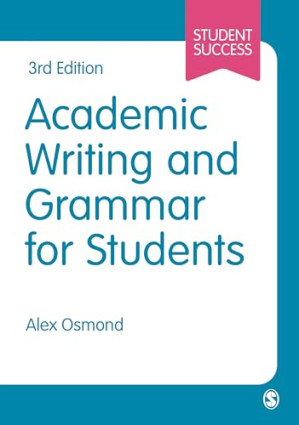
Academic Writing and Grammar for Students (Student Success) 🔍
Alex Osmond
SAGE Publications, Limited, 3, 2024
英语 [en] · PDF · 1.6MB · 2024 · 📘 非小说类图书 · 🚀/lgli/lgrs/zlib · Save
描述
From grammar and punctuation, to proofreading and fixing mistakes, this is your one-stop guide to improving your academic writing to achieve better grades at university.
Including quotes from tutors and examples of good and bad practice, this book provides step-by-step guidance on
Basic conventions of academic writing Critical thinking Conciseness and clarity Proofreading and referencing Common mistakes and how to avoid them.
Student Succes s is a series of essential guides for students of all levels. From how to think critically and write great essays to boosting your employability and managing your wellbeing, the Student Success series helps you study smarter and get the best from your time at university.
Including quotes from tutors and examples of good and bad practice, this book provides step-by-step guidance on
Basic conventions of academic writing Critical thinking Conciseness and clarity Proofreading and referencing Common mistakes and how to avoid them.
Student Succes s is a series of essential guides for students of all levels. From how to think critically and write great essays to boosting your employability and managing your wellbeing, the Student Success series helps you study smarter and get the best from your time at university.
备用文件名
lgrsnf/Academic Writing and Grammar for Students (Student Success) [3911794].pdf
备用文件名
zlib/Reference/Writing/Alex Osmond/Academic Writing and Grammar for Students_28880587.pdf
备用出版商
Sage Publications Ltd (Digital)
备用版本
Sage Publications, Ltd. UK (Collection), London, 2024
备用版本
United Kingdom and Ireland, United Kingdom
备用版本
3rd edition, London
备用描述
Cover
Half Title
Title Page
Copryright
Contents
About the Author
Acknowledgements
Introduction
Writing at university
What's in this book?
Basic conventions of academic writing
Basic grammatical concepts
Putting sentences together
Putting paragraphs together
Critical thinking
Referencing
Conciseness and clarity
Common mistakes and how to deal with them
Proofreading effectively
Notes on the text and the conventions I follow
Different subjects
Referencing
Further reading sections
Further reading
1. Basic Conventions of Academic Writing
Using abbreviations
Establishing objectivity
Referencing correctly
Avoiding slang/colloquial language
Avoiding emotive language
Avoiding the first person
Avoiding the second person
Avoiding contractions
Simplicity, clarity and conciseness
Further reading
2. Basic Grammatical Concepts
Types of words
Nouns, concrete nouns, abstract nouns, proper nouns and plurals
Concrete nouns
Abstract nouns
Proper nouns
Plurals
Effective noun use
Verbs
Effective verb use
Pronouns
Non-binary pronoun use
Effective pronoun use
Articles
Modifiers (Describing words and phrases)
Adjectives
Effective adjective use
Adverbs
Effective adverb use
Conjunctions
Effective conjunction use
Prepositions
Effective preposition use
Summing up
Further reading
3. Putting Sentences Together
Subject–verb–object
Active and passive
Removing the subject of the sentence
Emphasising the object of the sentence
Varying your sentence structure
Tense
The most common tenses in academic writing
Avoiding continuous tenses where possible
Hedging
Punctuation
. The full stop
? The question mark
! The exclamation mark
, The comma
: The colon
; The semi-colon
( ) Parentheses/round brackets
[ ] Square brackets
- The hyphen/dash
' The apostrophe
Further reading
4. Putting Paragraphs Together
Signposting language
Topic sentences and staying on topic
What, why, when
Further reading
5. Critical Thinking
The ‘P’ word: plagiarism
What is critical thinking?
Critical as opposed to descriptive
Summing up
Further reading
Bringing up alternate perspectives and conclusions (and then debunking them)
The rule of three
Repetition
Ad hominem arguments
Hyperbole
Rhetorical questions
Straw man
Further reading
6. Referencing
The different referencing systems/styles
Harvard referencing/the author–date system
Vancouver or numeric referencing
Footnotes
Modern Language Association (MLA) and American Psychological Association (APA) referencing
OSCOLA
More complex referencing techniques
Ellipsis
Square brackets
Errors in the original
Emphasis added and emphasis in original
Adding words to a sentence
Summing up
Further reading
7. Conciseness and Clarity
Watch those word counts
Redundant phrases
Other redundant phrases
Avoiding expletive constructions
Using simple words instead of complex ones
Simple sentences
Does this belong here?
Meaningless modifiers: ‘very’/‘really’/‘extremely’/‘severely’ (and so on)
The future tense/unnecessary signposting
Avoiding repetition
The active and passive voices
Changing negatives to affirmatives
Removing excessive ‘nominalisation’
Using the word ‘this’
More examples
Example one
Example two
Example three
Example four
Example five
Further reading
8. Common Mistakes and How to Deal With Them
Mixed constructions
Dangling modifiers
Using ‘it has been said that ...’
Using ‘I think/I feel ...’
Avoiding the word ‘interesting’
Poor presentation of tables and graphs
Comma splicing
Using ‘of’ instead of ‘have’
There/they’re/their
To/too
The word ‘of’ and possessive replacements
‘Putting things off’
Further reading
9. Proofreading Effectively
Distance yourself from your work
Proofread more than once
Leave more time than you think you need
Read your work aloud
Read from your last sentence back
Use technology but don't rely on it
Be ruthless
Proofread for you ...
... and keep things in context
Do your own proofreading
Further reading
Index
Half Title
Title Page
Copryright
Contents
About the Author
Acknowledgements
Introduction
Writing at university
What's in this book?
Basic conventions of academic writing
Basic grammatical concepts
Putting sentences together
Putting paragraphs together
Critical thinking
Referencing
Conciseness and clarity
Common mistakes and how to deal with them
Proofreading effectively
Notes on the text and the conventions I follow
Different subjects
Referencing
Further reading sections
Further reading
1. Basic Conventions of Academic Writing
Using abbreviations
Establishing objectivity
Referencing correctly
Avoiding slang/colloquial language
Avoiding emotive language
Avoiding the first person
Avoiding the second person
Avoiding contractions
Simplicity, clarity and conciseness
Further reading
2. Basic Grammatical Concepts
Types of words
Nouns, concrete nouns, abstract nouns, proper nouns and plurals
Concrete nouns
Abstract nouns
Proper nouns
Plurals
Effective noun use
Verbs
Effective verb use
Pronouns
Non-binary pronoun use
Effective pronoun use
Articles
Modifiers (Describing words and phrases)
Adjectives
Effective adjective use
Adverbs
Effective adverb use
Conjunctions
Effective conjunction use
Prepositions
Effective preposition use
Summing up
Further reading
3. Putting Sentences Together
Subject–verb–object
Active and passive
Removing the subject of the sentence
Emphasising the object of the sentence
Varying your sentence structure
Tense
The most common tenses in academic writing
Avoiding continuous tenses where possible
Hedging
Punctuation
. The full stop
? The question mark
! The exclamation mark
, The comma
: The colon
; The semi-colon
( ) Parentheses/round brackets
[ ] Square brackets
- The hyphen/dash
' The apostrophe
Further reading
4. Putting Paragraphs Together
Signposting language
Topic sentences and staying on topic
What, why, when
Further reading
5. Critical Thinking
The ‘P’ word: plagiarism
What is critical thinking?
Critical as opposed to descriptive
Summing up
Further reading
Bringing up alternate perspectives and conclusions (and then debunking them)
The rule of three
Repetition
Ad hominem arguments
Hyperbole
Rhetorical questions
Straw man
Further reading
6. Referencing
The different referencing systems/styles
Harvard referencing/the author–date system
Vancouver or numeric referencing
Footnotes
Modern Language Association (MLA) and American Psychological Association (APA) referencing
OSCOLA
More complex referencing techniques
Ellipsis
Square brackets
Errors in the original
Emphasis added and emphasis in original
Adding words to a sentence
Summing up
Further reading
7. Conciseness and Clarity
Watch those word counts
Redundant phrases
Other redundant phrases
Avoiding expletive constructions
Using simple words instead of complex ones
Simple sentences
Does this belong here?
Meaningless modifiers: ‘very’/‘really’/‘extremely’/‘severely’ (and so on)
The future tense/unnecessary signposting
Avoiding repetition
The active and passive voices
Changing negatives to affirmatives
Removing excessive ‘nominalisation’
Using the word ‘this’
More examples
Example one
Example two
Example three
Example four
Example five
Further reading
8. Common Mistakes and How to Deal With Them
Mixed constructions
Dangling modifiers
Using ‘it has been said that ...’
Using ‘I think/I feel ...’
Avoiding the word ‘interesting’
Poor presentation of tables and graphs
Comma splicing
Using ‘of’ instead of ‘have’
There/they’re/their
To/too
The word ‘of’ and possessive replacements
‘Putting things off’
Further reading
9. Proofreading Effectively
Distance yourself from your work
Proofread more than once
Leave more time than you think you need
Read your work aloud
Read from your last sentence back
Use technology but don't rely on it
Be ruthless
Proofread for you ...
... and keep things in context
Do your own proofreading
Further reading
Index
开源日期
2024-06-05
We strongly recommend that you support the author by buying or donating on their personal website, or borrowing in your local library.
🚀 快速下载
成为会员以支持书籍、论文等的长期保存。为了感谢您对我们的支持,您将获得高速下载权益。❤️
如果您在本月捐款,您将获得双倍的快速下载次数。
🐢 低速下载
由可信的合作方提供。 更多信息请参见常见问题解答。 (可能需要验证浏览器——无限次下载!)
- 低速服务器(合作方提供) #1 (稍快但需要排队)
- 低速服务器(合作方提供) #2 (稍快但需要排队)
- 低速服务器(合作方提供) #3 (稍快但需要排队)
- 低速服务器(合作方提供) #4 (稍快但需要排队)
- 低速服务器(合作方提供) #5 (无需排队,但可能非常慢)
- 低速服务器(合作方提供) #6 (无需排队,但可能非常慢)
- 低速服务器(合作方提供) #7 (无需排队,但可能非常慢)
- 低速服务器(合作方提供) #8 (无需排队,但可能非常慢)
- 低速服务器(合作方提供) #9 (无需排队,但可能非常慢)
- 下载后: 在我们的查看器中打开
所有选项下载的文件都相同,应该可以安全使用。即使这样,从互联网下载文件时始终要小心。例如,确保您的设备更新及时。
外部下载
-
对于大文件,我们建议使用下载管理器以防止中断。
推荐的下载管理器:JDownloader -
您将需要一个电子书或 PDF 阅读器来打开文件,具体取决于文件格式。
推荐的电子书阅读器:Anna的档案在线查看器、ReadEra和Calibre -
使用在线工具进行格式转换。
推荐的转换工具:CloudConvert和PrintFriendly -
您可以将 PDF 和 EPUB 文件发送到您的 Kindle 或 Kobo 电子阅读器。
推荐的工具:亚马逊的“发送到 Kindle”和djazz 的“发送到 Kobo/Kindle” -
支持作者和图书馆
✍️ 如果您喜欢这个并且能够负担得起,请考虑购买原版,或直接支持作者。
📚 如果您当地的图书馆有这本书,请考虑在那里免费借阅。
下面的文字仅以英文继续。
总下载量:
“文件的MD5”是根据文件内容计算出的哈希值,并且基于该内容具有相当的唯一性。我们这里索引的所有影子图书馆都主要使用MD5来标识文件。
一个文件可能会出现在多个影子图书馆中。有关我们编译的各种数据集的信息,请参见数据集页面。
有关此文件的详细信息,请查看其JSON 文件。 Live/debug JSON version. Live/debug page.