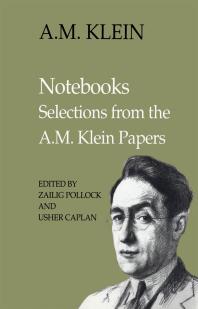
Notebooks : Selections from the A. M. Klein Papers (Collected Works of A. M. Klein) 🔍
A. M. Klein; Usher Caplan; Zailig Pollock
University of Toronto Press, Heritage Ser., 1, 1995
英语 [en] · PDF · 13.9MB · 1995 · 📘 非小说类图书 · 🚀/lgli/lgrs/nexusstc/zlib · Save
描述
Much of A.M. Klein's finest prose is to be found in the mass of uncompleted work that he abandoned at the time of his breakdown, and that became accessible only when his papers were deposited in the National Archives. Notebooks offers a generous selection of this work, revealing previously unsuspected facets of Klein's character and artistry.
The fiction, criticism, and memoirs collected here focus on Klein's exploration of the role of the artist. The works illuminate crucial periods of his career, especially the early 19403, when he was transforming himself into a modernist, and the early 19503, when he was struggling to overcome the misgivings about his art that were to lead to his final breakdown.
The semi-autobiographical text which Klein referred to as 'Raw Material' and the unfinished novel of prison life entitled 'Stranger and Afraid' cast a new light on Klein's often frustrating relationship with the Montreal Jewish community. In 'Marginalia' he discusses poetic form and technique and makes observations on the nature of poetry, thereby providing insights into his own concerns as a writer. In The Golem,' a profoundly ambiguous treatment of the act of creation, a selfportrait emerges of a storyteller who has lost faith in the power and value of his story. The volume includes a critical introduction, which places the material in the context of Klein's other works, as well as textual and explanatory notes.
'RAW MATERIAL' AND 'STRANGER AND AFRAID' 'Raw Material' and 'Stranger and Afraid' represent Klein's most ambitious and most revealing work at a crucial period in his career, the period between The Hitleriad and 'Portrait of the Poet as Landscape/ By the end of 1942, Klein had grown increasingly frustrated with the direction his career was taking. In the late thirties, after a silence of several years, he had returned to poetry, beginning with a number of political satires of a vaguely leftist cast. Soon, however, he turned to what was to be his central theme over the next few years, the Nazi threat to humanity, in general, and to the Jewish people, in particular. 'Childe Harold's Pilgrimage/ 'In Re Solomon Warshawer/ the psalms and ballads, and, finally, The Hitleriad all reflect this new concern. After completing The Hitleriad, Klein clearly felt the need to reassess his sense of himself as a poet, and, specifically, his relationship with the Jewish community to which most of the work of the preceding few years had been addressed. This reassessment is the central concern of a group of prose texts which Klein gathered together in a file he labelled 'Raw Material/ 'Raw Material' presents, especially in its later sections, a portrait of a profoundly frustrated poet, named Kay, whose poetry is of no interest to his community, which values only his hack work as a speech-writer and lecturer. Klein's anger at his community for failing to appreciate the true value of his work is expressed in a number of sardonic portraits of his family, his associates, and the Montreal Jewish community as a whole, revealing a side of him which one would hardly suspect from his published writings.
But as important as 'Raw Material' is for the insights it offers into Klein's troubled relationship with his community, it is more than just a collection of thinly disguised autobiographical documents. 'Raw Material' consists of a variety of texts, some of which are not at all 'raw,' but highly polished works of literature, foreshadowing 'Portrait of the Poet as Landscape' in their symbolic and allusive exploration of the role of the poet in the modern world, and foreshadowing, as well, The Second Scroll, in their testing of the boundaries separating diary, memoir, fable, fiction, poetry, and poetic prose.
Sometime in 1945, Klein decided to approach the issues explored in 'Raw Material' from an entirely new perspective. The result was an attempt at a prison novel, 'Stranger and Afraid/ There is evidence that Klein was already beginning to consider such a novel while he was still at work on 'Raw Material/3 and the close connection between 'Raw Material' and 'Stranger and Afraid' is reflected in the similarity between their central characters, Kay in the former and Drizen in the latter. (Drizen was actually named Kay in an early version of 'Stranger and Afraid/) As a convict imprisoned for a mysterious, unnamed crime, Drizen shares Kay's sense of impotence and vulner-UNTITLED NOVEL Klein's struggle, throughout the forties, to find alternatives to his increasingly frustrating role as a Jewish poet achieved its greatest success in the Quebec poems of The Rocking Chair, published in 1948. But, as Klein explained in a letter which he drafted that year to the American poet Karl Shapiro, recent xv 'THE GOLEM'
The final years of Klein's career, following the publication of The Second Scroll in 1951, were increasingly dark ones. All of the old frustrations concerning his relationship to his community resurface more powerfully than ever in the most important works of the period. These include the essays 'The Bible Manuscripts,' 'The Bible's Archetypical Poet,' and 'In Praise of the Diaspora'; the short story 'The Bells of Sobor Spasitula'; a series of bleakly powerful translations from the Hebrew poet Chaim Nachman Bialik; and, most importantly, the novel on which Klein was probably working at the time of his breakdown, The Golem.' 'The Golem' is Klein's last and most ambitious treatment of a legend to which he had turned several times throughout his career. The legend of the golem, a man created by magical art, is an ancient and widespread one in Jewish folklore, dating back at least to the Talmudic era.7 However, the bestknown version, and the one which forms the basis of Klein's novel, as of all modern treatments of the legend, is associated with Rabbi Judah Low ben Bezalel (c. 1525Bezalel (c. -1609)), the chief rabbi of Prague.
Rabbi Low was a much revered figure in his day, but it was not until long after his death that he became associated with the golem legend. In early versions of the legend, Rabbi Low created the golem merely to act as a servant, but in Yudel Rosenberg's Niflaot Maharal im ha-Golem (1909), the golem is created to defend the Jews against accusations of ritual murder. This is a motif which has no precedent in the original legends; its invention is Rosenberg's response to ritual murder trials in late nineteenth-and early twentieth-century Europe. Klein probably knew Rosenberg's book -Rosenberg emigrated to Canada, where he became a prominent Montreal rabbi 8 -but, in any case, Klein's treatment of the legend, like others in the twentieth century, adopts the ritual murder motif.
Klein was familiar with at least three other modern versions of the golem legend: the novels The Golem by Gustav Meyrink (1915) and The Golem of Prague by Chaim Bloch (1925), and the poetic drama The Golem by H. Leivick (1921). Meyrink's novel is mentioned in a note in the 'Golem' material [MS 3278], and Bloch's was a source for Klein's sonnet sequence Talisman in Seven Shreds' (c. i928/i93i).9 But only Leivick's drama, which Klein refers to in an article 'Welcome to Leivick ' [Canadian Jewish Chronicle, 28 April 1939, p. 4] and in notes for a lecture which he gave on Leivick on This passage is reminiscent of The Golem' in its use of the golem legend as a cautionary 'parable' about humanity's pride in its creative powers. In The Golem' Klein focuses on 'the creative act ' [MS 3573] in the artistic and, especially, the literary sense. He assigns a central role, without precedent in other treatments of the legend, to the self-consciously literary narrator, the
The fiction, criticism, and memoirs collected here focus on Klein's exploration of the role of the artist. The works illuminate crucial periods of his career, especially the early 19403, when he was transforming himself into a modernist, and the early 19503, when he was struggling to overcome the misgivings about his art that were to lead to his final breakdown.
The semi-autobiographical text which Klein referred to as 'Raw Material' and the unfinished novel of prison life entitled 'Stranger and Afraid' cast a new light on Klein's often frustrating relationship with the Montreal Jewish community. In 'Marginalia' he discusses poetic form and technique and makes observations on the nature of poetry, thereby providing insights into his own concerns as a writer. In The Golem,' a profoundly ambiguous treatment of the act of creation, a selfportrait emerges of a storyteller who has lost faith in the power and value of his story. The volume includes a critical introduction, which places the material in the context of Klein's other works, as well as textual and explanatory notes.
'RAW MATERIAL' AND 'STRANGER AND AFRAID' 'Raw Material' and 'Stranger and Afraid' represent Klein's most ambitious and most revealing work at a crucial period in his career, the period between The Hitleriad and 'Portrait of the Poet as Landscape/ By the end of 1942, Klein had grown increasingly frustrated with the direction his career was taking. In the late thirties, after a silence of several years, he had returned to poetry, beginning with a number of political satires of a vaguely leftist cast. Soon, however, he turned to what was to be his central theme over the next few years, the Nazi threat to humanity, in general, and to the Jewish people, in particular. 'Childe Harold's Pilgrimage/ 'In Re Solomon Warshawer/ the psalms and ballads, and, finally, The Hitleriad all reflect this new concern. After completing The Hitleriad, Klein clearly felt the need to reassess his sense of himself as a poet, and, specifically, his relationship with the Jewish community to which most of the work of the preceding few years had been addressed. This reassessment is the central concern of a group of prose texts which Klein gathered together in a file he labelled 'Raw Material/ 'Raw Material' presents, especially in its later sections, a portrait of a profoundly frustrated poet, named Kay, whose poetry is of no interest to his community, which values only his hack work as a speech-writer and lecturer. Klein's anger at his community for failing to appreciate the true value of his work is expressed in a number of sardonic portraits of his family, his associates, and the Montreal Jewish community as a whole, revealing a side of him which one would hardly suspect from his published writings.
But as important as 'Raw Material' is for the insights it offers into Klein's troubled relationship with his community, it is more than just a collection of thinly disguised autobiographical documents. 'Raw Material' consists of a variety of texts, some of which are not at all 'raw,' but highly polished works of literature, foreshadowing 'Portrait of the Poet as Landscape' in their symbolic and allusive exploration of the role of the poet in the modern world, and foreshadowing, as well, The Second Scroll, in their testing of the boundaries separating diary, memoir, fable, fiction, poetry, and poetic prose.
Sometime in 1945, Klein decided to approach the issues explored in 'Raw Material' from an entirely new perspective. The result was an attempt at a prison novel, 'Stranger and Afraid/ There is evidence that Klein was already beginning to consider such a novel while he was still at work on 'Raw Material/3 and the close connection between 'Raw Material' and 'Stranger and Afraid' is reflected in the similarity between their central characters, Kay in the former and Drizen in the latter. (Drizen was actually named Kay in an early version of 'Stranger and Afraid/) As a convict imprisoned for a mysterious, unnamed crime, Drizen shares Kay's sense of impotence and vulner-UNTITLED NOVEL Klein's struggle, throughout the forties, to find alternatives to his increasingly frustrating role as a Jewish poet achieved its greatest success in the Quebec poems of The Rocking Chair, published in 1948. But, as Klein explained in a letter which he drafted that year to the American poet Karl Shapiro, recent xv 'THE GOLEM'
The final years of Klein's career, following the publication of The Second Scroll in 1951, were increasingly dark ones. All of the old frustrations concerning his relationship to his community resurface more powerfully than ever in the most important works of the period. These include the essays 'The Bible Manuscripts,' 'The Bible's Archetypical Poet,' and 'In Praise of the Diaspora'; the short story 'The Bells of Sobor Spasitula'; a series of bleakly powerful translations from the Hebrew poet Chaim Nachman Bialik; and, most importantly, the novel on which Klein was probably working at the time of his breakdown, The Golem.' 'The Golem' is Klein's last and most ambitious treatment of a legend to which he had turned several times throughout his career. The legend of the golem, a man created by magical art, is an ancient and widespread one in Jewish folklore, dating back at least to the Talmudic era.7 However, the bestknown version, and the one which forms the basis of Klein's novel, as of all modern treatments of the legend, is associated with Rabbi Judah Low ben Bezalel (c. 1525Bezalel (c. -1609)), the chief rabbi of Prague.
Rabbi Low was a much revered figure in his day, but it was not until long after his death that he became associated with the golem legend. In early versions of the legend, Rabbi Low created the golem merely to act as a servant, but in Yudel Rosenberg's Niflaot Maharal im ha-Golem (1909), the golem is created to defend the Jews against accusations of ritual murder. This is a motif which has no precedent in the original legends; its invention is Rosenberg's response to ritual murder trials in late nineteenth-and early twentieth-century Europe. Klein probably knew Rosenberg's book -Rosenberg emigrated to Canada, where he became a prominent Montreal rabbi 8 -but, in any case, Klein's treatment of the legend, like others in the twentieth century, adopts the ritual murder motif.
Klein was familiar with at least three other modern versions of the golem legend: the novels The Golem by Gustav Meyrink (1915) and The Golem of Prague by Chaim Bloch (1925), and the poetic drama The Golem by H. Leivick (1921). Meyrink's novel is mentioned in a note in the 'Golem' material [MS 3278], and Bloch's was a source for Klein's sonnet sequence Talisman in Seven Shreds' (c. i928/i93i).9 But only Leivick's drama, which Klein refers to in an article 'Welcome to Leivick ' [Canadian Jewish Chronicle, 28 April 1939, p. 4] and in notes for a lecture which he gave on Leivick on This passage is reminiscent of The Golem' in its use of the golem legend as a cautionary 'parable' about humanity's pride in its creative powers. In The Golem' Klein focuses on 'the creative act ' [MS 3573] in the artistic and, especially, the literary sense. He assigns a central role, without precedent in other treatments of the legend, to the self-consciously literary narrator, the
备用文件名
lgli/Notebooks_ Selections from the A. M. Klein Papers - A. M. Klein.pdf
备用文件名
lgrsnf/Notebooks_ Selections from the A. M. Klein Papers - A. M. Klein.pdf
备用文件名
zlib/no-category/A. M. Klein; Usher Caplan; Zailig Pollock/Notebooks : Selections from the A. M. Klein Papers (Collected Works of A. M. Klein)_25792633.pdf
备选标题
Notebooks: Selections from the A.M. Klein Papers (Collected Works of A.M. Klein) (Heritage)
备选作者
A.M. HG Klein
备选作者
Klein, A.M.
备用出版商
Canadian Electronic Library
备用版本
Book collections on Project MUSE, Ottawa, Ontario, 2015
备用版本
Collected works of A.M. Klein, Toronto [Ontario, 2015
备用版本
Collected works of A.M. Klein, Toronto, Ontario, 1994
备用版本
University of Toronto Press, Toronto, Ontario, 1994
备用版本
Collected works of A.M. Klein, Toronto, 2016
备用版本
Canada - English Language, Canada
备用版本
Heritage, Toronto, 2015
备用版本
1, 19951215
元数据中的注释
{"edition":"1","isbns":["1442623055","1442623136","9781442623057","9781442623132"],"last_page":290,"publisher":"University of Toronto Press","series":"Heritage Ser."}
备用描述
<p>Much of A.M. Klein's finest prose is to be found in the mass of uncompleted work that he abandoned at the time of his breakdown, and that became accessible only when his papers were deposited in the National Archives. Notebooks offers a generous selection of this work, revealing previously unsuspected facets of Klein's character and artistry.</p><p>The fiction, criticism, and memoirs collected here focus on Klein's exploration of the role of the artist. The works illuminate crucial periods of his career, especially the early 1940s, when he was transforming himself into a modernist, and the early 1950s, when he was struggling to overcome the misgivings about his art that were to lead to his final breakdown.</p><p>The semi-autobiographical text which Klein referred to as 'Raw Material' and the unfinished novel of prison life entitled 'Stranger and Afraid' cast a new light on Klein's often frustrating relationship with the Montreal Jewish community. In 'Marginalia' he discusses poetic form and technique and makes observations on the nature of poetry, thereby providing insights into his own concerns as a writer. In 'The Golem,' a profoundly ambiguous treatment of the act of creation, a self-portrait emerges of a storyteller who has lost faith in the power and value of his story. The volume includes a critical introduction, that places the material in the context of Klein's other works, as well as textual and explanatory notes.</p>
备用描述
"Much of A.M. Klein's finest prose is to be found in the mass of uncompleted work that he abandoned at the time of his breakdown, and that became accessible only when his papers were deposited in the National Archives. Notebooks offers a generous selection of this work, revealing previously unsuspected facets of Klein's character and artistry." "The fiction, criticism, and memoirs collected here focus on Klein's exploration of the role of the artist. The works illuminate crucial periods of his career, especially the early 1940s, when he was transforming himself into a modernist, and the early 1950s, when he was struggling to overcome the misgivings about his art that were to lead to his final breakdown." "The semi-autobiographical text which Klein referred to as 'Raw Material' and the unfinished novel of prison life entitled 'Stranger and Afraid' cast a new light on Klein's often frustrating relationship with the Montreal Jewish community. In 'Marginalia' he discusses poetic form and technique and makes observations on the nature of poetry, thereby providing insights into his own concerns as a writer. In 'The Golem, ' a profoundly ambiguous treatment of the act of creation, a self-portrait emerges of a storyteller who has lost faith in the power and value of his story. The volume includes a critical introduction, which places the material in the context of Klein's other works, as well as textual and explanatory notes."--Jacket
备用描述
Much Of A.m. Klein's Finest Prose Is To Be Found In The Mass Of Uncompleted Work That He Abandoned At The Time Of His Breakdown, And That Became Accessible Only When His Papers Were Deposited In The National Archives. Notebooks Offers A Generous Selection Of This Work, Revealing Previously Unsuspected Facets Of Klein's Character And Artistry. The Fiction, Criticism, And Memoirs Collected Here Focus On Klein's Exploration Of The Role Of The Artist. The Works Illuminate Crucial Periods Of His Career, Especially The Early 1940s, When He Was Transforming Himself Into A Modernist, And The Early 1950s, When He Was Struggling To Overcome The Misgivings About His Art That Were To Lead To His Final Breakdown. The Semi-autobiographical Text Which Klein Referred To As 'raw Material' And The Unfinished Novel Of Prison Life Entitled 'stranger And Afraid' Cast A New Light On Klein's Often Frustrating Relationship With The Montreal Jewish Community. In 'marginalia' He Discusses Poetic Form And Technique And Makes Observations On The Nature Of Poetry, Thereby Providing Insights Into His Own Concerns As A Writer. In 'the Golem,' A Profoundly Ambiguous Treatment Of The Act Of Creation, A Self-portrait Emerges Of A Storyteller Who Has Lost Faith In The Power And Value Of His Story. The Volume Includes A Critical Introduction, That Places The Material In The Context Of Klein's Other Works, As Well As Textual And Explanatory Notes.
开源日期
2023-08-16
🚀 快速下载
成为会员以支持书籍、论文等的长期保存。为了感谢您对我们的支持,您将获得高速下载权益。❤️
如果您在本月捐款,您将获得双倍的快速下载次数。
🐢 低速下载
由可信的合作方提供。 更多信息请参见常见问题解答。 (可能需要验证浏览器——无限次下载!)
- 低速服务器(合作方提供) #1 (稍快但需要排队)
- 低速服务器(合作方提供) #2 (稍快但需要排队)
- 低速服务器(合作方提供) #3 (稍快但需要排队)
- 低速服务器(合作方提供) #4 (稍快但需要排队)
- 低速服务器(合作方提供) #5 (无需排队,但可能非常慢)
- 低速服务器(合作方提供) #6 (无需排队,但可能非常慢)
- 低速服务器(合作方提供) #7 (无需排队,但可能非常慢)
- 低速服务器(合作方提供) #8 (无需排队,但可能非常慢)
- 低速服务器(合作方提供) #9 (无需排队,但可能非常慢)
- 下载后: 在我们的查看器中打开
所有选项下载的文件都相同,应该可以安全使用。即使这样,从互联网下载文件时始终要小心。例如,确保您的设备更新及时。
外部下载
-
对于大文件,我们建议使用下载管理器以防止中断。
推荐的下载管理器:JDownloader -
您将需要一个电子书或 PDF 阅读器来打开文件,具体取决于文件格式。
推荐的电子书阅读器:Anna的档案在线查看器、ReadEra和Calibre -
使用在线工具进行格式转换。
推荐的转换工具:CloudConvert和PrintFriendly -
您可以将 PDF 和 EPUB 文件发送到您的 Kindle 或 Kobo 电子阅读器。
推荐的工具:亚马逊的“发送到 Kindle”和djazz 的“发送到 Kobo/Kindle” -
支持作者和图书馆
✍️ 如果您喜欢这个并且能够负担得起,请考虑购买原版,或直接支持作者。
📚 如果您当地的图书馆有这本书,请考虑在那里免费借阅。
下面的文字仅以英文继续。
总下载量:
“文件的MD5”是根据文件内容计算出的哈希值,并且基于该内容具有相当的唯一性。我们这里索引的所有影子图书馆都主要使用MD5来标识文件。
一个文件可能会出现在多个影子图书馆中。有关我们编译的各种数据集的信息,请参见数据集页面。
有关此文件的详细信息,请查看其JSON 文件。 Live/debug JSON version. Live/debug page.