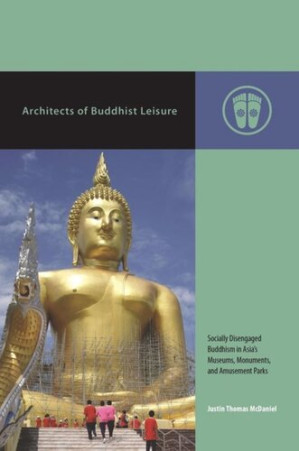
Architects of Buddhist Leisure : Socially Disengaged Buddhism in Asia’s Museums, Monuments, and Amusement Parks 🔍
Justin Thomas McDaniel (editor); Mark Michael Rowe (editor)
University of Hawaiʻi Press, 2017 dec 31
英语 [en] · PDF · 3.6MB · 2017 · 📘 非小说类图书 · 🚀/lgli/lgrs/nexusstc/upload/zlib · Save
描述
Buddhism, often described as an austere religion that condemns desire, promotes denial, and idealizes the contemplative life, actually has a thriving leisure culture in Asia. Creative religious improvisations designed by Buddhists have been produced both within and outside of monasteries across the region—in Nepal, Japan, Korea, Macau, Hong Kong, Singapore, Laos, Thailand, and Vietnam. Justin McDaniel looks at the growth of Asia’s culture of Buddhist leisure—what he calls “socially disengaged Buddhism”—through a study of architects responsible for monuments, museums, amusement parks, and other sites. In conversation with noted theorists of material and visual culture and anthropologists of art, McDaniel argues that such sites highlight the importance of public, leisure, and spectacle culture from a Buddhist perspective and illustrate how “secular” and “religious,” “public” and “private,” are in many ways false binaries. Moreover, places like Lek Wiriyaphan’s Sanctuary of Truth in Thailand, Suối Tiên Amusement Park in Saigon, and Shi Fa Zhao’s multilevel museum/ritual space/tea house in Singapore reflect a growing Buddhist ecumenism built through repetitive affective encounters instead of didactic sermons and sectarian developments. They present different Buddhist traditions, images, and aesthetic expressions as united but not uniform, collected but not concise: Together they form a gathering, not a movement.
Despite the ingenuity of lay and ordained visionaries like Wiriyaphan and Zhao and their colleagues Kenzo Tange, Chan-soo Park, Tadao Ando, and others discussed in this book, creators of Buddhist leisure sites often face problems along the way. Parks and museums are complex adaptive systems that are changed and influenced by budgets, available materials, local and global economic conditions, and visitors. Architects must often compromise and settle at local optima, and no matter what they intend, their buildings will develop lives of their own. Provocative and theoretically innovative, __Architects of Buddhist Leisure__ asks readers to question the very category of “religious” architecture. It challenges current methodological approaches in religious studies and speaks to a broad audience interested in modern art, architecture, religion, anthropology, and material culture.
Despite the ingenuity of lay and ordained visionaries like Wiriyaphan and Zhao and their colleagues Kenzo Tange, Chan-soo Park, Tadao Ando, and others discussed in this book, creators of Buddhist leisure sites often face problems along the way. Parks and museums are complex adaptive systems that are changed and influenced by budgets, available materials, local and global economic conditions, and visitors. Architects must often compromise and settle at local optima, and no matter what they intend, their buildings will develop lives of their own. Provocative and theoretically innovative, __Architects of Buddhist Leisure__ asks readers to question the very category of “religious” architecture. It challenges current methodological approaches in religious studies and speaks to a broad audience interested in modern art, architecture, religion, anthropology, and material culture.
备用文件名
nexusstc/Architects of Buddhist Leisure: Socially Disengaged Buddhism in Asia’s Museums, Monuments, and Amusement Parks/4da24dbf8dee6cd4795d9fa62801a51f.pdf
备用文件名
lgli/10.1515_9780824866013.pdf
备用文件名
lgrsnf/10.1515_9780824866013.pdf
备用文件名
zlib/no-category/Justin Thomas McDaniel (editor); Mark Michael Rowe (editor)/Architects of Buddhist Leisure: Socially Disengaged Buddhism in Asia’s Museums, Monuments, and Amusement Parks_25949620.pdf
备用出版商
Second Language Teaching & Curriculum Center, University of Hawaii at Manoa
备用出版商
University of Hawai'i Manoa - Center for Pacific Island Studies
备用版本
Contemporary Buddhism Ser, Honolulu, 2016
备用版本
United States, United States of America
备用版本
University of Hawai'i, Honolulu, 2017
备用版本
Contemporary Buddhism, Honolulu, 2017
元数据中的注释
degruyter.com
元数据中的注释
{"isbns":["0824866010","9780824866013"],"last_page":288,"publisher":"University of Hawaii Press"}
备用描述
Buddhism, often described as an austere religion that condemns desire, promotes denial, and idealizes the contemplative life, actually has a thriving leisure culture in Asia. Creative religious improvisations designed by Buddhists have been produced both within and outside of monasteries across the region—in Nepal, Japan, Korea, Macau, Hong Kong, Singapore, Laos, Thailand, and Vietnam. Justin McDaniel looks at the growth of Asia's culture of Buddhist leisure—what he calls “socially disengaged Buddhism”—through a study of architects responsible for monuments, museums, amusement parks, and other sites. In conversation with noted theorists of material and visual culture and anthropologists of art, McDaniel argues that such sites highlight the importance of public, leisure, and spectacle culture from a Buddhist perspective and illustrate how “secular” and “religious,” “public” and “private,” are in many ways false binaries. Moreover, places like Lek Wiriyaphan's Sanctuary of Truth in Thailand, Suối Tiên Amusement Park in Saigon, and Shi Fa Zhao's multilevel museum/ritual space/tea house in Singapore reflect a growing Buddhist ecumenism built through repetitive affective encounters instead of didactic sermons and sectarian developments. They present different Buddhist traditions, images, and aesthetic expressions as united but not uniform, collected but not concise: Together they form a gathering, not a movement.Despite the ingenuity of lay and ordained visionaries like Wiriyaphan and Zhao and their colleagues Kenzo Tange, Chan-soo Park, Tadao Ando, and others discussed in this book, creators of Buddhist leisure sites often face problems along the way. Parks and museums are complex adaptive systems that are changed and influenced by budgets, available materials, local and global economic conditions, and visitors. Architects must often compromise and settle at local optima, and no matter what they intend, their buildings will develop lives of their own. Provocative and theoretically innovative, Architects of Buddhist Leisure asks readers to question the very category of “religious” architecture. It challenges current methodological approaches in religious studies and speaks to a broad audience interested in modern art, architecture, religion, anthropology, and material culture.An electronic version of this book is freely available thanks to the support of libraries working with Knowledge Unlatched, a collaborative initiative designed to make high-quality books open access for the public good. The open-access version of this book is licensed under Creative Commons Attribution-NonCommercial-NoDerivatives 4.0 International (CC BY-NC-ND 4.0), which means that the work may be freely downloaded and shared for non-commercial purposes, provided credit is given to the author. Derivative works and commercial uses require permission from the publisher.
备用描述
Contents
Series Editor’s Preface
Acknowledgments
Introduction
1. Monuments and Metabolism
2. Ecumenical Parks and Cosmological Gardens
3. Buddhist Museums and Curio Cabinets
Conclusions and Comparisons
Notes
Bibliography
Index
About the Author
Series Editor’s Preface
Acknowledgments
Introduction
1. Monuments and Metabolism
2. Ecumenical Parks and Cosmological Gardens
3. Buddhist Museums and Curio Cabinets
Conclusions and Comparisons
Notes
Bibliography
Index
About the Author
开源日期
2023-08-22
❌ 此文件可能有问题,已从源库中隐藏。 有时这是应版权所有者的要求,有时是因为有更好的选择, 但有时是因为文件本身有问题。 下载可能仍然没问题,但我们建议先搜索替代文件。 更多细节:
- 运型exiftool处理此文件失败
如果您仍想下载此文件,请确保仅使用受信任的最新软件打开它。
🚀 快速下载
成为会员以支持书籍、论文等的长期保存。为了感谢您对我们的支持,您将获得高速下载权益。❤️
如果您在本月捐款,您将获得双倍的快速下载次数。
🐢 低速下载
由可信的合作方提供。 更多信息请参见常见问题解答。 (可能需要验证浏览器——无限次下载!)
- 低速服务器(合作方提供) #1 (稍快但需要排队)
- 低速服务器(合作方提供) #2 (稍快但需要排队)
- 低速服务器(合作方提供) #3 (稍快但需要排队)
- 低速服务器(合作方提供) #4 (稍快但需要排队)
- 低速服务器(合作方提供) #5 (无需排队,但可能非常慢)
- 低速服务器(合作方提供) #6 (无需排队,但可能非常慢)
- 低速服务器(合作方提供) #7 (无需排队,但可能非常慢)
- 低速服务器(合作方提供) #8 (无需排队,但可能非常慢)
- 低速服务器(合作方提供) #9 (无需排队,但可能非常慢)
- 下载后: 在我们的查看器中打开
外部下载
-
对于大文件,我们建议使用下载管理器以防止中断。
推荐的下载管理器:JDownloader -
您将需要一个电子书或 PDF 阅读器来打开文件,具体取决于文件格式。
推荐的电子书阅读器:Anna的档案在线查看器、ReadEra和Calibre -
使用在线工具进行格式转换。
推荐的转换工具:CloudConvert和PrintFriendly -
您可以将 PDF 和 EPUB 文件发送到您的 Kindle 或 Kobo 电子阅读器。
推荐的工具:亚马逊的“发送到 Kindle”和djazz 的“发送到 Kobo/Kindle” -
支持作者和图书馆
✍️ 如果您喜欢这个并且能够负担得起,请考虑购买原版,或直接支持作者。
📚 如果您当地的图书馆有这本书,请考虑在那里免费借阅。
下面的文字仅以英文继续。
总下载量:
“文件的MD5”是根据文件内容计算出的哈希值,并且基于该内容具有相当的唯一性。我们这里索引的所有影子图书馆都主要使用MD5来标识文件。
一个文件可能会出现在多个影子图书馆中。有关我们编译的各种数据集的信息,请参见数据集页面。
有关此文件的详细信息,请查看其JSON 文件。 Live/debug JSON version. Live/debug page.