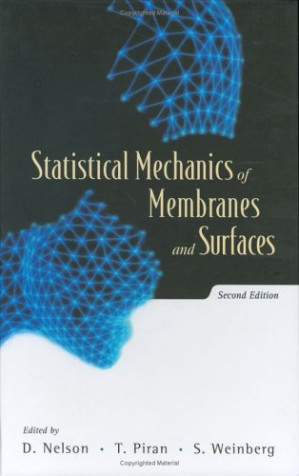
lgli/P_Physics/PT_Thermodynamics, statistical physics/Nelson D., Piran T., Weinberg S. (eds.) Statistical mechanics of membranes and surfaces (2ed., WS, 2004)(ISBN 9812387609)(443s)_PT_.pdf
Statistical Mechanics Of Membranes And Surfaces: 2nd Edition 🔍
David Nelson, Steven Weinberg, T Piran
World Scientific Publishing Company; World Scientific Publishing Co Pte Ltd, 2nd ed., Singapore, River Edge, NJ, United States, 2004
英语 [en] · PDF · 5.6MB · 2004 · 📘 非小说类图书 · 🚀/lgli/lgrs/nexusstc/zlib · Save
描述
This invaluable book explores the delicate interplay between geometry and statistical mechanics in materials such as microemulsions, wetting and growth interfaces, bulk lyotropic liquid crystals, chalcogenide glasses and sheet polymers, using tools from the fields of polymer physics, differential geometry, field theory and critical phenomena. Several chapters have been updated relative to the classic 1989 edition. Moreover, there are now three entirely new chapters — on effects of anisotropy and heterogeneity, on fixed connectivity membranes and on triangulated surface models of fluctuating membranes.
备用文件名
lgrsnf/P_Physics/PT_Thermodynamics, statistical physics/Nelson D., Piran T., Weinberg S. (eds.) Statistical mechanics of membranes and surfaces (2ed., WS, 2004)(ISBN 9812387609)(443s)_PT_.pdf
备用文件名
nexusstc/Statistical Mechanics of Membranes and Surfaces/407c1f92606f7e04acf75cb75c9b1a16.pdf
备用文件名
zlib/Physics/Others/David Nelson, Steven Weinberg, T Piran/Statistical mechanics of membranes and surfaces_454598.pdf
备选标题
Automated Database Applications Testing: Specification Representation For Automated Reasoning Specification Representation for Automated Reasoning
备选标题
Statistical Mechanics of Membranes and Surfaces (Second Edition)
备选作者
David R. Nelson; Tsvi Piran; Steven Weinberg
备选作者
Nelson, David; Piran, Tsvi; Weinberg, Steven
备选作者
edited by D. Nelson, T. Piran, S. Weingerg
备选作者
Nelson David, Tsvi Piran, Steven Weinberg
备用版本
World Scientific Publishing Company, Singapore, 2004
备用版本
2 edition, September 2004
备用版本
2nd ed, Singapore, c2004
备用版本
2nd Revised ed., 2004
备用版本
2 edition, June 2004
备用版本
Singapore, Singapore
备用版本
2, 20040614
元数据中的注释
Kolxo3 -- 24
元数据中的注释
lg18314
元数据中的注释
{"edition":"2","isbns":["9789812387608","9789812387721","9789812565518","9812387609","9812387722","9812565515"],"last_page":443,"publisher":"WORLD SCIENTIFIC"}
备用描述
CONTENTS......Page 10
Preface to the First Edition......Page 6
Preface to the Second Edition......Page 8
1.1. The Roughening Transition......Page 18
1.2. Wetting Transitions......Page 21
2.1. Experimental Realizations......Page 22
2.2. Plaquette Surfaces......Page 25
2.3. Perturbation Theory for Tethered Surfaces......Page 28
References......Page 33
Introduction......Page 36
1.2. Mean Field Theory for Order Parameters......Page 37
1.3. Derivation of Interface Models......Page 38
1.4. External Forces......Page 39
1.6. Wall Effects and the Interface Hamiltonian......Page 40
1.7. Wetting Transitions with Short-range Forces: Mean Field Theory......Page 42
2.1. The Wandering Exponent......Page 43
2.2. Interfaces in Two-dimensions: Random Walks......Page 44
2.4. The Stiffening or Roughening Transition......Page 45
2.5. Random Media......Page 46
2.7. Constrained Interfaces and the Wall-interface Potential......Page 48
2.8. Membranes......Page 49
2.10. Complete Wetting Revisited......Page 50
2.11. Many Walls and the Shape of a Vicinal Crystal Face......Page 51
3. Critical Wetting and Renormalization Groups for Interfaces......Page 53
3.1. Critical Wetting in d = 2 Dimensions......Page 54
3.2. Renormalization Groups for Critical Wetting......Page 55
3.3. The Linearized Functional Renormalization Group......Page 56
3.4. Critical Wetting in d = 3 Dimensions......Page 57
3.5. Test of the d = 3 Critical Wetting Predictions......Page 58
3.6. Approximate Nonlinear Renormalization Group......Page 59
3.8. Approach to d = 3: Anomalous Bifurcation......Page 60
3.9. Concluding Remarks......Page 61
References......Page 62
Introduction......Page 66
1.1. A History of the Discovery of Membrane Structure: A Few Basic Facts about Membranes......Page 68
(1) The amphiphilic nature of the constituents.......Page 72
2.1. Curvature Energy and a Simple Elastic Model......Page 73
2.2. Shapes and Fluctuations of Vesicles......Page 77
2.3. Measuring of Elastic Constants......Page 81
3.1. Fluctuations of a Single Fluid Membrane......Page 83
3.2. Perturbation Calculations and the Concept of Crumpling Transition......Page 86
3.3. The Thermodynamic Behavior of an Ensemble of Fluid Membranes......Page 90
4.1. Molecular Forces between Membranes......Page 95
4.2. Fluctuations-Induced Interactions......Page 97
4.3. The Competition between Molecular and Fluctuation-Induced Interactions: Functional Renormalization......Page 99
4.4. Complete versus Incomplete Unbinding and the Swelling of Lamellar Phases......Page 101
4.5. The Critical Unbinding Transition......Page 104
5.2. Curvature Instability in Fluid Membranes......Page 105
5.3. The Polymorphism of Lipid/Water Systems: Different Kinds of f-Membranes......Page 109
5.4. Towards a Mean-Field Theory of Lamellar Phases......Page 110
5.5. Cubic Phases as Crystals of f-Membranes......Page 113
References......Page 115
Abstract......Page 120
Acknowledgments......Page 124
References......Page 125
1.1. What is a "Tethered Surface"?......Page 128
1.2. The Tethered Surface as a Polymer......Page 130
2.1. Linear Polymers......Page 131
2.2. Gaussian Networks and Surfaces......Page 132
2.3. Properties of Phantom Tethered Surfaces......Page 136
3.1. Bounds on the Exponent ν......Page 137
3.2. Analytic Estimates of ν......Page 139
3.3. Monte Carlo Investigation of Tethered Surfaces......Page 140
4.1. Very Rigid and Very Flexible Surfaces......Page 142
5.1. Summary and Discussion......Page 145
5.2. What Next?......Page 146
References......Page 147
1. Normal-Normal Correlation in Liquid Membranes......Page 148
2. Tethered Surfaces with Bending Energy......Page 151
3. Landau Theory of the Crumpling Transition......Page 156
4. Defects and Hexatic Order in Membranes......Page 160
References......Page 165
1. Introduction......Page 166
2. Differential Geometry for Surfaces......Page 167
2.1. Surfaces, Tangent Vectors, Tensors......Page 168
2.2. Geodesics, Parallel Transport, Covariant Derivatives......Page 173
2.4. Extrinsic Curvature......Page 176
2.5. The Riemann Curvature Tensor......Page 178
2.6. The Gauss–Bonnet Theorem......Page 181
2.7. Minimal Surfaces......Page 184
2.8. Conformal (or Isothermal) Coordinates......Page 185
3.1. Free Field......Page 187
3.2. The Heat Kernel Regularization......Page 189
3.3. The Conformal Anomaly and the Liouville Action......Page 190
4. Fluid Membranes Models......Page 191
4.1. Continuous Model for Fluid Membranes......Page 192
4.2. Partition Function, Gauge Fixing......Page 193
4.3. Effective Action and the Background Field Method......Page 197
4.4. Renormalization of the Bending and Gaussian Rigidity......Page 198
4.6. Effect of Tangential Flows......Page 201
5.1. The Large d Limit......Page 202
5.2. Planar Configuration......Page 203
5.3. Renormalization Group Behavior......Page 206
5.4. Conformal Fluctuations and Instabilities......Page 208
6.2. The Liouville Model......Page 211
6.3. Discretized Models for Surfaces......Page 213
7. Hexatic Membranes......Page 214
7.1. Hexatic Membranes: Continuous Model......Page 215
7.2. Hexatic Membranes: Renormalization Group Behavior......Page 218
8. Crystalline Membranes......Page 221
References......Page 225
1.1. Edwards Model......Page 228
1.2. Gaussian D-Dimensional Manifold......Page 230
1.3. Dimensional Analysis......Page 231
1.5. Analytical Continuation in Dimension and Regularization......Page 233
1.6. Extension to Negative Dimensions......Page 234
2.1. Rules......Page 235
2.2.1. End-to-end Distance......Page 237
2.2.2. Partition Function......Page 238
2.2.3. Dimensional Regularization......Page 240
3.1. Scaling Functions......Page 245
3.2. Second Virial Coefficient......Page 246
3.3. Critical Exponents......Page 249
4. Contact Exponents......Page 250
5. On the Nonuniversality of Exponent γ......Page 255
6. Conclusion......Page 258
References......Page 259
1. Interacting Manifold Renormalization: A Brief History......Page 262
2.1. Perturbative Expansion......Page 265
2.2. Second Virial Coefficient......Page 267
2.3. Resummation of Leading Divergences......Page 268
2.4. Comparison to One-Loop Renormalization......Page 270
2.5. Analytic Continuation in D of the Euclidean Measure......Page 271
2.6. Analysis of Divergences......Page 273
2.7. Factorizations......Page 274
2.8. Renormalization......Page 275
3.1. Introduction......Page 277
3.2. Renormalizability to First Order......Page 278
3.3. Renormalizability to All Orders......Page 279
3.4. Perturbation Theory and Dipole Representation......Page 280
3.5. Singular Configurations and Electrostatics in RD......Page 283
3.6. Multi-local Operator Product Expansion......Page 284
3.7. Power Counting and Renormalization......Page 285
3.8. Finite Size Scaling and Direct Renormalization......Page 287
3.10. Θ-Point and Long-Range Interactions......Page 288
References......Page 289
1. Preamble......Page 292
2.1. Motivation and Introduction......Page 293
2.3. Mean-field theory......Page 296
2.4. Fluctuations and Self-avoidance in the Crumpled and Flat Phases......Page 297
2.4.1. Anomalous Elasticity of the Flat Phase......Page 298
2.4.2. SCSA of the Flat Phase......Page 299
2.5. Fluctuations in "Phantom" Tubules......Page 302
2.5.1. Anomalous Elasticity of the Tubule Phase......Page 303
2.5.2. Zero-modes and Tubule Shape Correlation......Page 305
2.6.1. Flory Theory......Page 307
2.6.2. Renormalization Group and Scaling Relations......Page 308
2.7.1. Renormalization Group Analysis of Crumpled-To-Tubule Transition......Page 315
2.7.2. Scaling Theory of Crumpled-To-Tubule and Tubule-To-Flat Transitions......Page 317
3.1. Motivation......Page 320
3.2. Model of a Heterogeneous Polymerized Membrane......Page 321
3.3.1. Short-range Disorder......Page 323
3.3.2. Long-range Disorder......Page 326
3.4. Strong Quenched Disorder: "Crumpled-glass"......Page 327
4. Interplay of Anisotropy and Heterogeneity: Nematic Elastomer Membranes......Page 331
References......Page 335
1. Introduction......Page 340
2. Physical Examples of Membranes......Page 341
3. Phase Diagrams......Page 343
3.1. Phantom Membranes......Page 345
3.1.1. The Crumpled Phase......Page 346
3.1.2. The Crumpling Transition......Page 347
3.1.3. The Flat Phase......Page 349
3.1.4. The Properties of the Flat Phase......Page 351
3.2.1. Numerical Simulations......Page 353
3.2.2. The Properties of the Self-avoiding Fixed Point......Page 354
4. Poisson Ratio and Auxetics......Page 355
5. Anisotropic Membranes......Page 357
5.1.1. The Phase Diagram......Page 358
5.2. The Tubular Phase......Page 360
6. Order on Curved Surfaces......Page 363
References......Page 370
1. Introduction......Page 376
2.1. Elastic Free Energy and Flory Theory......Page 378
2.1.1. The Crumpled Phase......Page 379
2.1.4. Phantom Networks and the Influence of Self-Avoidance......Page 380
2.2. Tethered Networks......Page 381
2.2.1. Tether-and-Bead and Gaussian Models......Page 382
2.2.2. Self-Avoidance and Bending Energy......Page 383
2.3.2. Periodic Boundary Conditions......Page 384
2.3.3. Determination of Elastic Constants......Page 385
2.4.1. Free Energy and Renormalization Group Results......Page 387
2.4.2. Simulations of the Flat Phase......Page 388
2.4.3. Effect of Self-Avoidance......Page 389
2.5. Heterogeneous Polymer-Fluid Networks......Page 391
2.6.1. Scaling Theory of Stretching Ridges......Page 392
2.6.2. Simulated Shapes of Spherical Shells......Page 395
2.6.3. Forced Crumpling of Elastic Sheets......Page 396
3.1. Spontaneous Curvature Model and Area-Di.erence-Elasticity Model for Bilayer Vesicles......Page 398
3.2.2. Bending Energy......Page 399
3.3. Phase Diagram of Fluid Vesicles at Low Bending Rigidities......Page 401
3.4. Quasi-Spherical Vesicles......Page 403
3.5.1. Renormalization Group Theory......Page 405
3.5.3. Undulation Modes of Quasi-Spherical Vesicles......Page 406
3.6. Fluctuations of Non-Spherical Vesicles......Page 408
3.7. Dynamics of Vesicles in External Fields......Page 410
3.7.1. Elongational and Shear Flow......Page 411
3.8. Fluid Membranes with Edges......Page 412
3.9.2. Triangulated-Surface Models......Page 414
3.9.3. Phase Separation and Budding Dynamics of Two-Component Membranes......Page 415
4.1.1. Theory of Kosterlitz, Thouless, Halperin, Nelson and Young (KTHNY)......Page 416
4.1.2. Simulation Results for Network Models in Two Dimensions......Page 418
4.2.1. Continuum Model and Renormalization Group Results......Page 419
4.2.2. Simulation Results for Triangulated Surfaces......Page 422
4.3. Budding of Crystalline Domains in Fluid Membranes......Page 424
5.1. Microemulsion and Sponge Phases......Page 426
5.2.1. Gaussian Random Fields......Page 429
5.2.2. Small-Scale Membrane Fluctuations, Scale-Dependent Rigidity, and Phase Behavior......Page 431
5.3. Triangulated-Surface Models for Membranes with Fluctuating Topology......Page 433
5.4. Simulation Results......Page 434
5.5. Comparison with Experiments......Page 436
6. Summary and Outlook......Page 437
References......Page 438
Preface to the First Edition......Page 6
Preface to the Second Edition......Page 8
1.1. The Roughening Transition......Page 18
1.2. Wetting Transitions......Page 21
2.1. Experimental Realizations......Page 22
2.2. Plaquette Surfaces......Page 25
2.3. Perturbation Theory for Tethered Surfaces......Page 28
References......Page 33
Introduction......Page 36
1.2. Mean Field Theory for Order Parameters......Page 37
1.3. Derivation of Interface Models......Page 38
1.4. External Forces......Page 39
1.6. Wall Effects and the Interface Hamiltonian......Page 40
1.7. Wetting Transitions with Short-range Forces: Mean Field Theory......Page 42
2.1. The Wandering Exponent......Page 43
2.2. Interfaces in Two-dimensions: Random Walks......Page 44
2.4. The Stiffening or Roughening Transition......Page 45
2.5. Random Media......Page 46
2.7. Constrained Interfaces and the Wall-interface Potential......Page 48
2.8. Membranes......Page 49
2.10. Complete Wetting Revisited......Page 50
2.11. Many Walls and the Shape of a Vicinal Crystal Face......Page 51
3. Critical Wetting and Renormalization Groups for Interfaces......Page 53
3.1. Critical Wetting in d = 2 Dimensions......Page 54
3.2. Renormalization Groups for Critical Wetting......Page 55
3.3. The Linearized Functional Renormalization Group......Page 56
3.4. Critical Wetting in d = 3 Dimensions......Page 57
3.5. Test of the d = 3 Critical Wetting Predictions......Page 58
3.6. Approximate Nonlinear Renormalization Group......Page 59
3.8. Approach to d = 3: Anomalous Bifurcation......Page 60
3.9. Concluding Remarks......Page 61
References......Page 62
Introduction......Page 66
1.1. A History of the Discovery of Membrane Structure: A Few Basic Facts about Membranes......Page 68
(1) The amphiphilic nature of the constituents.......Page 72
2.1. Curvature Energy and a Simple Elastic Model......Page 73
2.2. Shapes and Fluctuations of Vesicles......Page 77
2.3. Measuring of Elastic Constants......Page 81
3.1. Fluctuations of a Single Fluid Membrane......Page 83
3.2. Perturbation Calculations and the Concept of Crumpling Transition......Page 86
3.3. The Thermodynamic Behavior of an Ensemble of Fluid Membranes......Page 90
4.1. Molecular Forces between Membranes......Page 95
4.2. Fluctuations-Induced Interactions......Page 97
4.3. The Competition between Molecular and Fluctuation-Induced Interactions: Functional Renormalization......Page 99
4.4. Complete versus Incomplete Unbinding and the Swelling of Lamellar Phases......Page 101
4.5. The Critical Unbinding Transition......Page 104
5.2. Curvature Instability in Fluid Membranes......Page 105
5.3. The Polymorphism of Lipid/Water Systems: Different Kinds of f-Membranes......Page 109
5.4. Towards a Mean-Field Theory of Lamellar Phases......Page 110
5.5. Cubic Phases as Crystals of f-Membranes......Page 113
References......Page 115
Abstract......Page 120
Acknowledgments......Page 124
References......Page 125
1.1. What is a "Tethered Surface"?......Page 128
1.2. The Tethered Surface as a Polymer......Page 130
2.1. Linear Polymers......Page 131
2.2. Gaussian Networks and Surfaces......Page 132
2.3. Properties of Phantom Tethered Surfaces......Page 136
3.1. Bounds on the Exponent ν......Page 137
3.2. Analytic Estimates of ν......Page 139
3.3. Monte Carlo Investigation of Tethered Surfaces......Page 140
4.1. Very Rigid and Very Flexible Surfaces......Page 142
5.1. Summary and Discussion......Page 145
5.2. What Next?......Page 146
References......Page 147
1. Normal-Normal Correlation in Liquid Membranes......Page 148
2. Tethered Surfaces with Bending Energy......Page 151
3. Landau Theory of the Crumpling Transition......Page 156
4. Defects and Hexatic Order in Membranes......Page 160
References......Page 165
1. Introduction......Page 166
2. Differential Geometry for Surfaces......Page 167
2.1. Surfaces, Tangent Vectors, Tensors......Page 168
2.2. Geodesics, Parallel Transport, Covariant Derivatives......Page 173
2.4. Extrinsic Curvature......Page 176
2.5. The Riemann Curvature Tensor......Page 178
2.6. The Gauss–Bonnet Theorem......Page 181
2.7. Minimal Surfaces......Page 184
2.8. Conformal (or Isothermal) Coordinates......Page 185
3.1. Free Field......Page 187
3.2. The Heat Kernel Regularization......Page 189
3.3. The Conformal Anomaly and the Liouville Action......Page 190
4. Fluid Membranes Models......Page 191
4.1. Continuous Model for Fluid Membranes......Page 192
4.2. Partition Function, Gauge Fixing......Page 193
4.3. Effective Action and the Background Field Method......Page 197
4.4. Renormalization of the Bending and Gaussian Rigidity......Page 198
4.6. Effect of Tangential Flows......Page 201
5.1. The Large d Limit......Page 202
5.2. Planar Configuration......Page 203
5.3. Renormalization Group Behavior......Page 206
5.4. Conformal Fluctuations and Instabilities......Page 208
6.2. The Liouville Model......Page 211
6.3. Discretized Models for Surfaces......Page 213
7. Hexatic Membranes......Page 214
7.1. Hexatic Membranes: Continuous Model......Page 215
7.2. Hexatic Membranes: Renormalization Group Behavior......Page 218
8. Crystalline Membranes......Page 221
References......Page 225
1.1. Edwards Model......Page 228
1.2. Gaussian D-Dimensional Manifold......Page 230
1.3. Dimensional Analysis......Page 231
1.5. Analytical Continuation in Dimension and Regularization......Page 233
1.6. Extension to Negative Dimensions......Page 234
2.1. Rules......Page 235
2.2.1. End-to-end Distance......Page 237
2.2.2. Partition Function......Page 238
2.2.3. Dimensional Regularization......Page 240
3.1. Scaling Functions......Page 245
3.2. Second Virial Coefficient......Page 246
3.3. Critical Exponents......Page 249
4. Contact Exponents......Page 250
5. On the Nonuniversality of Exponent γ......Page 255
6. Conclusion......Page 258
References......Page 259
1. Interacting Manifold Renormalization: A Brief History......Page 262
2.1. Perturbative Expansion......Page 265
2.2. Second Virial Coefficient......Page 267
2.3. Resummation of Leading Divergences......Page 268
2.4. Comparison to One-Loop Renormalization......Page 270
2.5. Analytic Continuation in D of the Euclidean Measure......Page 271
2.6. Analysis of Divergences......Page 273
2.7. Factorizations......Page 274
2.8. Renormalization......Page 275
3.1. Introduction......Page 277
3.2. Renormalizability to First Order......Page 278
3.3. Renormalizability to All Orders......Page 279
3.4. Perturbation Theory and Dipole Representation......Page 280
3.5. Singular Configurations and Electrostatics in RD......Page 283
3.6. Multi-local Operator Product Expansion......Page 284
3.7. Power Counting and Renormalization......Page 285
3.8. Finite Size Scaling and Direct Renormalization......Page 287
3.10. Θ-Point and Long-Range Interactions......Page 288
References......Page 289
1. Preamble......Page 292
2.1. Motivation and Introduction......Page 293
2.3. Mean-field theory......Page 296
2.4. Fluctuations and Self-avoidance in the Crumpled and Flat Phases......Page 297
2.4.1. Anomalous Elasticity of the Flat Phase......Page 298
2.4.2. SCSA of the Flat Phase......Page 299
2.5. Fluctuations in "Phantom" Tubules......Page 302
2.5.1. Anomalous Elasticity of the Tubule Phase......Page 303
2.5.2. Zero-modes and Tubule Shape Correlation......Page 305
2.6.1. Flory Theory......Page 307
2.6.2. Renormalization Group and Scaling Relations......Page 308
2.7.1. Renormalization Group Analysis of Crumpled-To-Tubule Transition......Page 315
2.7.2. Scaling Theory of Crumpled-To-Tubule and Tubule-To-Flat Transitions......Page 317
3.1. Motivation......Page 320
3.2. Model of a Heterogeneous Polymerized Membrane......Page 321
3.3.1. Short-range Disorder......Page 323
3.3.2. Long-range Disorder......Page 326
3.4. Strong Quenched Disorder: "Crumpled-glass"......Page 327
4. Interplay of Anisotropy and Heterogeneity: Nematic Elastomer Membranes......Page 331
References......Page 335
1. Introduction......Page 340
2. Physical Examples of Membranes......Page 341
3. Phase Diagrams......Page 343
3.1. Phantom Membranes......Page 345
3.1.1. The Crumpled Phase......Page 346
3.1.2. The Crumpling Transition......Page 347
3.1.3. The Flat Phase......Page 349
3.1.4. The Properties of the Flat Phase......Page 351
3.2.1. Numerical Simulations......Page 353
3.2.2. The Properties of the Self-avoiding Fixed Point......Page 354
4. Poisson Ratio and Auxetics......Page 355
5. Anisotropic Membranes......Page 357
5.1.1. The Phase Diagram......Page 358
5.2. The Tubular Phase......Page 360
6. Order on Curved Surfaces......Page 363
References......Page 370
1. Introduction......Page 376
2.1. Elastic Free Energy and Flory Theory......Page 378
2.1.1. The Crumpled Phase......Page 379
2.1.4. Phantom Networks and the Influence of Self-Avoidance......Page 380
2.2. Tethered Networks......Page 381
2.2.1. Tether-and-Bead and Gaussian Models......Page 382
2.2.2. Self-Avoidance and Bending Energy......Page 383
2.3.2. Periodic Boundary Conditions......Page 384
2.3.3. Determination of Elastic Constants......Page 385
2.4.1. Free Energy and Renormalization Group Results......Page 387
2.4.2. Simulations of the Flat Phase......Page 388
2.4.3. Effect of Self-Avoidance......Page 389
2.5. Heterogeneous Polymer-Fluid Networks......Page 391
2.6.1. Scaling Theory of Stretching Ridges......Page 392
2.6.2. Simulated Shapes of Spherical Shells......Page 395
2.6.3. Forced Crumpling of Elastic Sheets......Page 396
3.1. Spontaneous Curvature Model and Area-Di.erence-Elasticity Model for Bilayer Vesicles......Page 398
3.2.2. Bending Energy......Page 399
3.3. Phase Diagram of Fluid Vesicles at Low Bending Rigidities......Page 401
3.4. Quasi-Spherical Vesicles......Page 403
3.5.1. Renormalization Group Theory......Page 405
3.5.3. Undulation Modes of Quasi-Spherical Vesicles......Page 406
3.6. Fluctuations of Non-Spherical Vesicles......Page 408
3.7. Dynamics of Vesicles in External Fields......Page 410
3.7.1. Elongational and Shear Flow......Page 411
3.8. Fluid Membranes with Edges......Page 412
3.9.2. Triangulated-Surface Models......Page 414
3.9.3. Phase Separation and Budding Dynamics of Two-Component Membranes......Page 415
4.1.1. Theory of Kosterlitz, Thouless, Halperin, Nelson and Young (KTHNY)......Page 416
4.1.2. Simulation Results for Network Models in Two Dimensions......Page 418
4.2.1. Continuum Model and Renormalization Group Results......Page 419
4.2.2. Simulation Results for Triangulated Surfaces......Page 422
4.3. Budding of Crystalline Domains in Fluid Membranes......Page 424
5.1. Microemulsion and Sponge Phases......Page 426
5.2.1. Gaussian Random Fields......Page 429
5.2.2. Small-Scale Membrane Fluctuations, Scale-Dependent Rigidity, and Phase Behavior......Page 431
5.3. Triangulated-Surface Models for Membranes with Fluctuating Topology......Page 433
5.4. Simulation Results......Page 434
5.5. Comparison with Experiments......Page 436
6. Summary and Outlook......Page 437
References......Page 438
备用描述
The Statistical Mechanics Of Membranes And Interfaces / David R. Nelson -- Interfaces : Fluctuations, Interactions And Related Transitions / Michael E. Fisher -- Equilibrium Statistical Mechanics Of Fluctuating Films And Membranes / Stanislas Leibler -- The Physics Of Microemulsions And Amphiphilic Monolayers / David Andelman -- Properties Of Tethered Surfaces / Yacov Kantor -- Theory Of Crumpling Transition / David R. Nelson -- Geometry And Field Theory Of Random Surfaces And Membranes / Franc̜ois David -- Statistical Mechanics Of Self-avoiding Crumpled Manifolds / Bertrand Duplantier -- Anistrophic And Heterogeneous Polymerized Membranes / Leo Radzihovsky -- Fixed-connectivity Membranes / Mark J. Bowick -- Triangulated-surface Models Of Fluctuating Membranes / G. Gompper And D.m. Kroll. Edited By D. Nelson, T. Piran, S. Weingerg. Includes Bibliographical References.
开源日期
2009-07-20
🚀 快速下载
成为会员以支持书籍、论文等的长期保存。为了感谢您对我们的支持,您将获得高速下载权益。❤️
如果您在本月捐款,您将获得双倍的快速下载次数。
🐢 低速下载
由可信的合作方提供。 更多信息请参见常见问题解答。 (可能需要验证浏览器——无限次下载!)
- 低速服务器(合作方提供) #1 (稍快但需要排队)
- 低速服务器(合作方提供) #2 (稍快但需要排队)
- 低速服务器(合作方提供) #3 (稍快但需要排队)
- 低速服务器(合作方提供) #4 (稍快但需要排队)
- 低速服务器(合作方提供) #5 (无需排队,但可能非常慢)
- 低速服务器(合作方提供) #6 (无需排队,但可能非常慢)
- 低速服务器(合作方提供) #7 (无需排队,但可能非常慢)
- 低速服务器(合作方提供) #8 (无需排队,但可能非常慢)
- 低速服务器(合作方提供) #9 (无需排队,但可能非常慢)
- 下载后: 在我们的查看器中打开
所有选项下载的文件都相同,应该可以安全使用。即使这样,从互联网下载文件时始终要小心。例如,确保您的设备更新及时。
外部下载
-
对于大文件,我们建议使用下载管理器以防止中断。
推荐的下载管理器:JDownloader -
您将需要一个电子书或 PDF 阅读器来打开文件,具体取决于文件格式。
推荐的电子书阅读器:Anna的档案在线查看器、ReadEra和Calibre -
使用在线工具进行格式转换。
推荐的转换工具:CloudConvert和PrintFriendly -
您可以将 PDF 和 EPUB 文件发送到您的 Kindle 或 Kobo 电子阅读器。
推荐的工具:亚马逊的“发送到 Kindle”和djazz 的“发送到 Kobo/Kindle” -
支持作者和图书馆
✍️ 如果您喜欢这个并且能够负担得起,请考虑购买原版,或直接支持作者。
📚 如果您当地的图书馆有这本书,请考虑在那里免费借阅。
下面的文字仅以英文继续。
总下载量:
“文件的MD5”是根据文件内容计算出的哈希值,并且基于该内容具有相当的唯一性。我们这里索引的所有影子图书馆都主要使用MD5来标识文件。
一个文件可能会出现在多个影子图书馆中。有关我们编译的各种数据集的信息,请参见数据集页面。
有关此文件的详细信息,请查看其JSON 文件。 Live/debug JSON version. Live/debug page.