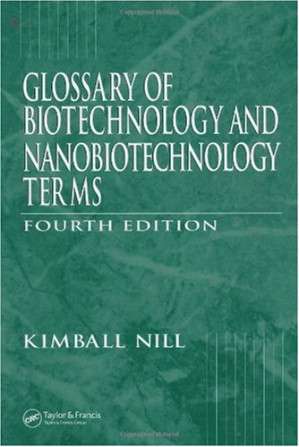
Glossary of Biotechnology and Nanobiotechnology Terms, Fourth Edition (Glossary of Biotechnology & Nanobiotechnology Terms) 🔍
Kimball Nill (Author)
C R C Press LLC Taylor & Francis Group [distributor, 4th ed., revised, Boca Raton, Florence, Nov. 2005
英语 [en] · PDF · 6.1MB · 2005 · 📘 非小说类图书 · 🚀/lgli/lgrs/nexusstc/upload/zlib · Save
描述
Annotation Even if you studied biotechnology in school, if you haven't stayed current, it's not likely you'll be able to speak the same language as today's biotech scientists. The same is even truer for nanotechnology where everything gets smaller and smaller, except the terminology required to navigate it.
In the Glossary of Biotechnology and Nanobiotechnology Terms, Fourth Edition, Kimball Nill continues to improve upon the reference that for over a decade has helped thousands of professionals, including scientists, attorneys, government workers, lobbyists, venture capitalists, and university tech transfer staff, to communicate successfully with those working on the cutting edge of modern science. Now in its fourth edition, Nill has taken the much appreciated step of adding nanotechnology to his glossary.
Just by casually perusing the Glossary of Biotechnology and Nanobiotechnology Terms, Fourth Edition you will learn a number of enlightening facts. Even those in related sciences will be surprised to discover what the language unveils.
The Glossary of Biotechnology and Nanobiotechnology Terms, Fourth Edition is a handy reference designed for people with little or no training in the biological and chemical sciences, as well as scientists communicating from other disciplines. Unlike other glossaries, this one is both informative and completely accessible. Instead of looking up one term to end up mired in equally difficult terminology, this intelligently designed volume follows what the author refers to as a Reference Chain that steadily leads you to simpler more common terminology, down to a level that anyone with a high school education will be able to understand.
The definitions are written utilizing words that enable you to conceptualize the idea embodied in the term, with explanations based on analogy whenever possible.
Consider this example:
Suppose you just received a funding request, a faculty memo, or patent concern that refers to A-DNA, which happens to be the first definition in the Glossary.
A-DNA
A particular right-handed helical form
of DNA (possessing 11 base pairs per turn),
which is the form that DNA molecules exist
in when they are partially dehydrated. A-form
DNA is found in fibers at 75% relative humidity
and requires the presence of sodium, potassium,
or cesium as the counterion. Instead of
lying flat, the bases are tilted with respect to
the helical axis, and there are more base pairs
per turn. The A-form is biologically interesting
because it is probably very close to the
conformation adopted by DNA-RNA hybrids
or by RNA-RNA double-stranded regions.
The reason is that the presence of the 2'2 hydroxyl
group prevents RNA from lying in
the B-form.
See also B-DNA, DNA-RNA HYBRID,
DEOXYRIBONUCLEIC ACID (DNA),
BASE PAIR (bp)
But then after looking at the above definition, you wonder what exactly is a DNA-RNA Hybrid?
DNA-RNA Hybrid A double helix that consists
of one chain of DNA hydrogen-bonded
to a chain of RNA by means of complementary
base pairs.
See also HYBRIDIZATION (MOLECULAR
GENETICS), HYBRIDIZATION (PLANT
GENETICS), DOUBLE HELIX
#x80;however while you've often heard mention of a double helix, you were never quite sure what that meant#x80;.
Double Helix The natural coiled conformation
of two complementary, antiparallel DNA
chains. This structure was first put forward by
Watson and Crick in 1953.
See also DEOXYRIBONUCLEIC ACID (DNA)
And that might brings you to ask, Do you really actually know what DNA is?
Deoxyribonucleic Acid (DNA)
Discovered
by Frederick Miescher in 1869, it is the chemical
basis for genes. The chemical building
blocks (molecules) of which genes (i.e.,
paired nucleotide units that code for a protein
to be produced by a cell's machinery, such as
its ribosomes) are constructed. Every inherited
characteristic has its origin somewhere in
the code of the organism's complement of
DNA. The code is made up of subunits called
nucleic acids. The sequence of the four
nucleic acids is interpreted by certain molecular
systems in order to produce the proteins
required by an organism. The structure of the
DNA molecule was elucidated in 1953#x80;.
The Glossary of Biotechnology and Nanobiotechnology Terms, Fourth Edition is packed with over 400 pages of exceptionally well-organized and cross-referenced terminology, making it an essential reference for anyone working directly or indirectly with those pioneering the frontiers of modern biology
In the Glossary of Biotechnology and Nanobiotechnology Terms, Fourth Edition, Kimball Nill continues to improve upon the reference that for over a decade has helped thousands of professionals, including scientists, attorneys, government workers, lobbyists, venture capitalists, and university tech transfer staff, to communicate successfully with those working on the cutting edge of modern science. Now in its fourth edition, Nill has taken the much appreciated step of adding nanotechnology to his glossary.
Just by casually perusing the Glossary of Biotechnology and Nanobiotechnology Terms, Fourth Edition you will learn a number of enlightening facts. Even those in related sciences will be surprised to discover what the language unveils.
The Glossary of Biotechnology and Nanobiotechnology Terms, Fourth Edition is a handy reference designed for people with little or no training in the biological and chemical sciences, as well as scientists communicating from other disciplines. Unlike other glossaries, this one is both informative and completely accessible. Instead of looking up one term to end up mired in equally difficult terminology, this intelligently designed volume follows what the author refers to as a Reference Chain that steadily leads you to simpler more common terminology, down to a level that anyone with a high school education will be able to understand.
The definitions are written utilizing words that enable you to conceptualize the idea embodied in the term, with explanations based on analogy whenever possible.
Consider this example:
Suppose you just received a funding request, a faculty memo, or patent concern that refers to A-DNA, which happens to be the first definition in the Glossary.
A-DNA
A particular right-handed helical form
of DNA (possessing 11 base pairs per turn),
which is the form that DNA molecules exist
in when they are partially dehydrated. A-form
DNA is found in fibers at 75% relative humidity
and requires the presence of sodium, potassium,
or cesium as the counterion. Instead of
lying flat, the bases are tilted with respect to
the helical axis, and there are more base pairs
per turn. The A-form is biologically interesting
because it is probably very close to the
conformation adopted by DNA-RNA hybrids
or by RNA-RNA double-stranded regions.
The reason is that the presence of the 2'2 hydroxyl
group prevents RNA from lying in
the B-form.
See also B-DNA, DNA-RNA HYBRID,
DEOXYRIBONUCLEIC ACID (DNA),
BASE PAIR (bp)
But then after looking at the above definition, you wonder what exactly is a DNA-RNA Hybrid?
DNA-RNA Hybrid A double helix that consists
of one chain of DNA hydrogen-bonded
to a chain of RNA by means of complementary
base pairs.
See also HYBRIDIZATION (MOLECULAR
GENETICS), HYBRIDIZATION (PLANT
GENETICS), DOUBLE HELIX
#x80;however while you've often heard mention of a double helix, you were never quite sure what that meant#x80;.
Double Helix The natural coiled conformation
of two complementary, antiparallel DNA
chains. This structure was first put forward by
Watson and Crick in 1953.
See also DEOXYRIBONUCLEIC ACID (DNA)
And that might brings you to ask, Do you really actually know what DNA is?
Deoxyribonucleic Acid (DNA)
Discovered
by Frederick Miescher in 1869, it is the chemical
basis for genes. The chemical building
blocks (molecules) of which genes (i.e.,
paired nucleotide units that code for a protein
to be produced by a cell's machinery, such as
its ribosomes) are constructed. Every inherited
characteristic has its origin somewhere in
the code of the organism's complement of
DNA. The code is made up of subunits called
nucleic acids. The sequence of the four
nucleic acids is interpreted by certain molecular
systems in order to produce the proteins
required by an organism. The structure of the
DNA molecule was elucidated in 1953#x80;.
The Glossary of Biotechnology and Nanobiotechnology Terms, Fourth Edition is packed with over 400 pages of exceptionally well-organized and cross-referenced terminology, making it an essential reference for anyone working directly or indirectly with those pioneering the frontiers of modern biology
备用文件名
nexusstc/Glossary of Biotechnology and Nanobiotechnology Terms/3ffd4261f2a63e330cf8e88a9493c518.pdf
备用文件名
lgli/_367807.3ffd4261f2a63e330cf8e88a9493c518.pdf
备用文件名
lgrsnf/_367807.3ffd4261f2a63e330cf8e88a9493c518.pdf
备用文件名
zlib/Biology and other natural sciences/Biotechnology/Kimball Nill (Author)/Glossary of Biotechnology and Nanobiotechnology Terms, Fourth Edition_1082392.pdf
备选作者
Kimball R Nill; NetLibrary, Inc
备选作者
Adobe Acrobat 7.0
备选作者
Nill, Kimball
备用出版商
Auerbach Publishers, Incorporated
备用出版商
Technomic Publishing Co., Inc.
备用出版商
Chapman & Hall/CRC
备用版本
CRC Press (Unlimited), Boca Raton, 2006
备用版本
United States, United States of America
备用版本
Biotechnology, 4. ed, Boca Raton, 2006
备用版本
4th ed., Boca Raton, Florida, 2006
备用版本
4th ed., Boca Raton, Florida, 2005
备用版本
4 edition, November 16, 2005
备用版本
4, PS, 2005
元数据中的注释
до 2011-08
元数据中的注释
lg643337
元数据中的注释
producers:
Acrobat Distiller 7.0.5 for Macintosh
Acrobat Distiller 7.0.5 for Macintosh
元数据中的注释
{"edition":"4","isbns":["0849366097","1420037218","9780849366093","9781420037210"],"last_page":413,"publisher":"CRC Press"}
元数据中的注释
12
备用描述
<p>Even if you studied biotechnology in school, if you haven't stayed current, it's not likely you'll be able to speak the same language as today's biotech scientists. The same is even truer for nanotechnology where everything gets smaller and smaller, except the terminology required to navigate it.</p><p>In the Glossary of Biotechnology and Nanobiotechnology Terms, Fourth Edition, Kimball Nill continues to improve upon the reference that for over a decade has helped thousands of professionals, including scientists, attorneys, government workers, lobbyists, venture capitalists, and university tech transfer staff, to communicate successfully with those working on the cutting edge of modern science. Now in its fourth edition, Nill has taken the much appreciated step of adding nanotechnology to his glossary.</p><p>Just by casually perusing the Glossary of Biotechnology and Nanobiotechnology Terms, Fourth Edition you will learn a number of enlightening facts. Even those in related sciences will be surprised to discover what the language unveils.</p><p>The Glossary of Biotechnology and Nanobiotechnology Terms, Fourth Edition is a handy reference designed for people with little or no training in the biological and chemical sciences, as well as scientists communicating from other disciplines. Unlike other glossaries, this one is both informative and completely accessible. Instead of looking up one term to end up mired in equally difficult terminology, this intelligently designed volume follows what the author refers to as a Reference Chain that steadily leads you to simpler more common terminology, down to a level that anyone with a high school education will be able to understand.</p><p>The definitions are written utilizing words that enable you to conceptualize the idea embodied in the term, with explanations based on analogy whenever possible.</p><p>Consider this example:<br>Suppose you just received a funding request, a faculty memo, or patent concern that refers to A-DNA, which happens to be the first definition in the Glossary.</p><p>A-DNA A particular right-handed helical form of DNA (possessing 11 base pairs per turn),<br>which is the form that DNA molecules exist in when they are partially dehydrated. A-form DNA is found in fibers at 75% relative humidity and requires the presence of sodium, potassium,<br>or cesium as the counterion. Instead of lying flat, the bases are tilted with respect to the helical axis, and there are more base pairs per turn. The A-form is biologically interesting because it is probably very close to the conformation adopted by DNA-RNA hybrids or by RNA-RNA double-stranded regions.<br>The reason is that the presence of the 2'2 hydroxyl group prevents RNA from lying in the B-form.<br>See also B-DNA, DNA-RNA HYBRID,<br>DEOXYRIBONUCLEIC ACID (DNA),<br>BASE PAIR (bp)</p><p>But then after looking at the above definition, you wonder what exactly is a DNA-RNA Hybrid?</p><p>DNA-RNA Hybrid A double helix that consists of one chain of DNA hydrogen-bonded to a chain of RNA by means of complementary base pairs.<br>See also HYBRIDIZATION (MOLECULAR GENETICS), HYBRIDIZATION (PLANT GENETICS), DOUBLE HELIX</p><p>â¦however while you've often heard mention of a double helix, you were never quite sure what that meantâ¦.</p><p>Double Helix The natural coiled conformation of two complementary, antiparallel DNA chains. This structure was first put forward by Watson and Crick in 1953.<br>See also DEOXYRIBONUCLEIC ACID (DNA)</p><p>And that might brings you to ask, Do you really actually know what DNA is?</p><p>Deoxyribonucleic Acid (DNA)<br>Discovered by Frederick Miescher in 1869, it is the chemical basis for genes. The chemical building blocks (molecules) of which genes (i.e.,<br>paired nucleotide units that code for a protein to be produced by a cell's machinery, such as its ribosomes) are constructed. Every inherited characteristic has its origin somewhere in the code of the organism's complement of DNA. The code is made up of subunits called nucleic acids. The sequence of the four nucleic acids is interpreted by certain molecular systems in order to produce the proteins required by an organism. The structure of the DNA molecule was elucidated in 1953â¦.</p><p>The Glossary of Biotechnology and Nanobiotechnology Terms, Fourth Edition is packed with over 400 pages of exceptionally well-organized and cross-referenced terminology, making it an essential reference for anyone working directly or indirectly with those pioneering the frontiers of modern biology.</p>
备用描述
"In the Glossary of Biotechnology and Nanobiotechnology Terms, Fourth Edition, Kimball Nill continues to improve upon the reference that for over a decade has helped thousands of professionals, including scientists in other fields, attorneys, government workers, lobbyists, venture capitalists, and university tech transfer staff to communicate successfully with those working on the cutting edge of modern science. Recognizing nanoscience's expanding contribution to biotech, Nill has taken the much appreciated step of adding relevant nano terminology to his glossary." "The Glossary of Biotechnology and Nanobiotechnology Terms, Fourth Edition is packed with over 400 pages of exceptionally well-organized and cross-referenced terminology, making it an essential reference for anyone working directly or indirectly with those pioneering the frontiers of modern biology."--Jacket
备用描述
As the fields of biotechnology and nanobiotechnology continue their growth and evolution, non-technical people must quickly become conversant with a topic that is highly technical. This title shows the nanotechnology terms relevant to biotechnology. It provides definitions of terms, clarifies fresh terms, and describes how they are used.
开源日期
2011-08-31
🚀 快速下载
成为会员以支持书籍、论文等的长期保存。为了感谢您对我们的支持,您将获得高速下载权益。❤️
如果您在本月捐款,您将获得双倍的快速下载次数。
🐢 低速下载
由可信的合作方提供。 更多信息请参见常见问题解答。 (可能需要验证浏览器——无限次下载!)
- 低速服务器(合作方提供) #1 (稍快但需要排队)
- 低速服务器(合作方提供) #2 (稍快但需要排队)
- 低速服务器(合作方提供) #3 (稍快但需要排队)
- 低速服务器(合作方提供) #4 (稍快但需要排队)
- 低速服务器(合作方提供) #5 (无需排队,但可能非常慢)
- 低速服务器(合作方提供) #6 (无需排队,但可能非常慢)
- 低速服务器(合作方提供) #7 (无需排队,但可能非常慢)
- 低速服务器(合作方提供) #8 (无需排队,但可能非常慢)
- 低速服务器(合作方提供) #9 (无需排队,但可能非常慢)
- 下载后: 在我们的查看器中打开
所有选项下载的文件都相同,应该可以安全使用。即使这样,从互联网下载文件时始终要小心。例如,确保您的设备更新及时。
外部下载
-
对于大文件,我们建议使用下载管理器以防止中断。
推荐的下载管理器:JDownloader -
您将需要一个电子书或 PDF 阅读器来打开文件,具体取决于文件格式。
推荐的电子书阅读器:Anna的档案在线查看器、ReadEra和Calibre -
使用在线工具进行格式转换。
推荐的转换工具:CloudConvert和PrintFriendly -
您可以将 PDF 和 EPUB 文件发送到您的 Kindle 或 Kobo 电子阅读器。
推荐的工具:亚马逊的“发送到 Kindle”和djazz 的“发送到 Kobo/Kindle” -
支持作者和图书馆
✍️ 如果您喜欢这个并且能够负担得起,请考虑购买原版,或直接支持作者。
📚 如果您当地的图书馆有这本书,请考虑在那里免费借阅。
下面的文字仅以英文继续。
总下载量:
“文件的MD5”是根据文件内容计算出的哈希值,并且基于该内容具有相当的唯一性。我们这里索引的所有影子图书馆都主要使用MD5来标识文件。
一个文件可能会出现在多个影子图书馆中。有关我们编译的各种数据集的信息,请参见数据集页面。
有关此文件的详细信息,请查看其JSON 文件。 Live/debug JSON version. Live/debug page.