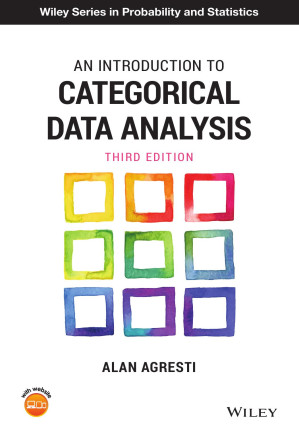
An Introduction to Categorical Data Analysis 🔍
Alan Agresti
John Wiley & Sons, Incorporated, Wiley in Probability and Statistics, 3, 2018
英语 [en] · MOBI · 2.9MB · 2018 · 📗 未知类型的图书 · 🚀/zlib · Save
描述
A valuable new edition of a standard reference
The use of statistical methods for categorical data has increased dramatically, particularly for applications in the biomedical and social sciences. An Introduction to Categorical Data Analysis, Third Edition summarizes these methods and shows readers how to use them using software. Readers will find a unified generalized linear models approach that connects logistic regression and loglinear models for discrete data with normal regression for continuous data.
Adding to the value in the new edition is:
• Illustrations of the use of R software to perform all the analyses in the book
• A new chapter on alternative methods for categorical data, including smoothing and regularization methods (such as the lasso), classification methods such as linear discriminant analysis and classification trees, and cluster analysis
• New sections in many chapters introducing the Bayesian approach for the methods of that chapter
• More than 70 analyses of data sets to illustrate application of the methods, and about 200 exercises, many containing other data sets
• An appendix showing how to use SAS, Stata, and SPSS, and an appendix with short solutions to most odd-numbered exercises
Written in an applied, nontechnical style, this book illustrates the methods using a wide variety of real data, including medical clinical trials, environmental questions, drug use by teenagers, horseshoe crab mating, basketball shooting, correlates of happiness, and much more.
An Introduction to Categorical Data Analysis, Third Edition is an invaluable tool for statisticians and biostatisticians as well as methodologists in the social and behavioral sciences, medicine and public health, marketing, education, and the biological and agricultural sciences.
The use of statistical methods for categorical data has increased dramatically, particularly for applications in the biomedical and social sciences. An Introduction to Categorical Data Analysis, Third Edition summarizes these methods and shows readers how to use them using software. Readers will find a unified generalized linear models approach that connects logistic regression and loglinear models for discrete data with normal regression for continuous data.
Adding to the value in the new edition is:
• Illustrations of the use of R software to perform all the analyses in the book
• A new chapter on alternative methods for categorical data, including smoothing and regularization methods (such as the lasso), classification methods such as linear discriminant analysis and classification trees, and cluster analysis
• New sections in many chapters introducing the Bayesian approach for the methods of that chapter
• More than 70 analyses of data sets to illustrate application of the methods, and about 200 exercises, many containing other data sets
• An appendix showing how to use SAS, Stata, and SPSS, and an appendix with short solutions to most odd-numbered exercises
Written in an applied, nontechnical style, this book illustrates the methods using a wide variety of real data, including medical clinical trials, environmental questions, drug use by teenagers, horseshoe crab mating, basketball shooting, correlates of happiness, and much more.
An Introduction to Categorical Data Analysis, Third Edition is an invaluable tool for statisticians and biostatisticians as well as methodologists in the social and behavioral sciences, medicine and public health, marketing, education, and the biological and agricultural sciences.
备选作者
Agresti, Alan
备用出版商
Wiley & Sons, Incorporated, John
备用出版商
Wiley Global Research (STMS)
备用出版商
American Geophysical Union
备用出版商
Wiley-Blackwell
备用版本
Wiley series in probability and statistics, Third edition, Hoboken, NJ, 2019
备用版本
John Wiley & Sons, Inc. Textbook Subscription, Hoboken, NJ, 2019
备用版本
United States, United States of America
备用版本
Hoboken, N.J, 2018
备用版本
3, 20181011
备用描述
4.3 LOGISTIC REGRESSION WITH CATEGORICAL PREDICTORS -- 4.3.1 Indicator Variables Represent Categories of Predictors -- 4.3.2 Example: Survey about Marijuana Use -- 4.3.3 ANOVA-Type Model Representation of Factors -- 4.3.4 Tests of Conditional Independence and of Homogeneity for Three-Way Contingency Tables -- 4.4 MULTIPLE LOGISTIC REGRESSION -- 4.4.1 Example: Horseshoe Crabs with Color and Width Predictors -- 4.4.2 Model Comparison to Check Whether a Term is Needed -- 4.4.3 Example: Treating Color as Quantitative or Binary -- 4.4.4 Allowing Interaction between Explanatory Variables -- 4.4.5 Effects Depend on Other Explanatory Variables in Model -- 4.5 SUMMARIZING EFFECTS IN LOGISTIC REGRESSION -- 4.5.1 Probability-Based Interpretations -- 4.5.2 Marginal Effects and Their Average -- 4.5.3 Standardized Interpretations -- 4.6 SUMMARIZING PREDICTIVE POWER: CLASSIFICATION TABLES, ROC CURVES, AND MULTIPLE CORRELATION -- 4.6.1 Summarizing Predictive Power: Classification Tables -- 4.6.2 Summarizing Predictive Power: ROC Curves -- 4.6.3 Summarizing Predictive Power: Multiple Correlation -- EXERCISES -- 5 Building and Applying Logistic Regression Models -- 5.1 STRATEGIES IN MODEL SELECTION -- 5.1.1 How Many Explanatory Variables Can the Model Handle? -- 5.1.2 Example: Horseshoe Crab Satellites Revisited -- 5.1.3 Stepwise Variable Selection Algorithms -- 5.1.4 Purposeful Selection of Explanatory Variables -- 5.1.5 Example: Variable Selection for Horseshoe Crabs -- 5.1.6 AIC and the Bias/Variance Tradeoff -- 5.2 MODEL CHECKING -- 5.2.1 Goodness of Fit: Model Comparison Using the Deviance -- 5.2.2 Example: Goodness of Fit for Marijuana Use Survey -- 5.2.3 Goodness of Fit: Grouped versus Ungrouped Data and Continuous Predictors -- 5.2.4 Residuals for Logistic Models with Categorical Predictors -- 5.2.5 Example: Graduate Admissions at University of Florida
备用描述
5.2.6 Standardized versus Pearson and Deviance Residuals -- 5.2.7 Influence Diagnostics for Logistic Regression -- 5.2.8 Example: Heart Disease and Blood Pressure -- 5.3 INFINITE ESTIMATES IN LOGISTIC REGRESSION -- 5.3.1 Complete and Quasi-Complete Separation: Perfect Discrimination -- 5.3.2 Example: Infinite Estimate for Toy Example -- 5.3.3 Sparse Data and Infinite Effects with Categorical Predictors -- 5.3.4 Example: Risk Factors for Endometrial Cancer Grade -- 5.4 BAYESIAN INFERENCE, PENALIZED LIKELIHOOD, AND CONDITIONAL LIKELIHOOD FOR LOGISTIC REGRESSION -- 5.4.1 Bayesian Modeling: Specification of Prior Distributions -- 5.4.2 Example: Risk Factors for Endometrial Cancer Revisited -- 5.4.3 Penalized Likelihood Reduces Bias in Logistic Regression -- 5.4.4 Example: Risk Factors for Endometrial Cancer Revisited -- 5.4.5 Conditional Likelihood and Conditional Logistic Regression -- 5.4.6 Conditional Logistic Regression and Exact Tests for Contingency Tables -- 5.5 ALTERNATIVE LINK FUNCTIONS: LINEAR PROBABILITY AND PROBIT MODELS -- 5.5.1 Linear Probability Model -- 5.5.2 Example: Political Ideology and Belief in Evolution -- 5.5.3 Probit Model and Normal Latent Variable Model -- 5.5.4 Example: Snoring and Heart Disease Revisited -- 5.5.5 Latent Variable Models Imply Binary Regression Models -- 5.5.6 CDFs and Shapes of Curves for Binary Regression Models -- 5.6 SAMPLE SIZE AND POWER FOR LOGISTIC REGRESSION -- 5.6.1 Sample Size for Comparing Two Proportions -- 5.6.2 Sample Size in Logistic Regression Modeling -- 5.6.3 Example: Modeling the Probability of Heart Disease -- Exercises -- 6 Multicategory Logit Models -- 6.1 BASELINE-CATEGORY LOGIT MODELS FOR NOMINAL RESPONSES -- 6.1.1 Baseline-Category Logits -- 6.1.2 Example: What Do Alligators Eat? -- 6.1.3 Estimating Response Probabilities -- 6.1.4 Checking Multinomial Model Goodness of Fit
备用描述
Intro -- An Introduction to Categorical Data Analysis -- Contents -- Preface -- About the Companion Website -- 1 Introduction -- 1.1 CATEGORICAL RESPONSE DATA -- 1.1.1 Response Variable and Explanatory Variables -- 1.1.2 Binary-Nominal-Ordinal Scale Distinction -- 1.1.3 Organization of this Book -- 1.2 PROBABILITY DISTRIBUTIONS FOR CATEGORICAL DATA -- 1.2.1 Binomial Distribution -- 1.2.2 Multinomial Distribution -- 1.3 STATISTICAL INFERENCE FOR A PROPORTION -- 1.3.1 Likelihood Function and Maximum Likelihood Estimation -- 1.3.2 Significance Test About a Binomial Parameter -- 1.3.3 Example: Surveyed Opinions About Legalized Abortion -- 1.3.4 Confidence Intervals for a Binomial Parameter -- 1.3.5 Better Confidence Intervals for a Binomial Proportion -- 1.4 STATISTICAL INFERENCE FOR DISCRETE DATA -- 1.4.1 Wald, Likelihood-Ratio, and Score Tests -- 1.4.2 Example: Wald, Score, and Likelihood-Ratio Binomial Tests -- 1.4.3 Small-Sample Binomial Inference and the Mid P-Value -- 1.5 BAYESIAN INFERENCE FOR PROPORTIONS -- 1.5.1 The Bayesian Approach to Statistical Inference -- 1.5.2 Bayesian Binomial Inference: Beta Prior Distributions -- 1.5.3 Example: Opinions about Legalized Abortion, Revisited -- 1.5.4 Other Prior Distributions -- 1.6 USING R SOFTWARE FOR STATISTICAL INFERENCE ABOUT PROPORTIONS -- 1.6.1 Reading Data Files and Installing Packages -- 1.6.2 Using R for Statistical Inference about Proportions -- 1.6.3 Summary: Choosing an Inference Method -- Exercises -- 2 Analyzing Contingency Tables -- 2.1 PROBABILITY STRUCTURE FOR CONTINGENCY TABLES -- 2.1.1 Joint, Marginal, and Conditional Probabilities -- 2.1.2 Example: Sensitivity and Specificity -- 2.1.3 Statistical Independence of Two Categorical Variables -- 2.1.4 Binomial and Multinomial Sampling -- 2.2 COMPARING PROPORTIONS IN 2×2 CONTINGENCY TABLES -- 2.2.1 Difference of Proportions
备用描述
2.2.2 Example: Aspirin and Incidence of Heart Attacks -- 2.2.3 Ratio of Proportions (Relative Risk) -- 2.2.4 Using R for Comparing Proportions in 2×2 Tables -- 2.3 THE ODDS RATIO -- 2.3.1 Properties of the Odds Ratio -- 2.3.2 Example: Odds Ratio for Aspirin Use and Heart Attacks -- 2.3.3 Inference for Odds Ratios and Log Odds Ratios -- 2.3.4 Relationship Between Odds Ratio and Relative Risk -- 2.3.5 Example: The Odds Ratio Applies in Case-Control Studies -- 2.3.6 Types of Studies: Observational Versus Experimental -- 2.4 CHI-SQUARED TESTS OF INDEPENDENCE -- 2.4.1 Pearson Statistic and the Chi-Squared Distribution -- 2.4.2 Likelihood-Ratio Statistic -- 2.4.3 Testing Independence in Two-Way Contingency Tables -- 2.4.4 Example: Gender Gap in Political Party Affiliation -- 2.4.5 Residuals for Cells in a Contingency Table -- 2.4.6 Partitioning Chi-Squared Statistics -- 2.4.7 Limitations of Chi-Squared Tests -- 2.5 TESTING INDEPENDENCE FOR ORDINAL VARIABLES -- 2.5.1 Linear Trend Alternative to Independence -- 2.5.2 Example: Alcohol Use and Infant Malformation -- 2.5.3 Ordinal Tests Usually Have Greater Power -- 2.5.4 Choice of Scores -- 2.5.5 Trend Tests for r×2 and 2×c and Nominal-Ordinal Tables -- 2.6 EXACT FREQUENTIST AND BAYESIAN INFERENCE -- 2.6.1 Fisher's Exact Test for 2×2 Tables -- 2.6.2 Example: Fisher's Tea Tasting Colleague -- 2.6.3 Conservatism for Actual (Type I Error) -- Mid -Values -- 2.6.4 Small-Sample Confidence Intervals for Odds Ratio -- 2.6.5 Bayesian Estimation for Association Measures -- 2.6.6 Example: Bayesian Inference in a Small Clinical Trial -- 2.7 ASSOCIATION IN THREE-WAY TABLES -- 2.7.1 Partial Tables -- 2.7.2 Example: Death Penalty Verdicts and Race -- 2.7.3 Simpson's Paradox -- 2.7.4 Conditional and Marginal Odds Ratios -- 2.7.5 Homogeneous Association -- Exercises -- 3 Generalized Linear Models
备用描述
3.1 COMPONENTS OF A GENERALIZED LINEAR MODEL -- 3.1.1 Random Component -- 3.1.2 Linear Predictor -- 3.1.3 Link Function -- 3.1.4 Ordinary Linear Model: GLM with Normal Random Component -- GENERALIZED LINEAR MODELS FOR BINARY DATA -- 3.2.1 Linear Probability Model -- 3.2.2 Logistic Regression Model -- 3.2.3 Example: Snoring and Heart Disease -- 3.2.4 Using R to Fit Generalized Linear Models for Binary Data -- 3.2.5 Data Files: Ungrouped or Grouped Binary Data -- 3.3 GENERALIZED LINEAR MODELS FOR COUNTS AND RATES -- 3.3.1 Poisson Distribution for Counts -- 3.3.2 Poisson Loglinear Model -- 3.3.3 Example: Female Horseshoe Crabs and their Satellites -- 3.3.4 Overdispersion: Greater Variability than Expected -- 3.4 STATISTICAL INFERENCE AND MODEL CHECKING -- 3.4.1 Wald, Likelihood-Ratio, and Score Inference Use the Likelihood Function -- 3.4.2 Example: Political Ideology and Belief in Evolution -- 3.4.3 The Deviance of a GLM -- 3.4.4 Model Comparison Using the Deviance -- 3.4.5 Residuals Comparing Observations to the Model Fit -- 3.5 FITTING GENERALIZED LINEAR MODELS -- 3.5.1 The Fisher Scoring Algorithm Fits GLMs -- 3.5.2 Bayesian Methods for Generalized Linear Models -- 3.5.3 GLMs: A Unified Approach to Statistical Analysis -- Exercises -- 4 Logistic Regression -- 4.1 THE LOGISTIC REGRESSION MODEL -- 4.1.1 The Logistic Regression Model -- 4.1.2 Odds Ratio and Linear Approximation Interpretations -- 4.1.3 Example: Whether a Female Horseshoe Crab Has Satellites -- 4.1.4 Logistic Regression with Retrospective Studies -- 4.1.5 Normally Distributed X Implies Logistic Regression for Y -- 4.2 STATISTICAL INFERENCE FOR LOGISTIC REGRESSION -- 4.2.1 Confidence Intervals for Effects -- 4.2.2 Significance Testing -- 4.2.3 Fitted Values and Confidence Intervals for Probabilities -- 4.2.4 Why Use a Model to Estimate Probabilities?
开源日期
2023-01-28
🚀 快速下载
成为会员以支持书籍、论文等的长期保存。为了感谢您对我们的支持,您将获得高速下载权益。❤️
如果您在本月捐款,您将获得双倍的快速下载次数。
🐢 低速下载
由可信的合作方提供。 更多信息请参见常见问题解答。 (可能需要验证浏览器——无限次下载!)
- 低速服务器(合作方提供) #1 (稍快但需要排队)
- 低速服务器(合作方提供) #2 (稍快但需要排队)
- 低速服务器(合作方提供) #3 (稍快但需要排队)
- 低速服务器(合作方提供) #4 (稍快但需要排队)
- 低速服务器(合作方提供) #5 (无需排队,但可能非常慢)
- 低速服务器(合作方提供) #6 (无需排队,但可能非常慢)
- 低速服务器(合作方提供) #7 (无需排队,但可能非常慢)
- 低速服务器(合作方提供) #8 (无需排队,但可能非常慢)
- 低速服务器(合作方提供) #9 (无需排队,但可能非常慢)
- 下载后: 在我们的查看器中打开
所有选项下载的文件都相同,应该可以安全使用。即使这样,从互联网下载文件时始终要小心。例如,确保您的设备更新及时。
外部下载
-
对于大文件,我们建议使用下载管理器以防止中断。
推荐的下载管理器:JDownloader -
您将需要一个电子书或 PDF 阅读器来打开文件,具体取决于文件格式。
推荐的电子书阅读器:Anna的档案在线查看器、ReadEra和Calibre -
使用在线工具进行格式转换。
推荐的转换工具:CloudConvert和PrintFriendly -
您可以将 PDF 和 EPUB 文件发送到您的 Kindle 或 Kobo 电子阅读器。
推荐的工具:亚马逊的“发送到 Kindle”和djazz 的“发送到 Kobo/Kindle” -
支持作者和图书馆
✍️ 如果您喜欢这个并且能够负担得起,请考虑购买原版,或直接支持作者。
📚 如果您当地的图书馆有这本书,请考虑在那里免费借阅。
下面的文字仅以英文继续。
总下载量:
“文件的MD5”是根据文件内容计算出的哈希值,并且基于该内容具有相当的唯一性。我们这里索引的所有影子图书馆都主要使用MD5来标识文件。
一个文件可能会出现在多个影子图书馆中。有关我们编译的各种数据集的信息,请参见数据集页面。
有关此文件的详细信息,请查看其JSON 文件。 Live/debug JSON version. Live/debug page.