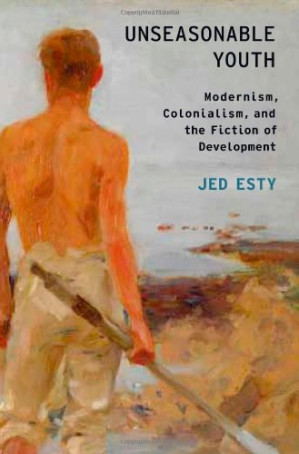
Unseasonable Youth: Modernism, Colonialism, and the Fiction of Development (Modernist Literature and Culture) 🔍
Esty, Joshua
IRL Press at Oxford University Press, Modernist literature & culture, 1, 2012
英语 [en] · PDF · 1.4MB · 2012 · 📘 非小说类图书 · 🚀/lgli/lgrs/nexusstc/upload/zlib · Save
描述
__Unseasonable Youth__ examines a range of modernist-era fictions that cast doubt on the ideology of progress through the figure of stunted or endless adolescence. Novels of youth by Oscar Wilde, Olive Schreiner, Rudyard Kipling, Joseph Conrad, H.G. Wells, James Joyce, Virginia Woolf, Jean Rhys, and Elizabeth Bowen disrupt the inherited conventions of the bildungsroman in order to criticize bourgeois values and to reinvent the biographical plot, but also to explore the contradictions inherent in mainstream developmental discourses of self, nation, and empire. The intertwined tropes of frozen youth and uneven development, as motifs of failed progress, play a crucial role in the emergence of dilatory modernist style and in the reimagination of colonial space at the fin-de-siècle. The genre-bending logic of uneven development - never wholly absent from the coming-of-age novel -- takes on a new and more intense form in modernism as it fixes its broken allegory to the problem of colonial development. In novels of unseasonable youth, the nineteenth-century idea of world progress comes up against stubborn signs of underdevelopment and uneven development, just at the same moment that post-Darwinian racial sciences and quasi-Freudian sexological discourses lend greater influence to the idea that certain forms of human difference cannot be mitigated by civilizing or developmental forces. In this historical context, the temporal meaning and social vocation of the bildungsroman undergo a comprehensive shift, as the history of the novel indexes the gradual displacement of historical-progressive thinking by anthropological-structural thinking in the Age of Empire.
备用文件名
lgli/K:\!genesis\!repository8\8\farway\Unseasonable Youth_978–0–19–985796–8.pdf
备用文件名
lgrsnf/K:\!genesis\!repository8\8\farway\Unseasonable Youth_978–0–19–985796–8.pdf
备用文件名
nexusstc/Unseasonable youth : modernism, colonialism, and the fiction of development/13a08d1ce0bc694971a72d61dccb587b.pdf
备用文件名
zlib/Poetry/American Poetry/Esty, Joshua/Unseasonable youth : modernism, colonialism, and the fiction of development_2923286.pdf
备选作者
Joshua Esty
备选作者
Esty, Jed
备选作者
Jed Esty
备用出版商
Oxford Institute for Energy Studies
备用出版商
German Historical Institute London
备用版本
Modernist literature & culture, Modernist literature & culture, New York, New York State, 2012
备用版本
Modernist literature & culture, New York, 2013
备用版本
Oxford University Press USA, New York, 2012
备用版本
United Kingdom and Ireland, United Kingdom
备用版本
1, 2011-11-04
备用版本
1, PS, 2011
元数据中的注释
lg1680587
元数据中的注释
{"edition":"1","isbns":["0199857962","9780199857968"],"last_page":304,"publisher":"Oxford University Press","series":"Modernist literature & culture"}
元数据中的注释
Includes bibliographical references and index.
备用描述
"The bildungsroman, with its elegant arc charting a protagonist's progression from childhood to maturity, is one of literature's most familiar and enduring genres. Yet in the late nineteenth and early twentieth centuries a series of novels appeared that began to upend this classical formula. Rather than moving smoothly into adulthood, the characters in these new coming of age fictions seemed to veer off course into a state of suspended or stunted adolescence. Modernist-era novels of unseasonable youth disrupt the inherited conventions of the bildungsroman in order to criticize bourgeois values and to reinvent the biographical plot, but also to explore the contradictions inherent in developmental discourses of self, nation, and empire. Narratives of world progress run up against stubborn developmental obstacles, just at the same moment that post-Darwinian racial sciences and Freudian sexological theories were lending influence to the idea that some forms of human difference cannot be mitigated by civilizing forces. In this context, the modernist bildungsroman can be seen as narrating the gradual displacement of historical-progressive thinking by anthropological-structural thinking in the Age of Empire. Jed Esty follows this fascinating line of argument through analysis of novels by Kipling, Wilde, Conrad, Joyce, Woolf, Rhys, and others to reveal how intertwined tropes of frozen youth and uneven development, as motifs of failed progress, play a crucial role in the emergence of dilatory modernist style and in the re-imagination of colonial space at the fin de siecle. Features : - Reveals how late Victorian and modernist novelists upended and subverted the typical conventions of the rite of passage story - Brings modernist studies into dialogue with the burgeoning subfield of childhood studies through its examination of adolescence - Covers seminal bildungsromans by Goethe, Kipling, Wilde, Joyce, and others ." Publisher's note
备用描述
"The bildungsroman, with its elegant arc charting a protagonist's progression from childhood to maturity, is one of literature's most familiar and enduring genres. Yet in the late nineteenth and early twentieth centuries a series of novels appeared that began to upend this classical formula. Rather than moving smoothly into adulthood, the characters in these new coming of age fictions seemed to veer off course into a state of suspended or stunted adolescence. Modernist-era novels of unseasonable youth disrupt the inherited conventions of the bildungsroman in order to criticize bourgeois values and to reinvent the biographical plot, but also to explore the contradictions inherent in developmental discourses of self, nation, and empire. Narratives of world progress run up against stubborn developmental obstacles, just at the same moment that post-Darwinian racial sciences and Freudian sexological theories were lending influence to the idea that some forms of human difference cannot be mitigated by civilizing forces. In this context, the modernist bildungsroman can be seen as narrating the gradual displacement of historical-progressive thinking by anthropological-structural thinking in the Age of Empire. Jed Esty follows this fascinating line of argument through analysis of novels by Kipling, Wilde, Conrad, Joyce, Woolf, Rhys, and others to reveal how intertwined tropes of frozen youth and uneven development, as motifs of failed progress, play a crucial role in the emergence of dilatory modernist style and in the re-imagination of colonial space at the fin de siècle."--Provided by publisher
备用描述
Cover 1
Contents 8
Foreword 10
Acknowledgments 14
1. Introduction: Scattered Souls—The Bildungsroman and Colonial Modernity 20
After the Novel of Progress 20
Kipling’ s Imperial Time 26
Genre, History, and the Trope of Youth 33
Modernist Subjectivity and the World-System 44
2. “National-Historical Time” from Goethe to George Eliot 58
Infinite Development versus National Form 60
Nationhood and Adulthood in The Mill on the Floss 72
After Eliot: Aging Forms and Globalized Provinces 83
3. Youth/Death: Schreiner and Conrad in the Contact Zone 90
Outpost without Progress: Olive Schreiner’s Story of an African Farm 93
“A free and wandering tale”: Conrad’s Lord Jim 102
4. Souls of Men under Capitalism: Wilde, Wells, and the Anti-Novel 120
“Unripe Time”: Dorian Gray and Metropolitan Youth 123
An “unassimilable enormity of traffic”: Commerce and Decay in Tono-Bungay 134
5. Tropics of Youth in Woolf and Joyce 146
The “weight of the world”: Woolf ’s Colonial Adolescence 150
“Elfin Preludes”: Joyce’s Adolescent Colony 161
6. Virgins of Empire: The Antidevelopmental Plot in Rhys and Bowen 179
Gender and Colonialism in the Modernist Semi-Periphery 179
Endlessly Devolving: Jean Rhys’s Voyage in the Dark 185
Querying Innocence: Elizabeth Bowen’s The Last September 198
7. Conclusion: Alternative Modernity and Autonomous Youth after 1945 214
Notes 234
Works Cited 278
Index 294
A 294
B 294
C 295
D 296
E 296
F 296
G 296
H 297
I 297
J 297
K 297
L 298
M 298
N 299
O 299
P 299
R 299
S 300
T 300
U 301
V 301
W 301
Y 301
Z 301
Contents 8
Foreword 10
Acknowledgments 14
1. Introduction: Scattered Souls—The Bildungsroman and Colonial Modernity 20
After the Novel of Progress 20
Kipling’ s Imperial Time 26
Genre, History, and the Trope of Youth 33
Modernist Subjectivity and the World-System 44
2. “National-Historical Time” from Goethe to George Eliot 58
Infinite Development versus National Form 60
Nationhood and Adulthood in The Mill on the Floss 72
After Eliot: Aging Forms and Globalized Provinces 83
3. Youth/Death: Schreiner and Conrad in the Contact Zone 90
Outpost without Progress: Olive Schreiner’s Story of an African Farm 93
“A free and wandering tale”: Conrad’s Lord Jim 102
4. Souls of Men under Capitalism: Wilde, Wells, and the Anti-Novel 120
“Unripe Time”: Dorian Gray and Metropolitan Youth 123
An “unassimilable enormity of traffic”: Commerce and Decay in Tono-Bungay 134
5. Tropics of Youth in Woolf and Joyce 146
The “weight of the world”: Woolf ’s Colonial Adolescence 150
“Elfin Preludes”: Joyce’s Adolescent Colony 161
6. Virgins of Empire: The Antidevelopmental Plot in Rhys and Bowen 179
Gender and Colonialism in the Modernist Semi-Periphery 179
Endlessly Devolving: Jean Rhys’s Voyage in the Dark 185
Querying Innocence: Elizabeth Bowen’s The Last September 198
7. Conclusion: Alternative Modernity and Autonomous Youth after 1945 214
Notes 234
Works Cited 278
Index 294
A 294
B 294
C 295
D 296
E 296
F 296
G 296
H 297
I 297
J 297
K 297
L 298
M 298
N 299
O 299
P 299
R 299
S 300
T 300
U 301
V 301
W 301
Y 301
Z 301
备用描述
Content: Contents
Series Editors' Foreword
Chapter one: Introduction
Scattered Souls: The Bildungsroman and Colonial Modernity
After the Novel of Progress
Kipling's Imperial Time
Genre, History, and the Trope of Youth
Modernist Subjectivity and the World-System
Chapter two
"National-Historical Time" from Goethe to George Eliot
Infinite Development vs. National Form
Nationhood and Adulthood in The Mill on the Floss
After Eliot: Aging Forms and Globalized Provinces
Chapter three
Youth/Death: Schreiner and Conrad in the Contact Zone
Outpost Without Progress: Schreiner's Story of An African Farm
"A free and wandering tale": Conrad's Lord Jim
Chapter four
Souls of Men under Capitalism: Wilde, Wells, and the Anti-Novel
"Unripe Time": Dorian Gray and Metropolitan Youth
Commerce and Decay in Tono-Bungay
Chapter five
Tropics of Youth in Woolf and Joyce
The "weight of the world": Woolf's Colonial Adolescence
"Elfin Preludes": Joyce's Adolescent Colony
Chapter six
Virgins of Empire: The Antidevelopmental Plot in Rhys and Bowen
Gender and Colonialism in the Modernist Semi-Periphery
Endlessly Devolving: Jean Rhys's Voyage in the Dark
Querying Innocence: Elizabeth Bowen's The Last September
Chapter seven: Conclusion
Alternative Modernity and Autonomous Youth After 1945
Works Cited
Index
Series Editors' Foreword
Chapter one: Introduction
Scattered Souls: The Bildungsroman and Colonial Modernity
After the Novel of Progress
Kipling's Imperial Time
Genre, History, and the Trope of Youth
Modernist Subjectivity and the World-System
Chapter two
"National-Historical Time" from Goethe to George Eliot
Infinite Development vs. National Form
Nationhood and Adulthood in The Mill on the Floss
After Eliot: Aging Forms and Globalized Provinces
Chapter three
Youth/Death: Schreiner and Conrad in the Contact Zone
Outpost Without Progress: Schreiner's Story of An African Farm
"A free and wandering tale": Conrad's Lord Jim
Chapter four
Souls of Men under Capitalism: Wilde, Wells, and the Anti-Novel
"Unripe Time": Dorian Gray and Metropolitan Youth
Commerce and Decay in Tono-Bungay
Chapter five
Tropics of Youth in Woolf and Joyce
The "weight of the world": Woolf's Colonial Adolescence
"Elfin Preludes": Joyce's Adolescent Colony
Chapter six
Virgins of Empire: The Antidevelopmental Plot in Rhys and Bowen
Gender and Colonialism in the Modernist Semi-Periphery
Endlessly Devolving: Jean Rhys's Voyage in the Dark
Querying Innocence: Elizabeth Bowen's The Last September
Chapter seven: Conclusion
Alternative Modernity and Autonomous Youth After 1945
Works Cited
Index
备用描述
Unseasonable Youth examines a range of modernist-era fictions by Wilde, Woolf, Conrad, Joyce, Bowen, and others to challenge and expand our understanding of the bildungsroman genre.
开源日期
2017-04-22
🚀 快速下载
成为会员以支持书籍、论文等的长期保存。为了感谢您对我们的支持,您将获得高速下载权益。❤️
🐢 低速下载
由可信的合作方提供。 更多信息请参见常见问题解答。 (可能需要验证浏览器——无限次下载!)
- 低速服务器(合作方提供) #1 (稍快但需要排队)
- 低速服务器(合作方提供) #2 (稍快但需要排队)
- 低速服务器(合作方提供) #3 (稍快但需要排队)
- 低速服务器(合作方提供) #4 (稍快但需要排队)
- 低速服务器(合作方提供) #5 (无需排队,但可能非常慢)
- 低速服务器(合作方提供) #6 (无需排队,但可能非常慢)
- 低速服务器(合作方提供) #7 (无需排队,但可能非常慢)
- 低速服务器(合作方提供) #8 (无需排队,但可能非常慢)
- 低速服务器(合作方提供) #9 (无需排队,但可能非常慢)
- 下载后: 在我们的查看器中打开
所有选项下载的文件都相同,应该可以安全使用。即使这样,从互联网下载文件时始终要小心。例如,确保您的设备更新及时。
外部下载
-
对于大文件,我们建议使用下载管理器以防止中断。
推荐的下载管理器:JDownloader -
您将需要一个电子书或 PDF 阅读器来打开文件,具体取决于文件格式。
推荐的电子书阅读器:Anna的档案在线查看器、ReadEra和Calibre -
使用在线工具进行格式转换。
推荐的转换工具:CloudConvert和PrintFriendly -
您可以将 PDF 和 EPUB 文件发送到您的 Kindle 或 Kobo 电子阅读器。
推荐的工具:亚马逊的“发送到 Kindle”和djazz 的“发送到 Kobo/Kindle” -
支持作者和图书馆
✍️ 如果您喜欢这个并且能够负担得起,请考虑购买原版,或直接支持作者。
📚 如果您当地的图书馆有这本书,请考虑在那里免费借阅。
下面的文字仅以英文继续。
总下载量:
“文件的MD5”是根据文件内容计算出的哈希值,并且基于该内容具有相当的唯一性。我们这里索引的所有影子图书馆都主要使用MD5来标识文件。
一个文件可能会出现在多个影子图书馆中。有关我们编译的各种数据集的信息,请参见数据集页面。
有关此文件的详细信息,请查看其JSON 文件。 Live/debug JSON version. Live/debug page.