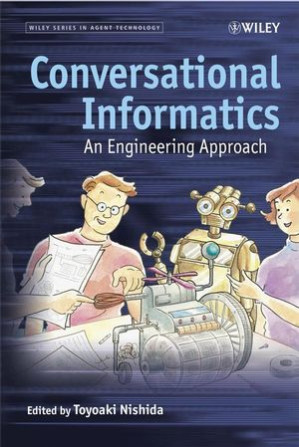
Conversational Informatics: An Engineering Approach (Wiley Series in Agent Technology) 🔍
Nishida, Toyoaki (editor)
John Wiley & Sons, Ltd, Wiley Series in Agent Technology, Wiley Series in Agent Technology, 1, 2007
英语 [en] · PDF · 19.0MB · 2007 · 📘 非小说类图书 · 🚀/lgli/lgrs/nexusstc/zlib · Save
描述
Conversational informatics investigates human behaviour with a view to designing conversational artifacts capable of interacting with humans in a conversational fashion. It spans a broad array of topics including linguistics, psychology and human-computer interaction. Until recently research in such areas has been carried out in isolation, with no attempt made to connect the various disciplines. Advancements in science and technology have changed this. Conversational Informatics provides an interdisciplinary introduction to conversational informatics and places emphasis upon the integration of scientific approaches to achieve engineering goals and to advance further understanding of conversation. It features a collection of surveys structured around four prominent research areas: conversational artifacts, conversational contents, conversation environment design and conversation measurement, analysis and modelling Conversational artifacts shows how synthetic characters or intelligent robots use eye gaze, gestures and other non-verbal communicators to interact. Conversational contents looks at developing techniques for acquiring, editing, distributing and utilising the contents that are produced and consumed in conversation. Conversation environment design explains techniques for creating intelligent virtual environments and for representing individuals within a virtual environment by monitoring and reproducing their non-verbal conversational behaviour. Conversation measurement, analysis and modelling demonstrate how conversational behaviour can be measured and analyzed. Conversational Informatics will be an invaluable resource for postgraduate students and researchers in Computer Science and Electrical Engineering as well as engineers and developers working in the field of automation, robotics and agents technology.Content:
Chapter 1 Introduction (pages 1–18): Toyoaki Nishida
Chapter 2 Conversational Agents and the Construction of Humorous Acts (pages 19–47): Anton Nijholt
Chapter 3 Why Emotions should be Integrated into Conversational Agents (pages 49–67): Christian Becker, Stefan Kopp and Ipke Wachsmuth
Chapter 4 More Than Just a Friendly Phrase: Multimodal Aspects of Polite Behavior in Agents (pages 69–84): Matthias Rehm and Elisabeth Andre
Chapter 5 Attentional Behaviors as Nonverbal Communicative Signals in Situated Interactions with Conversational Agents (pages 85–102): Yukiko I. Nakano and Toyoaki Nishida
Chapter 6 Attentional Gestures in Dialogues Between People and Robots (pages 103–115): Candace L. Sidner and Christopher Lee
Chapter 7 Dialogue Context for Visual Feedback Recognition (pages 117–131): Louis?Philippe Morency, Candace L. Sidner and Trevor Darrell
Chapter 8 Trading Spaces: How Humans and Humanoids Use Speech and Gesture to Give Directions (pages 133–160): Stefan Kopp, Paul A. Tepper, Kimberley Ferriman, Kristina Striegnitz and Justine Cassell
Chapter 9 Facial Gestures: Taxonomy and Application of Nonverbal, Nonemotional Facial Displays for Embodied Conversational Agents (pages 161–182): Goranka Zoric, Karlo Smid and Igor S. Pandzic
Chapter 10 Conversation Quantization and Sustainable Knowledge Globe (pages 183–200): Hidekazu Kubota, Yasuyuki Sumi and Toyoaki Nishida
Chapter 11 Automatic Text Presentation for the Conversational Knowledge Process (pages 201–216): Sadao Kurohashi, Daisuke Kawahara, Nobuhiro Kaji and Tomohide Shibata
Chapter 12 Video Content Acquisition and Editing for Conversation Scenes (pages 217–232): Yuichi Nakamura
Chapter 13 Personalization of Video Contents (pages 233–248): Noboru Babaguchi
Chapter 14 Conversational Content Acquisition by Ubiquitous Sensors (pages 249–267): Yasuyuki Sumi, Kenji Mase and Toyoaki Nishida
Chapter 15 Real?Time Human Proxy (pages 269–287): Rin?Ichiro Taniguchi and Daisaku Arita
Chapter 16 Lecture Archiving System (pages 289–303): Satoshi Nishiguchi, Koh Kakusho and Michihiko Minoh
Chapter 17 A Scientific Approach to Conversational Informatics: Description, Analysis, and Modeling of Human Conversation (pages 305–330): Yasuharu Den and Mika Enomoto
Chapter 18 Embodied Synchrony in Conversation (pages 331–351): Chika Nagaoka, Masashi Komori and Sakiko Yoshikawa
Chapter 19 Modeling Communication Atmosphere (pages 353–369): Tomasz M. Rutkowski and Danilo P. Mandic
Chapter 20 Analysis of Interaction Mechanisms in Online Communities (pages 371–380): Naohiro Matsumura
Chapter 21 Mutual Adaptation: A New Criterion for Designing and Evaluating Human–Computer Interaction (pages 381–402): Kazuhiro Ueda and Takanori Komatsu
Chapter 1 Introduction (pages 1–18): Toyoaki Nishida
Chapter 2 Conversational Agents and the Construction of Humorous Acts (pages 19–47): Anton Nijholt
Chapter 3 Why Emotions should be Integrated into Conversational Agents (pages 49–67): Christian Becker, Stefan Kopp and Ipke Wachsmuth
Chapter 4 More Than Just a Friendly Phrase: Multimodal Aspects of Polite Behavior in Agents (pages 69–84): Matthias Rehm and Elisabeth Andre
Chapter 5 Attentional Behaviors as Nonverbal Communicative Signals in Situated Interactions with Conversational Agents (pages 85–102): Yukiko I. Nakano and Toyoaki Nishida
Chapter 6 Attentional Gestures in Dialogues Between People and Robots (pages 103–115): Candace L. Sidner and Christopher Lee
Chapter 7 Dialogue Context for Visual Feedback Recognition (pages 117–131): Louis?Philippe Morency, Candace L. Sidner and Trevor Darrell
Chapter 8 Trading Spaces: How Humans and Humanoids Use Speech and Gesture to Give Directions (pages 133–160): Stefan Kopp, Paul A. Tepper, Kimberley Ferriman, Kristina Striegnitz and Justine Cassell
Chapter 9 Facial Gestures: Taxonomy and Application of Nonverbal, Nonemotional Facial Displays for Embodied Conversational Agents (pages 161–182): Goranka Zoric, Karlo Smid and Igor S. Pandzic
Chapter 10 Conversation Quantization and Sustainable Knowledge Globe (pages 183–200): Hidekazu Kubota, Yasuyuki Sumi and Toyoaki Nishida
Chapter 11 Automatic Text Presentation for the Conversational Knowledge Process (pages 201–216): Sadao Kurohashi, Daisuke Kawahara, Nobuhiro Kaji and Tomohide Shibata
Chapter 12 Video Content Acquisition and Editing for Conversation Scenes (pages 217–232): Yuichi Nakamura
Chapter 13 Personalization of Video Contents (pages 233–248): Noboru Babaguchi
Chapter 14 Conversational Content Acquisition by Ubiquitous Sensors (pages 249–267): Yasuyuki Sumi, Kenji Mase and Toyoaki Nishida
Chapter 15 Real?Time Human Proxy (pages 269–287): Rin?Ichiro Taniguchi and Daisaku Arita
Chapter 16 Lecture Archiving System (pages 289–303): Satoshi Nishiguchi, Koh Kakusho and Michihiko Minoh
Chapter 17 A Scientific Approach to Conversational Informatics: Description, Analysis, and Modeling of Human Conversation (pages 305–330): Yasuharu Den and Mika Enomoto
Chapter 18 Embodied Synchrony in Conversation (pages 331–351): Chika Nagaoka, Masashi Komori and Sakiko Yoshikawa
Chapter 19 Modeling Communication Atmosphere (pages 353–369): Tomasz M. Rutkowski and Danilo P. Mandic
Chapter 20 Analysis of Interaction Mechanisms in Online Communities (pages 371–380): Naohiro Matsumura
Chapter 21 Mutual Adaptation: A New Criterion for Designing and Evaluating Human–Computer Interaction (pages 381–402): Kazuhiro Ueda and Takanori Komatsu
备用文件名
lgrsnf/A:\compressed\10.1002%2F9780470512470.pdf
备用文件名
nexusstc/Conversational Informatics: An Engineering Approach/003a0b23858892891919bb0fa8f2503b.pdf
备用文件名
zlib/Engineering/Michael Wooldridge(eds.)/Conversational Informatics: An Engineering Approach_2151248.pdf
备选标题
Developing autonomous agent systems : a practical guide to designing, building, implementing and testing agent systems
备选标题
Programming Multi-Agent Systems in AgentSpeak using Jason (Wiley Series in Agent Technology)
备选标题
Developing Intelligent Agent Systems: A Practical Guide (Wiley Series in Agent Technology)
备选标题
Developing Multi-Agent Systems with JADE (Wiley Series in Agent Technology)
备选标题
Building multi-agent systems : a practical introduction with Jason
备选标题
Engineering approaches to conversational informatics
备选作者
Bellifemine, Fabio Luigi, Caire, Giovanni, Greenwood, Dominic
备选作者
Fabio Luigi Bellifemine; Giovanni Caire; Dominic Greenwood
备选作者
Bordini, Rafael H., Hübner, Jomi Fred, Wooldridge, Michael
备选作者
Rafael H Bordini; Jomi Fred Hübner; Michael J Wooldridge
备选作者
Padgham, Lin, Winikoff, Michael
备选作者
Lin Padgham & Michael Winikoff
备选作者
Toyoaki Nishida; T Nishida
备选作者
edited by Toyoaki Nishida
备选作者
Michael Wooldridge(eds.)
备用出版商
John Wiley & Sons, Incorporated
备用出版商
Wiley & Sons, Limited, John
备用出版商
Spectrum Publications
备用出版商
Wiley-Interscience
备用出版商
Halsted Press
备用版本
Wiley series in agent technology, Chichester, England, Hoboken, NJ, England, 2007
备用版本
Wiley series in agent technology, Chichester, England, Hoboken, NJ, England, 2004
备用版本
Wiley series in agent technology, Chichester, West Sussex, United Kingdom, 2007
备用版本
Wiley series in agent technology, Chichester, West Sussex, England, ©2007
备用版本
Wiley series in agent technology, Chichester England ; Hoboken NJ, c2007
备用版本
Wiley series in Agent Technology, Chichester, England, cop. 2007
备用版本
Wiley Series in Agent Technology, New York, NY, 2007
备用版本
John Wiley & Sons, Inc., Chichester, England, 2004
备用版本
John Wiley & Sons, Inc., Chichester, England, 2007
备用版本
Wiley Series in Agent Technology, PT, 2004
备用版本
United States, United States of America
备用版本
Hoboken, NJ, New Jersey, 2007
备用版本
December 4, 2007
备用版本
January 9, 2008
备用版本
April 20, 2007
备用版本
2007 nov 02
备用版本
1, US, 2007
备用版本
1, PS, 2007
备用版本
1, 2004
元数据中的注释
lg997314
元数据中的注释
{"container_title":"Wiley Series in Agent Technology","edition":"1","isbns":["0470026995","0470029005","0470057475","0470512474","0470861207","9780470026991","9780470029008","9780470057476","9780470512470","9780470861202"],"last_page":430,"publisher":"Wiley","series":"Wiley Series in Agent Technology"}
元数据中的注释
Includes bibliographical references and index.
元数据中的注释
Includes bibliographical references (p. [261]-268) and index
元数据中的注释
Includes bibliographical references (p. [215]-220) and index.
元数据中的注释
Указ.
Библиогр.: с. 275-279
Библиогр.: с. 275-279
元数据中的注释
РГБ
元数据中的注释
Russian State Library [rgb] MARC:
=001 003363061
=005 20080122125342.0
=008 080114s2007\\\\xxk||||\\\\\\\0||\|\eng|d
=017 \\ $a И414-08 $b РГБ
=020 \\ $a 978-0-470-05747-6
=040 \\ $a RuMoRGB $b rus $e rcr
=041 0\ $a eng
=044 \\ $a xxk
=084 \\ $a З973.210.2-018.19JADE,0 $2 rubbk
=084 \\ $a З813.4,0 $2 rubbk
=100 1\ $a Bellifemine, Fabio
=245 00 $a Developing multi-agent systems with JADE $c Fabio Bellifemine, Giovanni Caire, Dominic Greenwood
=260 \\ $a Chichester, West Sussex $b Wiley $c cop. 2007
=300 \\ $a X, 286, [4] с. $b ил. $c 25 см
=490 0\ $a Wiley series in agent technology
=500 \\ $a Указ.
=504 \\ $a Библиогр.: с. 275-279
=650 \7 $a Вычислительная техника -- Вычислительные машины электронные цифровые -- Интеллектуальные машины -- Интеллектуальные вычислительные системы -- Программирование -- Языки программирования -- JADE $2 rubbk
=650 \7 $a Радиоэлектроника -- Кибернетика -- Искусственный интеллект -- "Интеллектуализация " компьютеров $2 rubbk
=653 \\ $a объектно-ориентированное микропрограммирование
=653 \\ $a JADE
=700 1\ $a Caire, Giovanni
=700 1\ $a Greenwood, Dominic
=852 4\ $a РГБ $b FB $j 5 08-4/10 $x 90
=001 003363061
=005 20080122125342.0
=008 080114s2007\\\\xxk||||\\\\\\\0||\|\eng|d
=017 \\ $a И414-08 $b РГБ
=020 \\ $a 978-0-470-05747-6
=040 \\ $a RuMoRGB $b rus $e rcr
=041 0\ $a eng
=044 \\ $a xxk
=084 \\ $a З973.210.2-018.19JADE,0 $2 rubbk
=084 \\ $a З813.4,0 $2 rubbk
=100 1\ $a Bellifemine, Fabio
=245 00 $a Developing multi-agent systems with JADE $c Fabio Bellifemine, Giovanni Caire, Dominic Greenwood
=260 \\ $a Chichester, West Sussex $b Wiley $c cop. 2007
=300 \\ $a X, 286, [4] с. $b ил. $c 25 см
=490 0\ $a Wiley series in agent technology
=500 \\ $a Указ.
=504 \\ $a Библиогр.: с. 275-279
=650 \7 $a Вычислительная техника -- Вычислительные машины электронные цифровые -- Интеллектуальные машины -- Интеллектуальные вычислительные системы -- Программирование -- Языки программирования -- JADE $2 rubbk
=650 \7 $a Радиоэлектроника -- Кибернетика -- Искусственный интеллект -- "Интеллектуализация " компьютеров $2 rubbk
=653 \\ $a объектно-ориентированное микропрограммирование
=653 \\ $a JADE
=700 1\ $a Caire, Giovanni
=700 1\ $a Greenwood, Dominic
=852 4\ $a РГБ $b FB $j 5 08-4/10 $x 90
备用描述
Conversational informatics investigates human behaviour with a view to designing conversational artifacts capable of interacting with humans in a conversational fashion. It spans a broad array of topics including linguistics, psychology and human-computer interaction. Until recently research in such areas has been carried out in isolation, with no attempt made to connect the various disciplines. Advancements in science and technology have changed this. __Conversational Informatics__ provides an interdisciplinary introduction to conversational informatics and places emphasis upon the integration of scientific approaches to achieve engineering goals and to advance further understanding of conversation.
It features a collection of surveys structured around four prominent research areas: __conversational artifacts, conversational contents, conversation environment design__ and __conversation measurement, analysis and modelling__
* **Conversational artifacts** shows how synthetic characters or intelligent robots use eye gaze, gestures and other non-verbal communicators to interact.
* **Conversational contents** looks at developing techniques for acquiring, editing, distributing and utilising the contents that are produced and consumed in conversation.
* **Conversation environment design** explains techniques for creating intelligent virtual environments and for representing individuals within a virtual environment by monitoring and reproducing their non-verbal conversational behaviour.
* **Conversation measurement, analysis and modelling** demonstrate how conversational behaviour can be measured and analyzed.
__Conversational Informatics__ will be an invaluable resource for postgraduate students and researchers in Computer Science and Electrical Engineering as well as engineers and developers working in the field of automation, robotics and agents technology.Content: Chapter 1 Introduction (pages 1–18): Toyoaki NishidaChapter 2 Conversational Agents and the Construction of Humorous Acts (pages 19–47): Anton NijholtChapter 3 Why Emotions should be Integrated into Conversational Agents (pages 49–67): Christian Becker, Stefan Kopp and Ipke WachsmuthChapter 4 More Than Just a Friendly Phrase: Multimodal Aspects of Polite Behavior in Agents (pages 69–84): Matthias Rehm and Elisabeth AndreChapter 5 Attentional Behaviors as Nonverbal Communicative Signals in Situated Interactions with Conversational Agents (pages 85–102): Yukiko I. Nakano and Toyoaki NishidaChapter 6 Attentional Gestures in Dialogues Between People and Robots (pages 103–115): Candace L. Sidner and Christopher LeeChapter 7 Dialogue Context for Visual Feedback Recognition (pages 117–131): Louis?Philippe Morency, Candace L. Sidner and Trevor DarrellChapter 8 Trading Spaces: How Humans and Humanoids Use Speech and Gesture to Give Directions (pages 133–160): Stefan Kopp, Paul A. Tepper, Kimberley Ferriman, Kristina Striegnitz and Justine CassellChapter 9 Facial Gestures: Taxonomy and Application of Nonverbal, Nonemotional Facial Displays for Embodied Conversational Agents (pages 161–182): Goranka Zoric, Karlo Smid and Igor S. PandzicChapter 10 Conversation Quantization and Sustainable Knowledge Globe (pages 183–200): Hidekazu Kubota, Yasuyuki Sumi and Toyoaki NishidaChapter 11 Automatic Text Presentation for the Conversational Knowledge Process (pages 201–216): Sadao Kurohashi, Daisuke Kawahara, Nobuhiro Kaji and Tomohide ShibataChapter 12 Video Content Acquisition and Editing for Conversation Scenes (pages 217–232): Yuichi NakamuraChapter 13 Personalization of Video Contents (pages 233–248): Noboru BabaguchiChapter 14 Conversational Content Acquisition by Ubiquitous Sensors (pages 249–267): Yasuyuki Sumi, Kenji Mase and Toyoaki NishidaChapter 15 Real?Time Human Proxy (pages 269–287): Rin?Ichiro Taniguchi and Daisaku AritaChapter 16 Lecture Archiving System (pages 289–303): Satoshi Nishiguchi, Koh Kakusho and Michihiko MinohChapter 17 A Scientific Approach to Conversational Informatics: Description, Analysis, and Modeling of Human Conversation (pages 305–330): Yasuharu Den and Mika EnomotoChapter 18 Embodied Synchrony in Conversation (pages 331–351): Chika Nagaoka, Masashi Komori and Sakiko YoshikawaChapter 19 Modeling Communication Atmosphere (pages 353–369): Tomasz M. Rutkowski and Danilo P. MandicChapter 20 Analysis of Interaction Mechanisms in Online Communities (pages 371–380): Naohiro MatsumuraChapter 21 Mutual Adaptation: A New Criterion for Designing and Evaluating Human–Computer Interaction (pages 381–402): Kazuhiro Ueda and Takanori Komatsu
It features a collection of surveys structured around four prominent research areas: __conversational artifacts, conversational contents, conversation environment design__ and __conversation measurement, analysis and modelling__
* **Conversational artifacts** shows how synthetic characters or intelligent robots use eye gaze, gestures and other non-verbal communicators to interact.
* **Conversational contents** looks at developing techniques for acquiring, editing, distributing and utilising the contents that are produced and consumed in conversation.
* **Conversation environment design** explains techniques for creating intelligent virtual environments and for representing individuals within a virtual environment by monitoring and reproducing their non-verbal conversational behaviour.
* **Conversation measurement, analysis and modelling** demonstrate how conversational behaviour can be measured and analyzed.
__Conversational Informatics__ will be an invaluable resource for postgraduate students and researchers in Computer Science and Electrical Engineering as well as engineers and developers working in the field of automation, robotics and agents technology.Content: Chapter 1 Introduction (pages 1–18): Toyoaki NishidaChapter 2 Conversational Agents and the Construction of Humorous Acts (pages 19–47): Anton NijholtChapter 3 Why Emotions should be Integrated into Conversational Agents (pages 49–67): Christian Becker, Stefan Kopp and Ipke WachsmuthChapter 4 More Than Just a Friendly Phrase: Multimodal Aspects of Polite Behavior in Agents (pages 69–84): Matthias Rehm and Elisabeth AndreChapter 5 Attentional Behaviors as Nonverbal Communicative Signals in Situated Interactions with Conversational Agents (pages 85–102): Yukiko I. Nakano and Toyoaki NishidaChapter 6 Attentional Gestures in Dialogues Between People and Robots (pages 103–115): Candace L. Sidner and Christopher LeeChapter 7 Dialogue Context for Visual Feedback Recognition (pages 117–131): Louis?Philippe Morency, Candace L. Sidner and Trevor DarrellChapter 8 Trading Spaces: How Humans and Humanoids Use Speech and Gesture to Give Directions (pages 133–160): Stefan Kopp, Paul A. Tepper, Kimberley Ferriman, Kristina Striegnitz and Justine CassellChapter 9 Facial Gestures: Taxonomy and Application of Nonverbal, Nonemotional Facial Displays for Embodied Conversational Agents (pages 161–182): Goranka Zoric, Karlo Smid and Igor S. PandzicChapter 10 Conversation Quantization and Sustainable Knowledge Globe (pages 183–200): Hidekazu Kubota, Yasuyuki Sumi and Toyoaki NishidaChapter 11 Automatic Text Presentation for the Conversational Knowledge Process (pages 201–216): Sadao Kurohashi, Daisuke Kawahara, Nobuhiro Kaji and Tomohide ShibataChapter 12 Video Content Acquisition and Editing for Conversation Scenes (pages 217–232): Yuichi NakamuraChapter 13 Personalization of Video Contents (pages 233–248): Noboru BabaguchiChapter 14 Conversational Content Acquisition by Ubiquitous Sensors (pages 249–267): Yasuyuki Sumi, Kenji Mase and Toyoaki NishidaChapter 15 Real?Time Human Proxy (pages 269–287): Rin?Ichiro Taniguchi and Daisaku AritaChapter 16 Lecture Archiving System (pages 289–303): Satoshi Nishiguchi, Koh Kakusho and Michihiko MinohChapter 17 A Scientific Approach to Conversational Informatics: Description, Analysis, and Modeling of Human Conversation (pages 305–330): Yasuharu Den and Mika EnomotoChapter 18 Embodied Synchrony in Conversation (pages 331–351): Chika Nagaoka, Masashi Komori and Sakiko YoshikawaChapter 19 Modeling Communication Atmosphere (pages 353–369): Tomasz M. Rutkowski and Danilo P. MandicChapter 20 Analysis of Interaction Mechanisms in Online Communities (pages 371–380): Naohiro MatsumuraChapter 21 Mutual Adaptation: A New Criterion for Designing and Evaluating Human–Computer Interaction (pages 381–402): Kazuhiro Ueda and Takanori Komatsu
备用描述
<p class="null1">Build your own intelligent agent system...</p>
<p>Intelligent agent technology is a tool of modern computer science that can be used to engineer complex computer programmes that behave rationally in dynamic and changing environments. Applications range from small programmes that intelligently search the Web buying and selling goods via electronic commerce, to autonomous space probes. </p>
<p>This powerful technology is not widely used, however, as developing intelligent agent software requires high levels of training and skill. The authors of this book have developed and tested a methodology and tools for developing intelligent agent systems. With this methodology (<i>Prometheus</i>) developers can start agent-oriented designs and implementations easily from scratch saving valuable time and resources.</p>
<p><i>Developing Intelligent Agent Systems</i> not only answers the questions “what are agents?” and “why are they useful?” but also the crucial question: “how do I design and build intelligent agent systems?” The book covers everything a practitioner needs to know to begin to effectively use this technology - including an introduction to the notion of agents, a description of the concepts involved, and a software engineering methodology.</p>
<p>Read on for:</p>
<ul>
<li>a practical step-by-step introduction to designing and building intelligent agent systems.</li>
<li>a full life-cycle methodology for developing intelligent agent systems covering specification, analysis, design and implementation of agents.</li>
<li><i>PDT: Prometheus Design Tool</i> – software support for the <i>Prometheus</i> design process.</li>
<li>the example of an electronic bookstore to illustrate the design process throughout the book.</li>
</ul>
<p>Electronic resources including the Prometheus Design Tool (PDT), can be found at: <i>http://www.cs.rmit.edu.au/agents/prometheus</i></p>
<p>This book is aimed at industrial software developers, software engineers and at advanced undergraduate students. It assumes knowledge of basic software engineering but does not require knowledge of Artificial Intelligence or of mathematics. Familiarity with Java will help in reading the examples in Chapter 10.</p>
<p>Intelligent agent technology is a tool of modern computer science that can be used to engineer complex computer programmes that behave rationally in dynamic and changing environments. Applications range from small programmes that intelligently search the Web buying and selling goods via electronic commerce, to autonomous space probes. </p>
<p>This powerful technology is not widely used, however, as developing intelligent agent software requires high levels of training and skill. The authors of this book have developed and tested a methodology and tools for developing intelligent agent systems. With this methodology (<i>Prometheus</i>) developers can start agent-oriented designs and implementations easily from scratch saving valuable time and resources.</p>
<p><i>Developing Intelligent Agent Systems</i> not only answers the questions “what are agents?” and “why are they useful?” but also the crucial question: “how do I design and build intelligent agent systems?” The book covers everything a practitioner needs to know to begin to effectively use this technology - including an introduction to the notion of agents, a description of the concepts involved, and a software engineering methodology.</p>
<p>Read on for:</p>
<ul>
<li>a practical step-by-step introduction to designing and building intelligent agent systems.</li>
<li>a full life-cycle methodology for developing intelligent agent systems covering specification, analysis, design and implementation of agents.</li>
<li><i>PDT: Prometheus Design Tool</i> – software support for the <i>Prometheus</i> design process.</li>
<li>the example of an electronic bookstore to illustrate the design process throughout the book.</li>
</ul>
<p>Electronic resources including the Prometheus Design Tool (PDT), can be found at: <i>http://www.cs.rmit.edu.au/agents/prometheus</i></p>
<p>This book is aimed at industrial software developers, software engineers and at advanced undergraduate students. It assumes knowledge of basic software engineering but does not require knowledge of Artificial Intelligence or of mathematics. Familiarity with Java will help in reading the examples in Chapter 10.</p>
备用描述
Conversational Agents And The Construction Of Humorous Acts / Anton Nijholt -- Why Emotions Should Be Integrated Into Conversational Agents / Christian Becker, Stefan Kopp, And Ipke Washsmuth -- More Than Just A Friendly Phrase: Multimodal Aspects Of Polite Behavior In Agents / Matthias Rehm And Elisabeth Andre -- Attentional Behaviors As Nonverbal Communicative Signals In Situated Interactions With Conversational Agents / Uykiko I. Nakano And Toyoaki Nishida -- Attention Gestures In Dialogues Between People And Robots / Candace L. Sidner And Christopher Lee -- Dialogue Context For Visual Feedback Recognition / Louis-philippe Morency, Candace L. Sidner, And Trevor Darrell -- Trading Spaces: How Humans And Humanoids Use Speech And Gesture To Give Directions / Stefan Kopp [and Others] -- Facial Gestures: Taxonomy And Application Of Nonverbal, Nonemotional Facial Displays For Embodies Conversational Agents / Goranka Zoric, Karlo Smid, And Igor S. Pandzic --^ Conversation Quantization And Sustainable Knowledge Globa / Hidekazu Kubota, Yasuyuki Sumi, And Toyoaki Nishida -- Automatic Text Presentation For The Conversational Knowledge Process / Sadao Kurohashi [and Others] -- Video Content Acquisition And Editing For Conversation Scenes / Yuichi Nakamura -- Personalization Of Video Contents / Noboru Babaguchi -- Conversational Content Acquisition By Ubiquitous Sensors / Yasuyuki Sumi, Kenji Mase, And Toyoaki Nishida -- Real-time Human Proxy / Rin-ichiro Taniguchi And Daisaku Arita -- Lecture Archiving System / Satoshi Nishiguchi, Koh Kakusho, And Michihiko Minoh -- A Scientific Approach To Conversational Informatics: Description, Analysis, And Modeling Of Human Conversation / Yasuharu Den And Mika Enomoto -- Embodies Synchrony In Conversation / Chika Nagaoka, Masashi Komori, And Sakiko Yoshikawa -- Modelling Communication Atmosphere / Tomasz M. Rutkowski And Danilo P. Mandic --^ Analysis Of Interaction Mechanisms In Online Communities / Naohiro Matsumura -- Mutual Adaptation: A New Criterion For Designing And Evaluating Human-computer Interaction / Kazuhiro Ueda And Takanori Komatsu. Edited By Toyoaki Nishida. Includes Bibliographical References And Index.
备用描述
<p class="null1">Learn how to employ JADE to build multi-agent systems!</p>
<p>JADE (Java Agent DEvelopment framework) is a middleware for the development of applications, both in the mobile and fixed environment, based on the Peer-to-Peer intelligent autonomous agent approach. JADE enables developers to implement and deploy multi-agent systems, including agents running on wireless networks and limited-resource devices.</p>
<p><i>Developing Multi-Agent Systems with JADE</i> is a practical guide to using JADE. The text will give an introduction to agent technologies and the JADE Platform, before proceeding to give a comprehensive guide to programming with JADE. Basic features such as creating agents, agent tasks, agent communication, agent discovery and GUIs are covered, as well as more advanced features including ontologies and content languages, complex behaviours, interaction protocols, agent mobility, and the in-process interface. Issues such as JADE internals, running JADE agents on mobile devices, deploying a fault tolerant JADE platform, and main add-ons are also covered in depth.</p>
<p><i>Developing Multi-Agent Systems with JADE</i>:</p>
<ul>
<li>Comprehensive guide to using JADE to build multi-agent systems and agent orientated programming.</li>
<li>Describes and explains ontologies and content language, interaction protocols and complex behaviour.</li>
<li>Includes material on persistence, security and a semantics framework.</li>
<li>Contains numerous examples, problems, and illustrations to enhance learning.</li>
<li>Presents a case study demonstrating the use of JADE in practice.</li>
<li>Offers an accompanying website with additional learning resources such as sample code, exercises and PPT-slides.</li>
</ul>
<p>This invaluable resource will provide multi-agent systems practitioners, programmers working in the software industry with an interest on multi-agent systems as well as final year undergraduate and postgraduate students in CS and advanced networking and telecoms courses with a comprehensive guide to using JADE to employ multi agent systems.</p>
<p>With contributions from experts in JADE and multi agent technology.</p>
<p>JADE (Java Agent DEvelopment framework) is a middleware for the development of applications, both in the mobile and fixed environment, based on the Peer-to-Peer intelligent autonomous agent approach. JADE enables developers to implement and deploy multi-agent systems, including agents running on wireless networks and limited-resource devices.</p>
<p><i>Developing Multi-Agent Systems with JADE</i> is a practical guide to using JADE. The text will give an introduction to agent technologies and the JADE Platform, before proceeding to give a comprehensive guide to programming with JADE. Basic features such as creating agents, agent tasks, agent communication, agent discovery and GUIs are covered, as well as more advanced features including ontologies and content languages, complex behaviours, interaction protocols, agent mobility, and the in-process interface. Issues such as JADE internals, running JADE agents on mobile devices, deploying a fault tolerant JADE platform, and main add-ons are also covered in depth.</p>
<p><i>Developing Multi-Agent Systems with JADE</i>:</p>
<ul>
<li>Comprehensive guide to using JADE to build multi-agent systems and agent orientated programming.</li>
<li>Describes and explains ontologies and content language, interaction protocols and complex behaviour.</li>
<li>Includes material on persistence, security and a semantics framework.</li>
<li>Contains numerous examples, problems, and illustrations to enhance learning.</li>
<li>Presents a case study demonstrating the use of JADE in practice.</li>
<li>Offers an accompanying website with additional learning resources such as sample code, exercises and PPT-slides.</li>
</ul>
<p>This invaluable resource will provide multi-agent systems practitioners, programmers working in the software industry with an interest on multi-agent systems as well as final year undergraduate and postgraduate students in CS and advanced networking and telecoms courses with a comprehensive guide to using JADE to employ multi agent systems.</p>
<p>With contributions from experts in JADE and multi agent technology.</p>
备用描述
Build your own intelligent agent system... Intelligent agent technology is a tool of modern computer science that can be used to engineer complex computer programmes that behave rationally in dynamic and changing environments. Applications range from small programmes that intelligently search the Web buying and selling goods via electronic commerce, to autonomous space probes. This powerful technology is not widely used, however, as developing intelligent agent software requires high levels of training and skill. The authors of this book have developed and tested a methodology and tools for developing intelligent agent systems. With this methodology (Prometheus) developers can start agent-oriented designs and implementations easily from scratch saving valuable time and resources. Developing Intelligent Agent Systems not only answers the questions “what are agents?” and “why are they useful?” but also the crucial question: “how do I design and build intelligent agent systems?” The book covers everything a practitioner needs to know to begin to effectively use this technology - including an introduction to the notion of agents, a description of the concepts involved, and a software engineering methodology. Read on for: a practical step-by-step introduction to designing and building intelligent agent systems. a full life-cycle methodology for developing intelligent agent systems covering specification, analysis, design and implementation of agents. PDT: Prometheus Design Tool – software support for the Prometheus design process. the example of an electronic bookstore to illustrate the design process throughout the book. Electronic resources including the Prometheus Design Tool (PDT), can be found at: http://www.cs.rmit.edu.au/agents/prometheus This book is aimed at industrial software developers, software engineers and at advanced undergraduate students. It assumes knowledge of basic software engineering but does not require knowledge of Artificial Intelligence or of mathematics. Familiarity with Java will help in reading the examples in chapter 10.
备用描述
<p><i>Jason</i> is an Open Source interpreter for an extended version of AgentSpeak – a logic-based agent-oriented programming language – written in JavaTM. It enables users to build complex multi-agent systems that are capable of operating in environments previously considered too unpredictable for computers to handle. <i>Jason</i> is easily customisable and is suitable for the implementation of reactive planning systems according to the Belief-Desire-Intention (BDI) architecture.</p>
<p><i>Programming Multi-Agent Systems in AgentSpeak using Jason</i> provides a brief introduction to multi-agent systems and the BDI agent architecture on which AgentSpeak is based. The authors explain <i>Jason’s</i> AgentSpeak variant and provide a comprehensive, practical guide to using <i>Jason</i> to program multi-agent systems. Some of the examples include diagrams generated using an agent-oriented software engineering methodology particularly suited for implementation using BDI-based programming languages. The authors also give guidance on good programming style with AgentSpeak.</p>
<p class="null1">Programming Multi-Agent Systems in AgentSpeak using Jason</p>
<ul>
<li>Describes and explains in detail the AgentSpeak extension interpreted by Jason and shows how to create multi-agent systems using the Jason platform.</li>
<li>Reinforces learning with examples, problems, and illustrations.</li>
<li>Includes two case studies which demonstrate the use of <i>Jason</i> in practice.</li>
<li>Features an accompanying website that provides further learning resources including sample code, exercises, and slides</li>
</ul>
<p>This essential guide to AgentSpeak and <i>Jason</i> will be invaluable to senior undergraduate and postgraduate students studying multi-agent systems. The book will also be of interest to software engineers, designers, developers, and programmers interested in multi-agent systems.</p>
<p><i>Programming Multi-Agent Systems in AgentSpeak using Jason</i> provides a brief introduction to multi-agent systems and the BDI agent architecture on which AgentSpeak is based. The authors explain <i>Jason’s</i> AgentSpeak variant and provide a comprehensive, practical guide to using <i>Jason</i> to program multi-agent systems. Some of the examples include diagrams generated using an agent-oriented software engineering methodology particularly suited for implementation using BDI-based programming languages. The authors also give guidance on good programming style with AgentSpeak.</p>
<p class="null1">Programming Multi-Agent Systems in AgentSpeak using Jason</p>
<ul>
<li>Describes and explains in detail the AgentSpeak extension interpreted by Jason and shows how to create multi-agent systems using the Jason platform.</li>
<li>Reinforces learning with examples, problems, and illustrations.</li>
<li>Includes two case studies which demonstrate the use of <i>Jason</i> in practice.</li>
<li>Features an accompanying website that provides further learning resources including sample code, exercises, and slides</li>
</ul>
<p>This essential guide to AgentSpeak and <i>Jason</i> will be invaluable to senior undergraduate and postgraduate students studying multi-agent systems. The book will also be of interest to software engineers, designers, developers, and programmers interested in multi-agent systems.</p>
备用描述
Jason is an Open Source interpreter for an extended version of AgentSpeak – a logic-based agent-oriented programming language – written in JavaTM. It enables users to build complex multi-agent systems that are capable of operating in environments previously considered too unpredictable for computers to handle. Jason is easily customisable and is suitable for the implementation of reactive planning systems according to the Belief-Desire-Intention (BDI) architecture. Programming Multi-Agent Systems in AgentSpeak using Jason provides a brief introduction to multi-agent systems and the BDI agent architecture on which AgentSpeak is based. The authors explain Jason's AgentSpeak variant and provide a comprehensive, practical guide to using Jason to program multi-agent systems. Some of the examples include diagrams generated using an agent-oriented software engineering methodology particularly suited for implementation using BDI-based programming languages. The authors also give guidance on good programming style with AgentSpeak. Programming Multi-Agent Systems in AgentSpeak using Jason Describes and explains in detail the AgentSpeak extension interpreted by Jason and shows how to create multi-agent systems using the Jason platform. Reinforces learning with examples, problems, and illustrations. Includes two case studies which demonstrate the use of Jason in practice. Features an accompanying website that provides further learning resources including sample code, exercises, and slides This essential guide to AgentSpeak and Jason will be invaluable to senior undergraduate and postgraduate students studying multi-agent systems. The book will also be of interest to software engineers, designers, developers, and programmers interested in multi-agent systems.
备用描述
JADE (Java Agent DEvelopment framework) enables developers to implement and deploy multi-agent systems, including agents running on wireless networks and limited-resource devices. This text gives an introduction to agent technologies and the JADE Platform, before proceeding to give a comprehensive guide to programming with JADE
备用描述
Providing an introduction to the field of Conversational Informatics from an engineering perspective, Engineering Approaches to Conversational Informatics emphasizes the integration of engineering and scientific approaches to understanding and augmenting conversations.
备用描述
Using a running example of an online bookstore to illustrate the various stages of the design process, this book gives step-by-step processes showing how to design intelligent agents
开源日期
2013-08-01
🚀 快速下载
成为会员以支持书籍、论文等的长期保存。为了感谢您对我们的支持,您将获得高速下载权益。❤️
如果您在本月捐款,您将获得双倍的快速下载次数。
🐢 低速下载
由可信的合作方提供。 更多信息请参见常见问题解答。 (可能需要验证浏览器——无限次下载!)
- 低速服务器(合作方提供) #1 (稍快但需要排队)
- 低速服务器(合作方提供) #2 (稍快但需要排队)
- 低速服务器(合作方提供) #3 (稍快但需要排队)
- 低速服务器(合作方提供) #4 (稍快但需要排队)
- 低速服务器(合作方提供) #5 (无需排队,但可能非常慢)
- 低速服务器(合作方提供) #6 (无需排队,但可能非常慢)
- 低速服务器(合作方提供) #7 (无需排队,但可能非常慢)
- 低速服务器(合作方提供) #8 (无需排队,但可能非常慢)
- 低速服务器(合作方提供) #9 (无需排队,但可能非常慢)
- 下载后: 在我们的查看器中打开
所有选项下载的文件都相同,应该可以安全使用。即使这样,从互联网下载文件时始终要小心。例如,确保您的设备更新及时。
外部下载
-
对于大文件,我们建议使用下载管理器以防止中断。
推荐的下载管理器:JDownloader -
您将需要一个电子书或 PDF 阅读器来打开文件,具体取决于文件格式。
推荐的电子书阅读器:Anna的档案在线查看器、ReadEra和Calibre -
使用在线工具进行格式转换。
推荐的转换工具:CloudConvert和PrintFriendly -
您可以将 PDF 和 EPUB 文件发送到您的 Kindle 或 Kobo 电子阅读器。
推荐的工具:亚马逊的“发送到 Kindle”和djazz 的“发送到 Kobo/Kindle” -
支持作者和图书馆
✍️ 如果您喜欢这个并且能够负担得起,请考虑购买原版,或直接支持作者。
📚 如果您当地的图书馆有这本书,请考虑在那里免费借阅。
下面的文字仅以英文继续。
总下载量:
“文件的MD5”是根据文件内容计算出的哈希值,并且基于该内容具有相当的唯一性。我们这里索引的所有影子图书馆都主要使用MD5来标识文件。
一个文件可能会出现在多个影子图书馆中。有关我们编译的各种数据集的信息,请参见数据集页面。
有关此文件的详细信息,请查看其JSON 文件。 Live/debug JSON version. Live/debug page.